





What is Risk Analysis in the Context of Civil Disturbance Events
Civil disturbance risk analysis assesses how coordinated protests, strikes, or blockades affect national stability, logistics, and business continuity. In Mexico, farmer and labor movements often adopt highway blockades as a core pressure tactic, targeting arterial transport corridors that link agricultural regions to industrial and export hubs.
Historical precedent from the 2019 fuel protests to recent Salamanca and León farmer demonstrations shows that while direct violence is infrequent, disruptions are often prolonged and geographically widespread. These patterns make proactive contingency planning critical for transport-dependent sectors such as manufacturing, retail, and logistics.
Executive Summary
- Date of Incident: 27 October 2025
- Location: Nationwide (focus on Guanajuato, Michoacán, Jalisco, Sonora, and Sinaloa)
- Risk Category: Civil Disturbance
- Severity Score: 4/5
- Confidence Level: 90 %
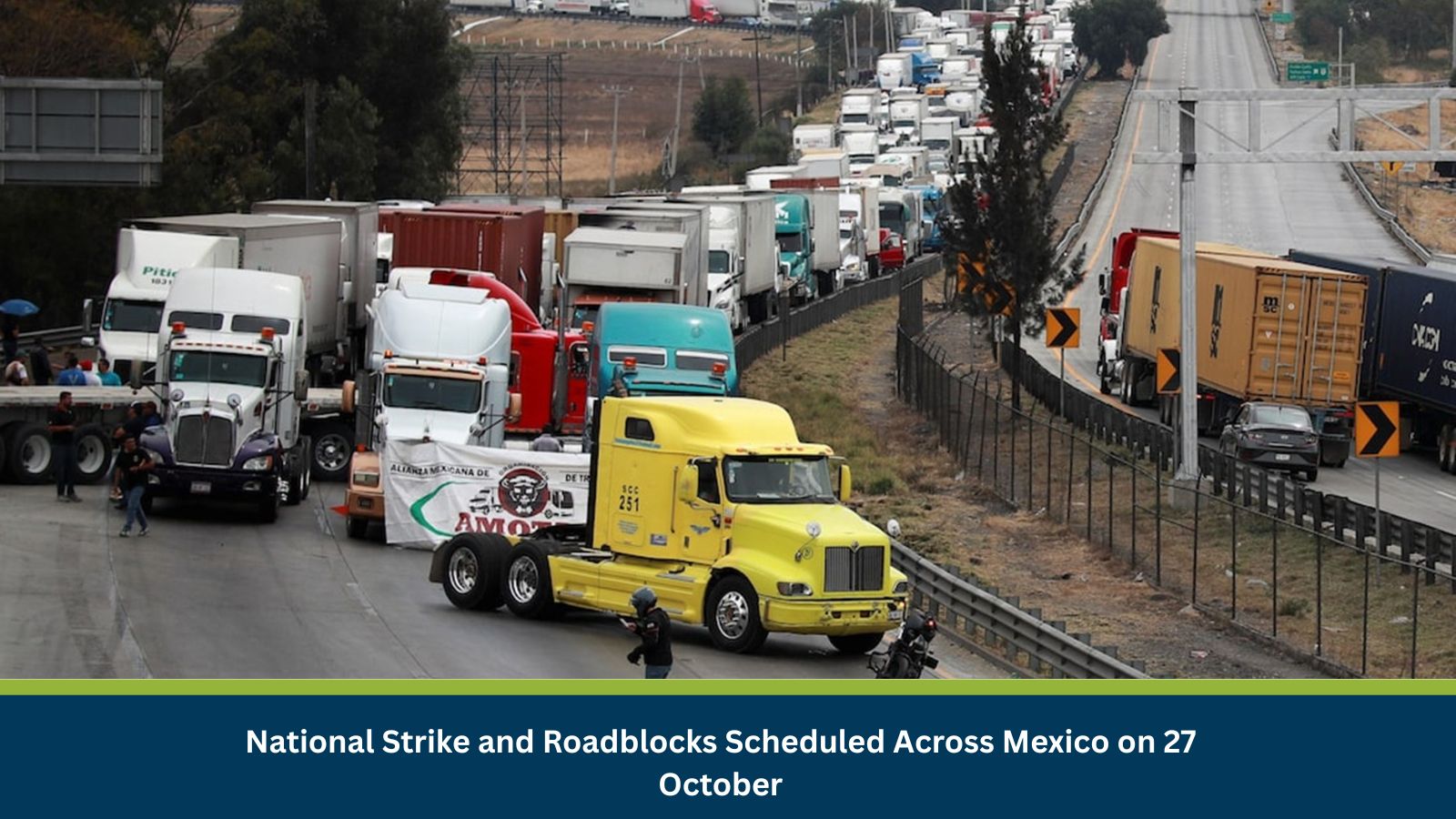
A nationwide strike and coordinated roadblocks organized by farmer unions are set for Monday, 27 October, with demonstrators warning of “highway closures” if demands remain unmet. Disruptions are expected on key highways including the Salamanca–Celaya, Irapuato–León, and Guadalajara–Colima routes. The event is assessed as high-severity (4/5) due to its confirmed organization, historical persistence of road occupations, and the overlap with regions already affected by elevated crime rates. Although large-scale violence is not anticipated, localized clashes and logistical paralysis are probable.
Current Updates
A national strike and extensive roadblocks are officially scheduled to commence across Mexico on Monday, October 27, 2025. This action is being led by farmers who have announced their intent to ‘close highways’ if their demands remain unaddressed, as reported by Elimparcial.com. This widespread mobilization is anticipated to affect major road networks and critical infrastructure, signaling a significant nationwide disruption.
Known Hotspots and Sensitive Areas
- High Impact: Salamanca–Celaya Highway, Irapuato–León Highway, Santiago Valley–Salamanca Road, Guadalajara–Colima Highway.
- Medium Impact: City approaches to León, Guanajuato, and Irapuato; industrial parks in the Bajío automotive belt (Silao, Salamanca).
- Low Impact: Northern and coastal states (Sonora, Sinaloa) where symbolic solidarity blockades may occur.
Government and agricultural offices, toll booths, and major logistics hubs are expected protest focal points.
Impact on Transportation and Services
Severe mobility disruption is anticipated nationwide. Federal routes México-45 and México-57—critical north-south and east-west corridors—are likely to experience prolonged blockages, stalling freight and commuter traffic for one to three days. Air connectivity will remain functional but passengers may face access delays to regional airports such as Guanajuato International (BJX) and Guadalajara GDL. Inter-city bus and freight operators should expect route diversions and reduced throughput.
Recommended Actions
- Employee Safety & Mobility: Implement remote work for non-essential staff; issue real-time route updates and emergency contact lists.
- Logistics Continuity: Advance or delay shipments; pre-position essential stock at secure hubs; coordinate with freight forwarders for alternate routing.
- Facility Security: Secure gates, parking areas, and fuel assets near protest zones; limit staff travel during peak hours of unrest.
- Communications: Maintain transparent, multilingual updates for staff, clients, and suppliers on expected service delays.
- Incident Monitoring: Activate a cross-functional incident management team (IMT) to track government advisories, social-media feeds, and live traffic dashboards.
Multidimensional Impact
The strike is expected to inflict moderate-to-severe economic disruption, particularly on just-in-time industries in the Bajío region. Supply-chain delays may elevate input costs and extend delivery timelines. Public frustration could deepen societal polarization and increase pressure on federal authorities to negotiate swiftly. Extended blockades could also impede emergency response or public-utility maintenance in rural areas.
Emergency Contacts
- Police / Fire / Ambulance: 911
- Government of Guanajuato State
- Secretariat of Communications and Transportation (SCT)
- Federal Civil Protection (Protección Civil)
Final Thoughts
Trajectory analysis suggests one-to-three days of acute disruption with residual logistical effects through the week. Key watchpoints include potential spillovers into industrial corridors, counter-protests, and law-enforcement escalation. Organizations should sustain remote operations, ensure personnel accountability, and leverage real-time situational intelligence platforms such as Datasurfr Predict for live route updates and operational continuity across Mexico’s evolving civil disturbance landscape. Stay ahead of operational risks with real-time alerts, scenario modeling, and expert advisories with datasurfr’s Predict. Start your 14-day free trial of Datasurfr’s Risk Intelligence Platform today.
… [Trackback]
[…] Information on that Topic: mitkatadvisory.com/risk-analysis-national-strike-and-roadblocks-scheduled-across-mexico-on-27-october/ […]
… [Trackback]
[…] Read More here to that Topic: mitkatadvisory.com/risk-analysis-national-strike-and-roadblocks-scheduled-across-mexico-on-27-october/ […]
… [Trackback]
[…] Read More Information here to that Topic: mitkatadvisory.com/risk-analysis-national-strike-and-roadblocks-scheduled-across-mexico-on-27-october/ […]
… [Trackback]
[…] Information to that Topic: mitkatadvisory.com/risk-analysis-national-strike-and-roadblocks-scheduled-across-mexico-on-27-october/ […]
… [Trackback]
[…] Info on that Topic: mitkatadvisory.com/risk-analysis-national-strike-and-roadblocks-scheduled-across-mexico-on-27-october/ […]
… [Trackback]
[…] Read More on to that Topic: mitkatadvisory.com/risk-analysis-national-strike-and-roadblocks-scheduled-across-mexico-on-27-october/ […]
… [Trackback]
[…] Read More Info here to that Topic: mitkatadvisory.com/risk-analysis-national-strike-and-roadblocks-scheduled-across-mexico-on-27-october/ […]
… [Trackback]
[…] Find More Info here to that Topic: mitkatadvisory.com/risk-analysis-national-strike-and-roadblocks-scheduled-across-mexico-on-27-october/ […]
… [Trackback]
[…] Find More here to that Topic: mitkatadvisory.com/risk-analysis-national-strike-and-roadblocks-scheduled-across-mexico-on-27-october/ […]
… [Trackback]
[…] Find More on that Topic: mitkatadvisory.com/risk-analysis-national-strike-and-roadblocks-scheduled-across-mexico-on-27-october/ […]
… [Trackback]
[…] Read More on on that Topic: mitkatadvisory.com/risk-analysis-national-strike-and-roadblocks-scheduled-across-mexico-on-27-october/ […]
… [Trackback]
[…] Read More on on that Topic: mitkatadvisory.com/risk-analysis-national-strike-and-roadblocks-scheduled-across-mexico-on-27-october/ […]
… [Trackback]
[…] Read More Info here to that Topic: mitkatadvisory.com/risk-analysis-national-strike-and-roadblocks-scheduled-across-mexico-on-27-october/ […]