





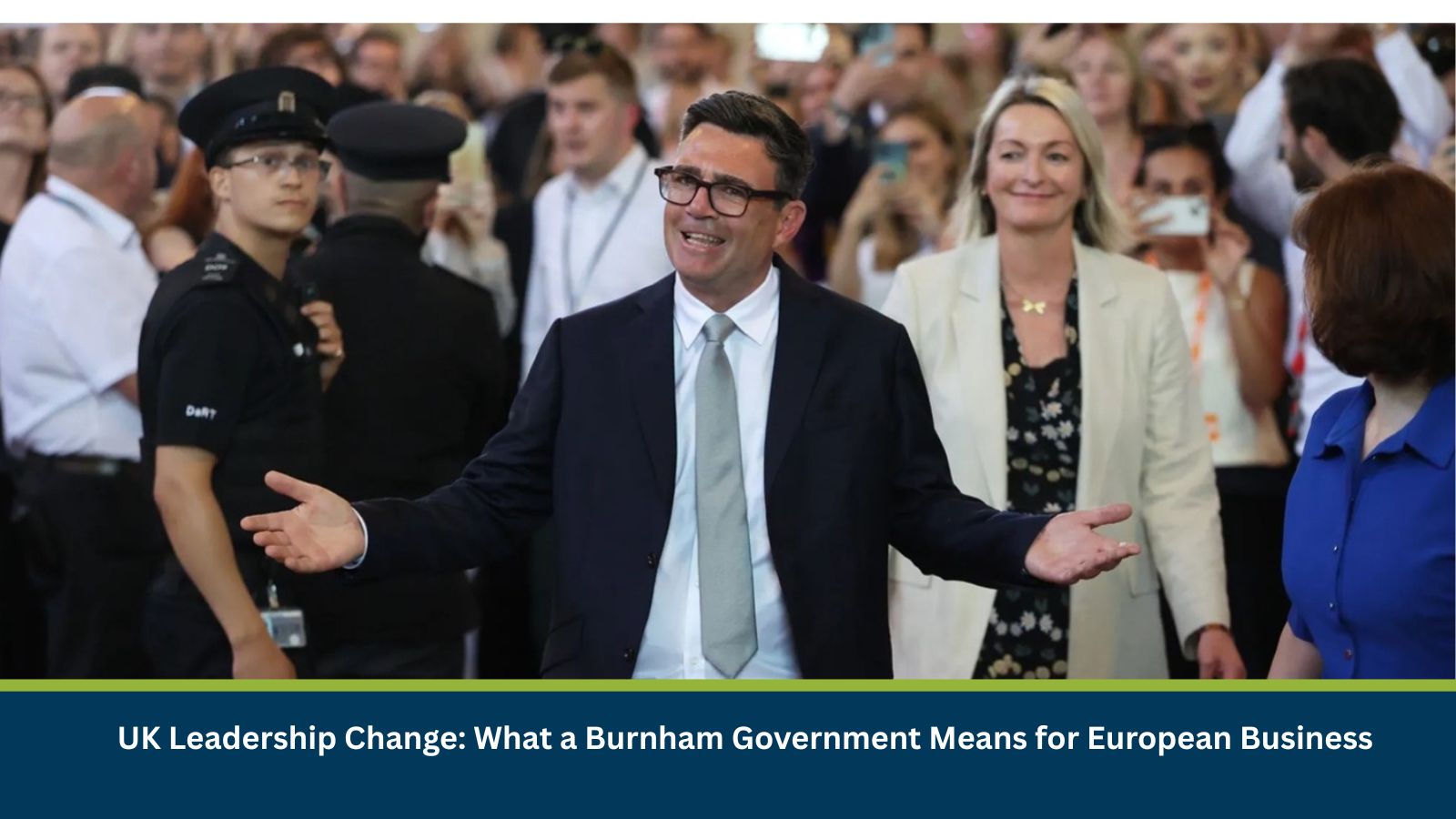
UK Leadership Change: What a Burnham Government Means for European Business
On 22 June 2026, Keir Starmer announced he will resign as UK Prime Minister, days after Andy Burnham, the mayor of Greater Manchester, won the Makerfield by-election and returned to Parliament. Burnham is now the clear frontrunner to become Labour leader and Prime Minister, with rival Wes Streeting having endorsed him, making a “coronation” more likely than a contest. Nominations open on 9 July and the contest could conclude as early as 16 July.
For businesses with UK exposure, this is a mid-term change of government with no general election. The preceding uncertainty and political changes are a significant political risk event for Europe’s second-largest economy, with implications for government intervention, regulation, tax, investment certainty and UK–EU relations.
What Is Happening: British Political Uncertainty
Britain is changing leader without a national vote. Under the UK system, the governing party can replace its leader mid-term, and that leader becomes Prime Minister. Burnham’s by-election win cleared the constitutional bar to stand, and Starmer’s resignation has cleared the path. Burnham led Greater Manchester from 2017 and has enjoyed consistently positive approval ratings.
The change in Labour leadership follows a collapse in Labour’s political strength: heavy losses in the May 2026 local, Scottish and Welsh elections, the end of a century of Labour control in Wales, and the surge of Nigel Farage’s Reform UK. The leadership change is, in part, an attempt to halt that decline before the next general election, due by 2029.
Burnham’s Economic Agenda: “Business-Friendly Socialism” Burnham frames his platform as “business-friendly socialism”: greater public stewardship of essential services combined with reassurance to financial markets. His Manchester-tested “Manchesterism” favours stronger public control of energy, water, housing and transport, place-based regional investment and pro-worker labour measures. He has committed to keep Labour’s fiscal rules and has courted economists to reassure investors and the bond market, positioning himself between Labour redistribution and market-focused restraint. While his exact policy platform is uncertain, early signals point in several directions:
- Public control: a more interventionist regulatory posture on energy, water, housing and transport.
- Small-business support: business-rates cuts for high-street shops, cafés and pubs, funded by higher levies on large online retailers’ warehouses and on speculative landlords.
- Property and wealth taxation: reviewing council-taxes, a possible Land Value Tax, higher capital gains tax, and replacing inheritance tax with a social-care levy.
Risks to Monitor
• Continued political instability. Burnham would be the UK’s seventh prime minister in a decade. A change at the top does not signal stability; the underlying governance and economic problems are more likely than not to persist, prolonging the policy uncertainty that has weighed on UK growth and investment for years.
• Interventionist policy: opportunity and risk. A stronger-state approach cuts both ways: more regulation and compliance burden in energy, housing, water and transport, but also new openings for subsidies, public-private partnerships and regional investment incentives. The outcome depends on how policy is designed.
• Market and currency volatility. Despite the fiscal-rules pledge, any perception of higher spending or looser borrowing could move gilt yields and sterling, with knock-on effects for European firms with Pound exposure.
• Tax reform and repricing. A shift from taxing earned income toward property, land and capital gains could reshape planning for investors, landlords and asset-heavy firms,
• The Reform UK trajectory. Farage’s Reform UK is polling strongly ahead of the 2029 general election, and a Burnham government might not be able to change this. Its platform – sharp immigration restriction, distance from the EU, and scepticism of international commitments – could raise labour costs, reintroduce trade friction with the UK’s largest market, and widen regulatory uncertainty for multinationals.
What Businesses Should Do Now
- Monitor the leadership timeline, a new PM and programme could be in place within weeks.
- Identify where stronger state involvement raises regulatory or compliance cost, build that into planning; where it opens subsidies, regional incentives or public-private tenders, get the groundwork in early so you can bid quickly when schemes launch.
- Plan against the 2029 Reform scenario. Stress-test long-term UK investment, hiring and supply-chain decisions against a future government that restricts immigration and adds EU trade friction
- Watch gilt yields and sterling through the transition for early signs of stress, and currency hedge where possible.
- Stress-test UK tax exposure for a shift toward property, land and capital-gains taxation.
FAQs
What does the UK leadership change mean for European business?
The UK is replacing its prime minister mid-term, without a general election. Andy Burnham is the frontrunner, bringing a more interventionist agenda focused on public control of essential services, small-business support, and a shift toward property and wealth taxation. The change matters for tax, regulation and investment certainty, and a big medium-term risk is the 2029 general election.
Is a Burnham government good or bad for business?
Both, depending on the sector. His agenda could mean more regulation and higher taxes on property and capital, but also business-rates relief for small firms and new subsidy and partnership opportunities. He has pledged to keep Labour’s fiscal rules to reassure markets.
How MitKat’s Datasurfr Helps
UK political risk is shifting fast, and the implications for tax, regulation, trade and market stability are spread across many moving parts. MitKat’s Datasurfr brings these risks together into one
picture, combining real-time threat intelligence, OSINT monitoring and critical event alerts with expert analysis, so security, continuity and risk teams can act early. Book a free demo today.