





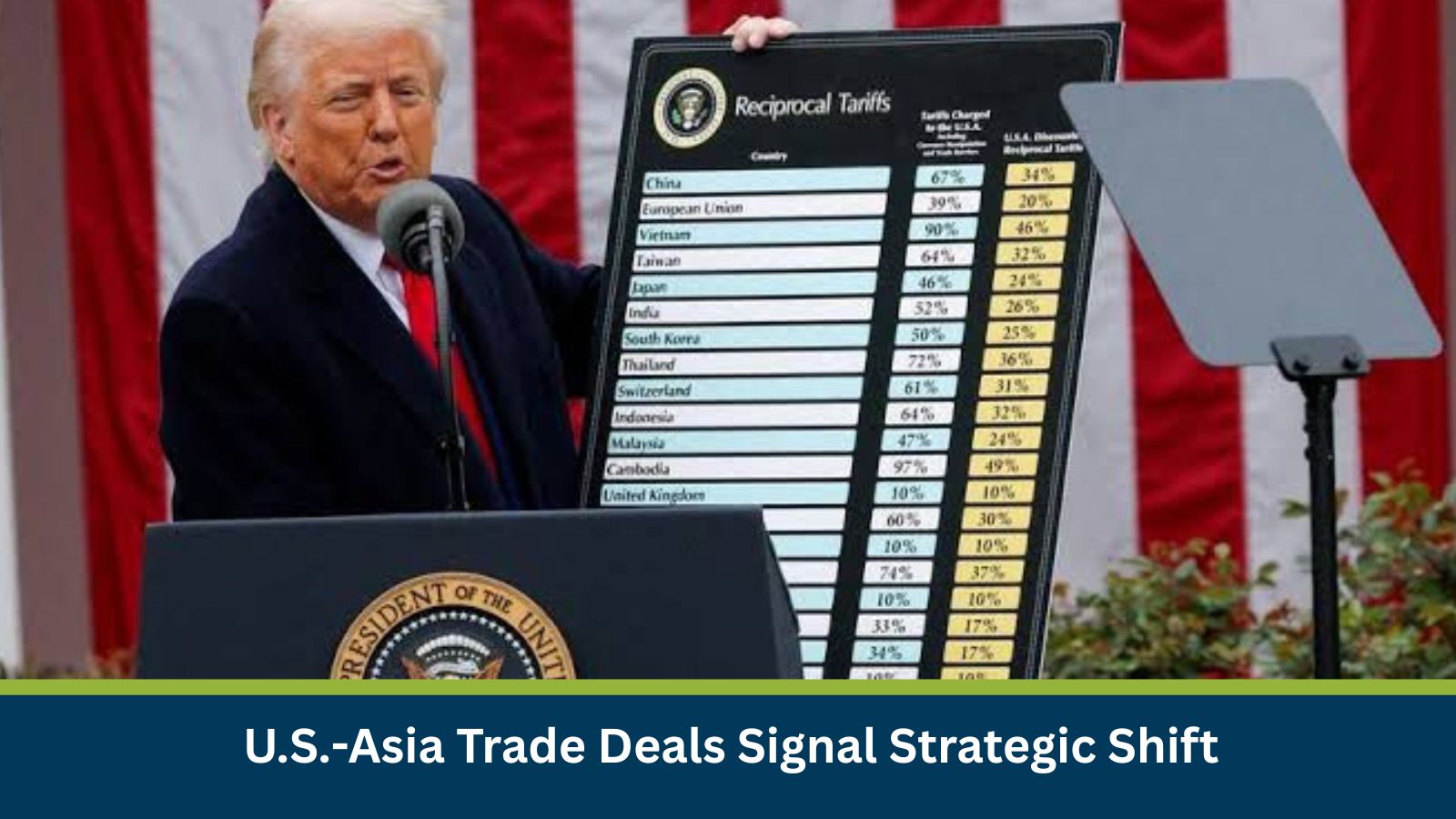
On July 22, the United States and Japan concluded a landmark trade agreement, marking the most significant deal of the Trump administration by trade volume. Framed as a diplomatic win by Prime Minister Shigeru Ishiba, it comes just days after his coalition’s upper house election losses.
Key provisions include a reduction in U.S. tariffs on Japanese autos from 27.5% to 15% alongside a uniform 15% duty on other Japanese exports. In exchange, Japan pledged USD 550 billion under the “Japan Investment America Initiative,” targeting U.S. supply chains in semiconductors, pharmaceuticals, AI, and more. The package includes the purchase of 100 Boeing aircraft and a USD 3 billion annual increase in U.S. defence procurement.
Also significant is Japan’s agreement to expand tariff-free rice import quotas, easing decades-old protections on a politically sensitive crop. This move could add pressure on countries like India in ongoing U.S. agricultural trade talks.
Markets responded positively, with Japanese auto stocks and the Nikkei index rallying sharply. Strategically, the flat 15% tariff structure may serve as a blueprint for upcoming U.S. negotiations with the EU, China, and South Korea.
Importantly, the deal signals a shift in U.S. trade policy toward investment-based reciprocity, where major capital commitments are exchanged for market access and tariff relief. This could set a precedent for future bilateral deals, with allies viewing such investment pledges as a new prerequisite for favourable terms. If seen as too demanding, however, it may also prompt partners to deepen economic ties among themselves, reducing reliance on Washington’s terms.
However, political headwinds remain. While Tokyo hails the deal as a breakthrough, opposition voices warn of adverse domestic impacts, and Diet approval, especially on investment and agricultural terms, remains uncertain. Businesses should closely monitor Japan’s internal debate and regional responses in the weeks ahead.
On the same day, the U.S. signed a separate bilateral agreement with the Philippines. Under the deal, the Philippines eliminated tariffs on U.S. goods, while the U.S. retained a 19% tariff on Philippine exports a decision that has drawn scrutiny given the USD 5 billion trade deficit Washington runs with Manila. Key Philippine sectors such as electronics, food processing, and textiles, already operating on thin margins, are expected to feel the pressure from reduced competitiveness.
Conversely, U.S. exporters stand to gain immediate cost advantages in the 110-million-strong Philippine consumer market. Medical products, vehicles, and agricultural commodities are particularly well-positioned to expand market share. The agreement may also accelerate the shift of U.S. supply chains away from China, with early moves already seen from Intel and Texas Instruments.
Geopolitically, the Philippines is being positioned as a preferred U.S. partner in Southeast Asia, citing its stable governance and deepening defence cooperation under the Enhanced Defence Cooperation Agreement (EDCA). The trade deal reinforces that alignment, reducing geopolitical risk for foreign investors.
Together, the Japan and Philippines agreements underscore a clear U.S. strategy: leveraging trade not just for economic gain, but for securing strategic footholds in Asia.