





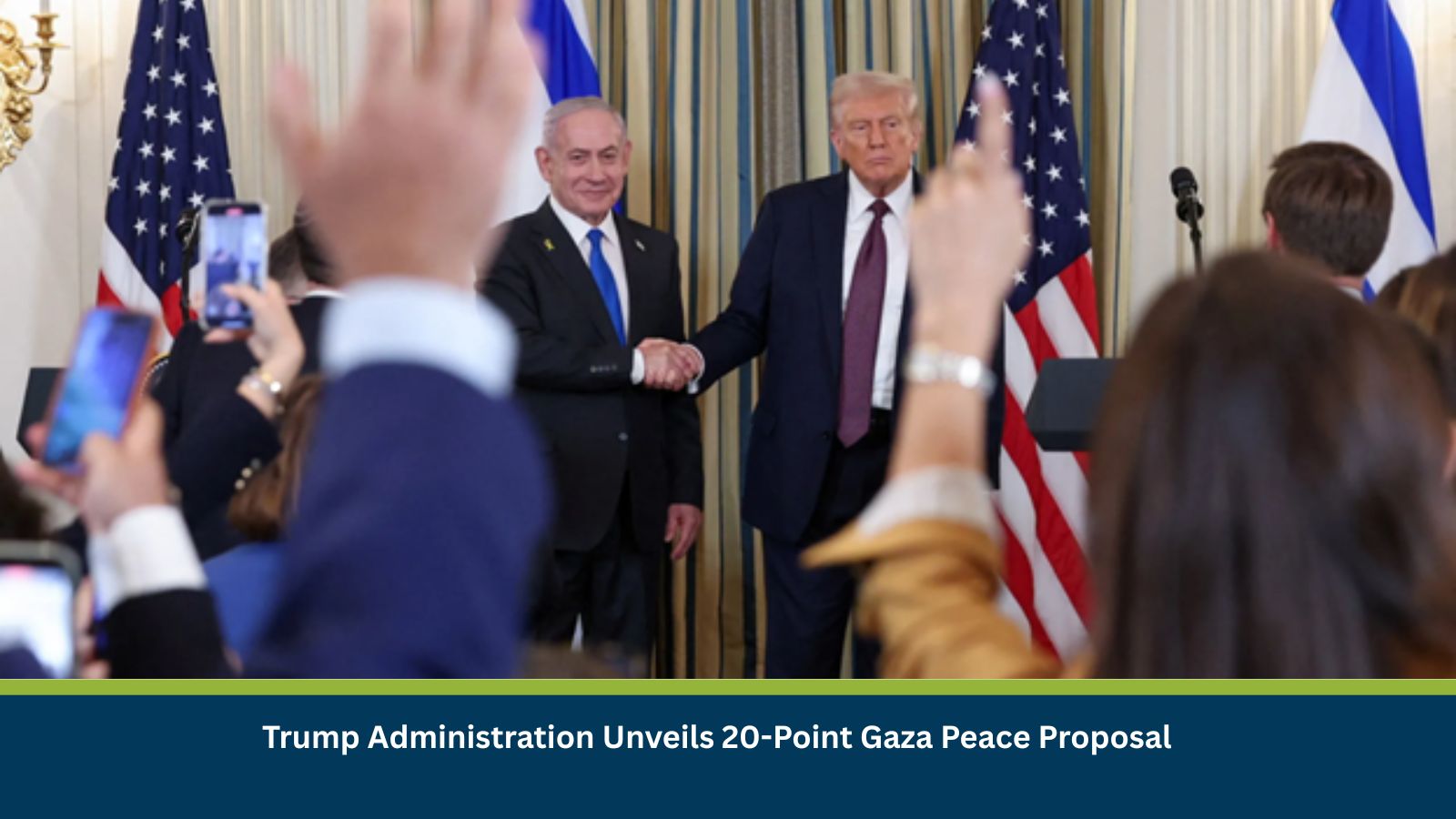
On Monday, 29 September, the administration of Donald Trump presented a 20-point proposal aimed at securing a ceasefire in the Gaza Strip, arranging the exchange of Israeli hostages for Palestinian prisoners, and outlining a framework for Gaza’s post-conflict future. Analysts described it as the administration’s most substantive effort to date, laying out immediate steps for de-escalation while referencing, in broad terms, “credible pathway to Palestinian self-determination and statehood.”
Core Provisions and Exchange Terms
The plan’s first phase required Hamas to return all Israeli hostages, both living and deceased, within 72 hours. In return, Israel would release 250 Palestinians serving life sentences and 1,700 others detained since the conflict began. Israel’s releases were contingent on the prior handover of hostages.
After the exchange, the plan called for a phased Israeli withdrawal from parts of Gaza and the transfer of administrative control to a technocratic committee, which would be supervised by an international “Board of Peace” headed by President Donald Trump. Security would be maintained by a temporary international stabilization force (ISF), developed by the US together with Arab and international partners. Israel would not occupy or annex Gaza. The plan guarantees that no one will be forced to leave Gaza and that residents are free to return. For reconciliation, an interfaith dialogue process would be established. Hamas is barred from governance, but its members could receive amnesty if they renounce violence and surrender weapons. Critics noted the document offered few details on how disarmament would be enforced.
Divergent Responses from Key Parties
Prime Minister Benjamin Netanyahu publicly supported the proposal, saying it “achieves our war aims” and warning that Israel would act unilaterally if Hamas rejected it. His endorsement drew criticism from far-right coalition partners, including National Security Minister Itamar Ben Gvir, who called the plan “full of holes” that weakened Israeli security. Netanyahu also rejected suggestions that the deal implied recognition of a Palestinian state, insisting such language was not included. Observers noted he was under pressure from both a war-weary public and his far-right allies.
Hamas officials told mediators they were “carefully reviewing” the proposal. A senior figure dismissed the prospect of disarmament and expressed distrust of the United States. A co-founder of the Palestinian National Initiative described the plan as “full of mines.” Hamas has agreed to a few parts of 20 point US Peace Plan, including freeing hostages and handing over Gaza governance to Palestinian technocrats, but is seeking negotiations on other issues.
Critics emphasized the “lack of input from Palestinians themselves,” while analysts highlighted the omission of settlement and occupation issues in East Jerusalem and the West Bank as major weaknesses that could further fragment Palestinian territories.
Widespread International Support
The plan received broad international backing. The European Union, the United Kingdom, Russia, France, Germany and India welcomed the effort. A joint statement from regional powers including the UAE, Saudi Arabia, Qatar, Egypt, and Jordan, alongside Turkey, Pakistan, and Indonesia, pledged to engage constructively in advancing the agreement.
President Trump has given Hamas until Sunday, 05 October, to respond, warning that rejection would allow Israel “full US support” to continue military operations. While the proposal offered what Washington described as a credible path toward Palestinian self-determination, its vague reforms, contested provisions, and deep mistrust between parties underscored the challenges ahead. While the proposal faced criticism and uncertainty, it marked the most comprehensive US effort in years, with both Israeli and Palestinian sides showing willingness to engage. Hamas and Israel have agreed to meet in Egypt on 06 October, along with mediators to further negotiate regarding the peace plan. This is a developing story.
Economic Vision and Policy Challenges
Takaichi’s main economic focus is on restoring public confidence and reviving growth. She has outlined a plan centered on “crisis management investment,” directing spending to sectors such as energy, biotechnology, advanced healthcare, semiconductors, and food security.
An advocate of late premier Shinzo Abe’s “Abenomics” strategy, she supports stimulating the economy through aggressive spending and accommodative monetary policy, while criticising the Bank of Japan’s (BOJ) interest rate hikes. At a press conference after her victory, she announced plans to cut taxes and expand subsidies but emphasized “the importance of fiscal prudence,” noting that BOJ policy must consider the fragility of the economy and wage growth.
Experts see her agenda as ambitious but constrained by politics. With the expansionary fiscal policy, few experts note the threat of higher inflation which may result in higher interest rates in the near time. For instance, Takahide Kiuchi, Executive Economist at Nomura Research Institute reflected this, “Takaichi has advocated the most expansionary fiscal policy. This could lead to rising interest rates, a weaker yen, and higher stock prices in financial markets. However, since the LDP is a minority ruling party in both houses of the Diet, cooperation from opposition parties is essential to implement her policies. Therefore, I expect the more extreme aspects of her proposals will be diluted during the legislative process,”
Japan faces multiple economic challenges, including a weak yen, public debt exceeding 200% of GDP, and pressures from U.S. tariffs and Chinese exports. Takaichi has stressed balancing fiscal discipline with strategic, innovation-driven investments while encouraging private-sector participation.
Political, Social, and Foreign Policy Outlook
Domestically, Takaichi inherits a weakened LDP that must negotiate with centrist and opposition parties to pass legislation. She faces the twin challenges of regaining public trust and addressing Japan’s aging and shrinking population, including support for youth, women, and families, as well as cautious engagement with immigration policy to maintain social cohesion.
On the international front, Takaichi is known for her hawkish foreign policy stance, supporting stronger national defence and maintaining close alignment with the United States. Analysts warn that her approach may raise concerns among Asian neighbours. “Her hawkish foreign policy stance may raise concerns among Asian nations,” said Kiuchi.
Her tenure will test Japan’s ability to manage demographic pressures, drive economic revitalization, and navigate ongoing geopolitical challenges simultaneously. As parliament prepares to vote for the new premier on 15 October, her appointment will make her the fourth prime minister in just five years, underscoring the country’s recent political instability. Observers will be watching closely to see whether Takaichi can unite a divided legislature and turn her policy agenda into tangible results, setting the tone for Japan’s political and economic direction in the years ahead.