





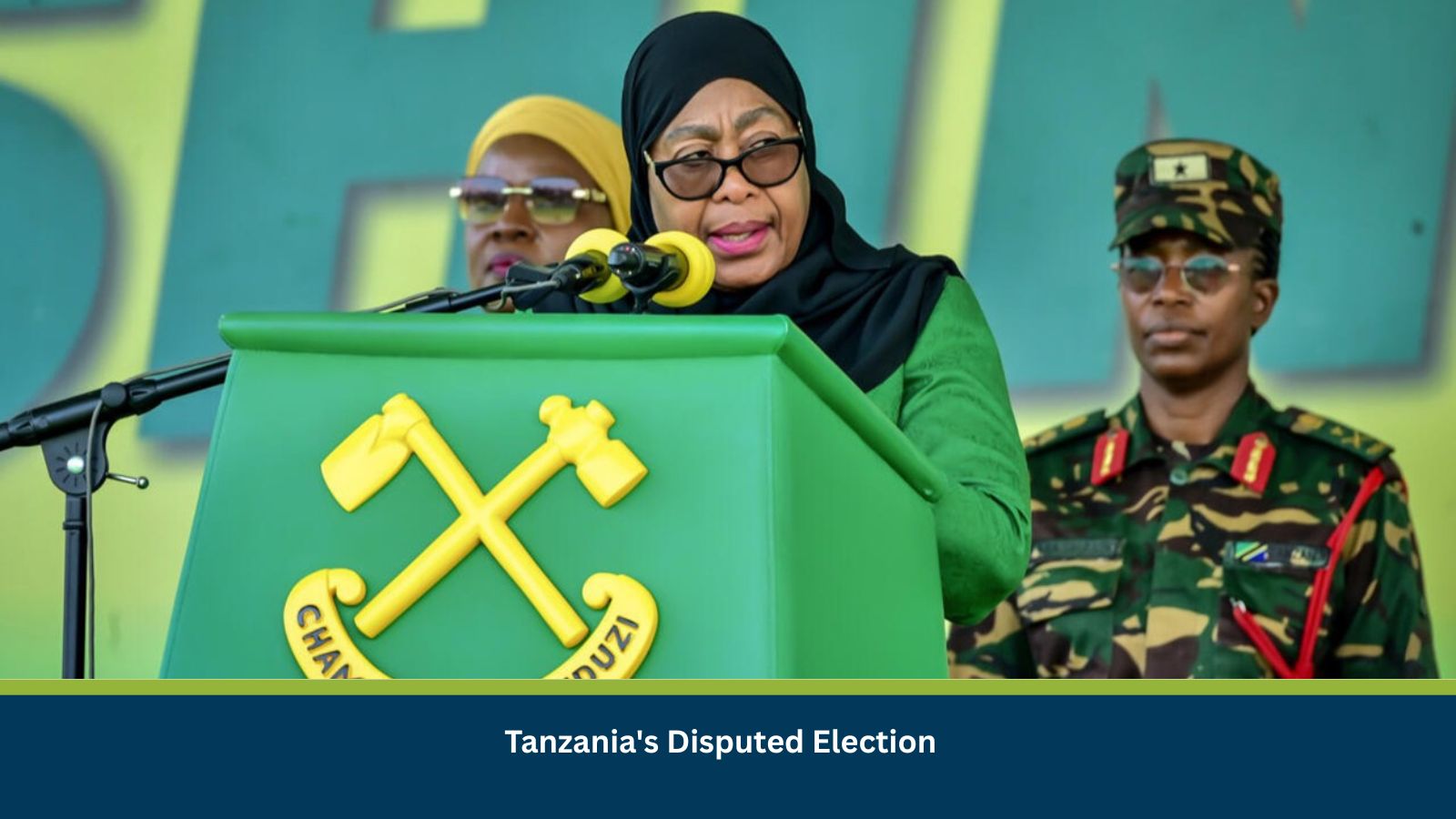
Tanzania’s recent general election, held on 29 October, has concluded with incumbent President Samia Suluhu Hassan securing a new term, a result that has been overshadowed by widespread turmoil, opposition rejection, and international concern. The vote and its aftermath underscore the persistent tension between the country’s long-standing political stability and growing demands for democratic transparency.
Outcome and Opposition Rejection
The official results, declared by the electoral commission chief Jacobs Mwambegele on 01 November announced President Hassan as the winner. She secured a dominant victory, garnering approximately 31.9 million votes, or 97.66% of the total, with the turnout estimated near 87% of the 37.6 million registered voters. The ruling Revolutionary Party (Chama cha Mapinduzi; CCM), which has controlled the Union government since the nation’s independence, also saw its candidate, Hussein Mwinyi, win the presidential vote in the semi-autonomous archipelago of Zanzibar with nearly 80% of the vote.
However, opposition parties immediately and categorically rejected the results, denouncing the vote as a “mockery of the democratic process.” Their primary grievance stemmed from the effective suppression of major challengers. The main opposition contenders, including Tundu Lissu, were either imprisoned on treason charges (which he denies) or barred from running on legal technicalities leaving the president with little effective opposition from only sixteen fringe parties.
Violent Protests and Security Response
The declaration of results fueled days of unrest across the country, beginning shortly after the poll closed. Protests erupted in cities including Dar es Salaam, with mostly young demonstrators attacking police and polling stations and tearing down the President’s posters.
The crisis quickly escalated, leading to a forceful security response:
Casualty reports remain difficult to verify due to a nationwide internet shutdown, but they indicate significant loss of life. A spokesperson for the opposition Chadema party claimed that around 700 people had been killed in clashes with security forces, stating the figures were compiled from party networks visiting hospitals and clinics.
Government Authorities deployed the military, extended a curfew, and utilized the internet shutdown in a bid to quell the unrest. President Hassan, in her victory speech thanked the security forces and condemned the demonstrators as “unpatriotic.”
International Response
The widespread violence and allegations of electoral misconduct prompted formal concern from the international community. UN Secretary-General Antonio Guterres issued a statement expressing that he was “deeply concerned” about the situation, including reports of deaths and injuries, and urged all involved parties to “prevent further escalation.”
Since gaining independence, Tanzania has maintained a largely politically stable environment and has avoided major conflicts, despite recurring periods characterized by authoritarian rule. This stability has fostered robust economic performance, backed by consistent international donor support. Notably, Tanzania achieved lower-middle-income country (LMIC) status in 2020, five years ahead of its target of 2025. The country benefits from a large domestic market of nearly seventy million people and a regional investment rate that helps shield its growth trajectory from severe external shocks.
The political structure has been historically dominated by the Revolutionary Party (Chama cha Mapinduzi; CCM). The CCM was formed in 1977 through the merger of the Tanganyika African National Union (TANU) and the Afro-Shirazi Party (ASP) of Zanzibar. By law, Tanzania operated as a one-party state until 1992, when a constitutional amendment established a multiparty political process. Despite the introduction of multiparty general elections in 1995, the CCM has consistently retained control of the Union government, maintaining its long-standing political dominance.
While Tanzania has successfully cultivated a robust, domestically driven economy that achieved LMIC status, the recurring controversies surrounding its elections highlighted by the mass protests and tragic casualties suggest that the nation has yet to fully resolve the inherent tensions between its long history of single-party dominance and the aspirations of a modern, multi-party democratic system.
Disclaimer: The article has reference to open sources including Al Jazeera, Guardian, BBC, and Reuters