





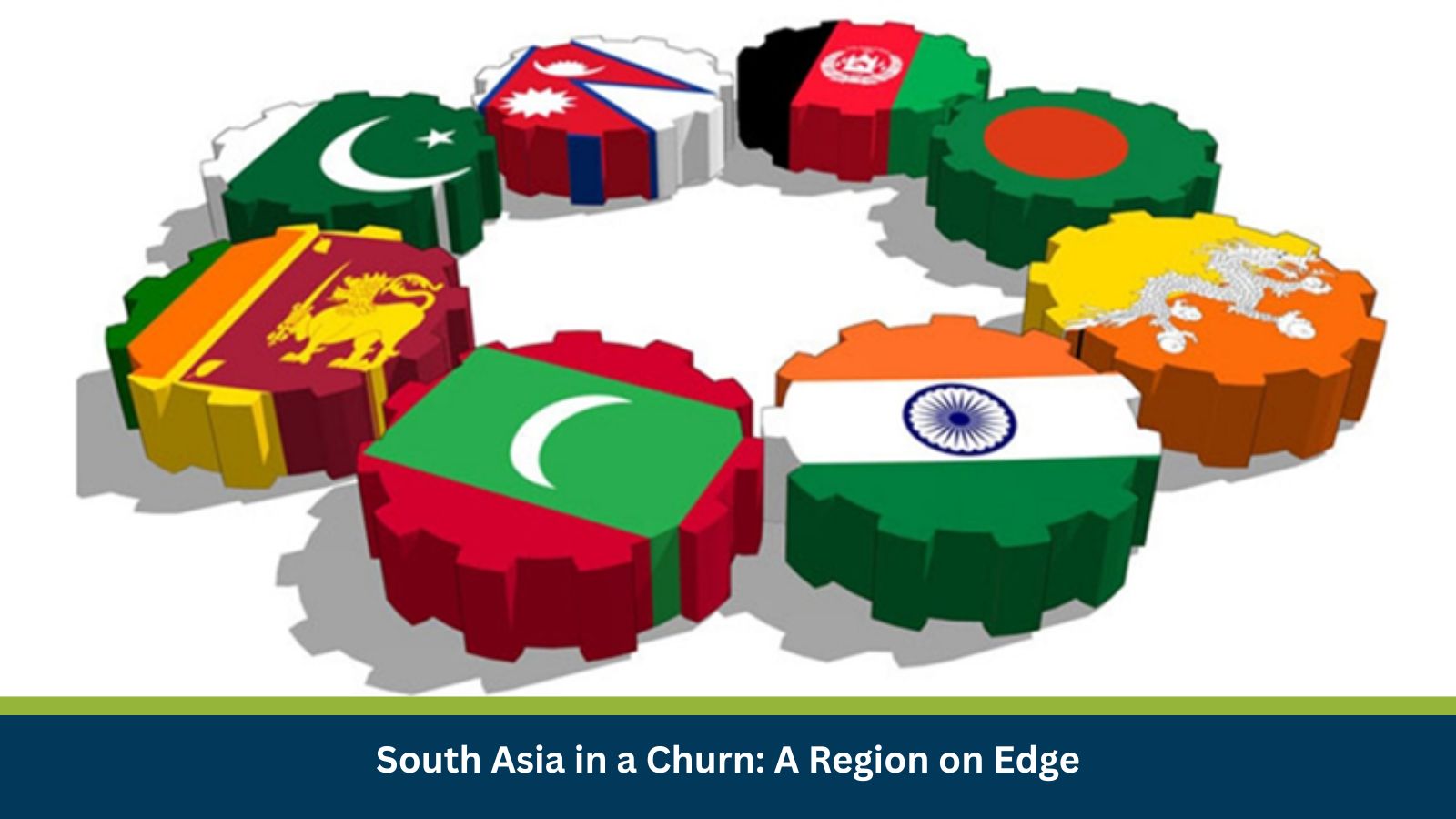
The political and social landscape of South Asia is in a state of flux, presenting a complex risk environment for multinational businesses and investors. The recent removal of sitting leaders in Nepal, Bangladesh, and Sri Lanka via mass street movements signals a new era of regional volatility, driven by a confluence of economic, social, and political pressures. In the last three years, three of India’s neighbors have seen mass street movements that removed sitting leaders. The recent popular revolts have also rocked other nations in the wider region like Indonesia and Myanmar.
Nepal: The Digital Trigger
In September 2025, a government decision to restrict major social media platforms triggered nationwide unrest in Nepal. The ban angered young people who saw it as an attack on free expression, and within days, street demonstrations swelled across major towns. What began as a digital-rights protest soon merged with wider frustrations over corruption, unemployment, and poor governance. The agitation, dubbed the “Gen Z” protest, was led by young people, specifically those under the age of 28, and began on September 8 with the government’s ban on 26 social media sites. The demonstrations turned violent, with protestors storming parliament, the presidential house, and the prime minister’s office, as well as torching government and media buildings and attacking politicians. Prime Minister KP Oli stepped down within 36 hours of the protest. According to some, this is the biggest crisis Nepal’s fledgling democracy has faced since the monarchy was abolished in 2008, as the unrest has exposed a deep rift between the political elite and the country’s restless youth. At present, the military took charge, with a caretaker government led by the President and an Interim Prime Minister. India has concerns due to a shared border and a Nepali diaspora, and experts say India will have to walk a diplomatic tightrope.
Bangladesh’s Political Fragility
Protests that began in July 2024 over job quotas for government employment expanded rapidly into a wider anti-government movement. By early August, Sheikh Hasina left Dhaka and sought refuge in India. An interim government headed by Nobel laureate Muhammad Yunus took charge, with the task of restoring calm and preparing the ground for new elections. Economic and social distress, combined with political disenchantment ahead of the January 2024 elections, had accumulated in recent years, cascading to the breaking point that caused Sheikh Hasina’s ouster. The youth initially led the protests, with the 15-to-29 age group comprising nearly 25% of the total population. While Bangladesh has made strides in economic growth, it still faces challenges in terms of wealth distribution. One year on, Bangladesh remains unstable, with political parties bickering over election dates. Mob violence, political attacks on rival parties and groups, and hostility to vulnerable minority groups by religious hard-liners have surged. Bangladesh is scheduled to hold its first elections since the protests next February, and Hasina is currently on trial in absentia.
Pakistan’s Enduring Threats
Pakistan’s risk profile is uniquely defined by the interplay of internal political friction and persistent security threats. The 2022-2024 unrest, triggered by the ouster of former Prime Minister Imran Khan, demonstrated the potential for political disagreements to spill over into widespread public disorder. This domestic turbulence is compounded by external security challenges. The intensification of attacks by groups such as the Tehreek-e-Taliban Pakistan (TTP) and the Baloch Liberation Army (BLA), coupled with the complicating factor of an Afghan Taliban sanctuary, creates a layered security environment.
Sri Lanka’s Economic Tipping Point
In 2022, a major economic crisis hit Sri Lanka, and public anger led to widespread protests in Colombo. The Rajapaksa brothers, then President Gotabaya Rajapaksa and Prime Minister Mahinda Rajapaksa, left the nation. From early 2022 to late 2024, Sri Lanka went through a momentous change in its political leadership. The Aragalaya (Sinhala for “struggle”) protest movement during the first half of 2022 demanded the resignation of Gotabaya Rajapaksa and other members. In just four months, between March and July 2022, the movement succeeded in forcing the resignations of both the prime minister and the president.
Afghanistan’s Geopolitical Shift
The year 2021 saw upheaval in Afghanistan, with the Taliban taking over after around two decades away from power. Clashes continue in some areas due to the ongoing conflict between the Taliban, ISIS-K, and anti-Taliban Republican insurgents. The Islamic Republic of Afghanistan, which collapsed during the Taliban takeover, remains the internationally recognized government.
What’s the common feature?
The confluence of internal political risks and external geopolitical pressures makes this region a complex market where traditional risk assessments may not be sufficient. The protest movements across the subcontinent share a common feature: a widespread resentment against the ruling elite and a political system they hold responsible for rampant corruption, deepening inequality, and economic disparities. The possibility of a contested election and subsequent social unrest poses a direct threat to logistics and on-the-ground operations.