





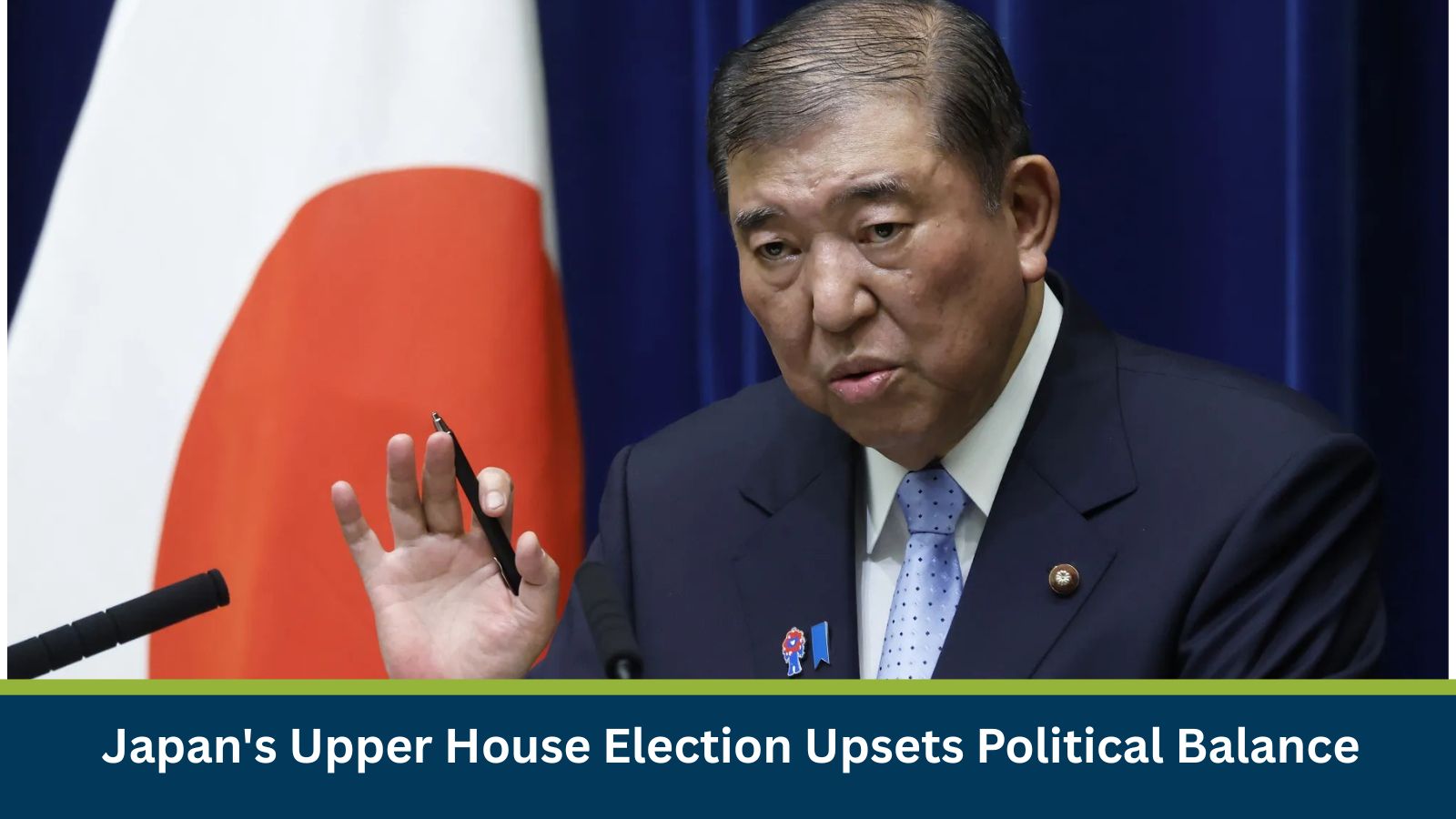
Japan’s Upper House elections, held on 20 July 2025, dealt a significant blow to Prime Minister Shigeru Ishiba’s ruling coalition. For the first time since the founding of the Liberal Democratic Party (LDP) in 1955, the government no longer holds a majority in either chamber of the National Diet. The LDP and its coalition partner Komeito secured a combined 47 of the 125 contested seats, bringing their total to 122—three short of a majority in the 248-member House of Councillors.
While the LDP remains the largest party, the results reflect deep public dissatisfaction with rising living costs, corruption scandals, and a weakening yen. The Constitutional Democratic Party (CDP) placed second, while the far-right Sanseito party made significant inroads, expanding from one to 14 seats on a hardline anti-immigration platform. This has reshaped Japan’s legislative landscape and injected new uncertainty into the political process.
Prime Minister Ishiba has so far resisted calls to resign; however, with the conclusion of the U.S.-Japan trade deal, calls for him to step down have intensified within the LDP. Political precedent suggests his position may not hold for long—past LDP leaders who lost the Upper House majority, including Hashimoto (1998), Abe (2007), and Fukuda (2008), all resigned within months. A no-confidence motion from the opposition is also being considered.
In this divided Diet, the LDP-Komeito coalition will now have to secure cross-party support to advance legislation. Contentious issues likely to face gridlock include:
- Tax Reform: Structural changes are unlikely. Opposition parties are pushing for bold consumption tax cuts, while the government prefers cautious, targeted handouts. Fiscal uncertainty may hinder planning for FY2026.
- Trade Policy: The U.S.-Japan trade deal announced days before the election reduces tariffs and secures a $550 billion Japanese investment in the U.S. However, the weakened LDP will face challenges ratifying the agreement in the divided Diet, complicating execution.
- Immigration: The Sanseito party’s rise marks the strongest anti-immigration shift in post-war Japan. With the CDP advocating multiculturalism and the DPP pushing for tighter foreign ownership rules, comprehensive immigration reform is unlikely without complex compromises.
- Inflation: With inflation still above 3%, the new parliamentary balance creates uncertainty over future economic relief, and sustained real wage stagnation could continue to suppress consumer demand.
In terms of business, the fractured legislature raises the risk of policy drift and slower decision-making across critical sectors such as energy, trade, and labour. Foreign businesses dependent on skilled foreign workers may face greater uncertainty amid renewed debate over immigration policy. Investors should expect market volatility driven by speculation over Prime Minister Ishiba’s future and the potential for an early general election. Heightened cybersecurity threats and misinformation risks, especially around political developments, should be monitored closely by corporate security teams.
While immediate disruptions remain unlikely, companies should prepare for a prolonged period of political jockeying, cautious policymaking, and unpredictable regulatory shifts—particularly in sectors sensitive to public sentiment and government oversight.