




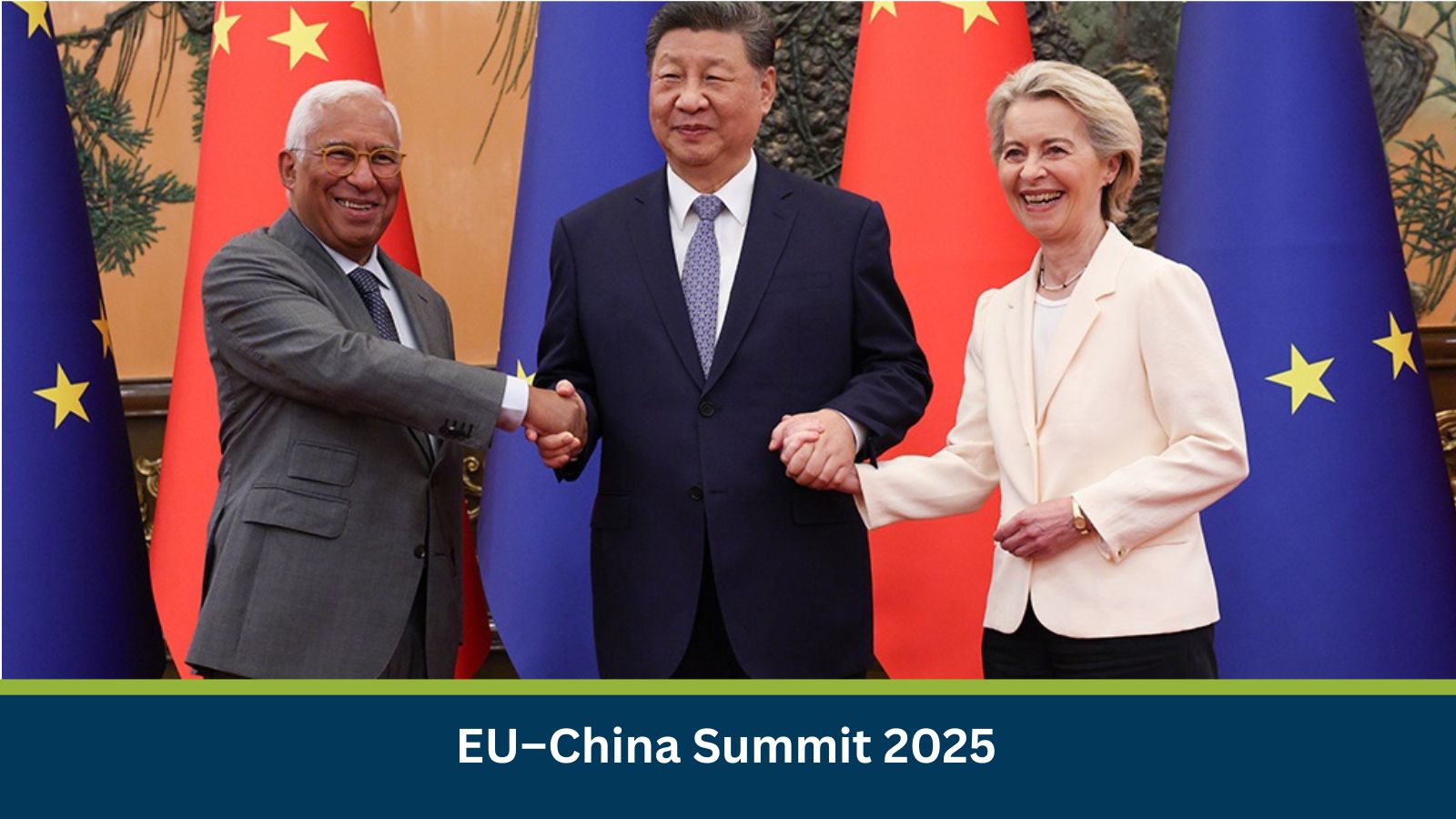
The 25th EU–China Summit, held in Beijing on 24 July 2025, marked a significant turning point in bilateral relations. While commemorating 50 years of diplomatic ties, the summit revealed growing tensions, rooted in trade imbalances, geopolitical divergence, and regulatory frictions.
European Commission President Ursula von der Leyen described the relationship as an “inflection point”, pointing to deepening economic asymmetries and political mistrust, particularly around China’s ties with Russia. President Xi Jinping, in turn, urged the EU to “properly handle frictions” and avoid the use of “restrictive trade tools.”
Trade is central to EU–China ties, with both among each other’s top partners. In 2024, bilateral trade exceeded USD 850 billion, but a USD 360 billion EU trade deficit raised alarm in Brussels. European concerns centre on industrial overcapacity, notably in EVs, solar panels, and steel fueled by Chinese state subsidies. The EU has launched anti-subsidy and dumping investigations, triggering retaliatory tariffs from Beijing on European liquors and medical devices. Brussels hinted that future openness would hinge on reciprocity from China.
The Russia–Ukraine war remains a geopolitical fault line. The EU urged China to use its influence to advance peace, while Beijing reiterated neutrality. This divergence complicates broader cooperation. The EU also raised human rights concerns in Xinjiang, Tibet, and Hong Kong, which Beijing dismissed as interference. These tensions extend beyond diplomacy, influencing tech partnerships, academic ties, and investment screening, especially in sensitive sectors like AI, biotech, and surveillance.
Climate change emerged as a rare point of alignment. Both sides reaffirmed their commitment to the Paris Agreement and agreed to collaborate on biodiversity, circular economy, and COP30 preparations. However, this cooperation is also likely to be shaped by competition over green technology leadership, ESG standards, and carbon pricing frameworks.
The tone of the summit was notably subdued. It was shortened from two days to one at China’s request, and Chinese President Xi Jinping did not accept earlier invitations to Brussels, further signalling strained ties. Despite the discord, both sides acknowledged the necessity of engagement. Xi Jingping called for “mutual trust” and warned against “building walls.” While the EU positioned its stance as one of “de-risking” rather than decoupling. The summit took place against the backdrop of the looming US trade tariffs adding further weight to the complex trade landscape.
Business leaders must reassess supply chain risks and factor in geopolitical tensions while making sourcing decisions. The Chinese market, though lucrative, now demands careful navigation of regulatory and political complexities. Investments, especially in critical and tech-sensitive sectors are anticipated to face tighter scrutiny.
The 2025 EU–China Summit reaffirmed that while economic interdependence continues, trust is weakening. For the global business community, the message is clear: future EU–China engagement will be transactional, cautious, and influenced by security, and sovereignty.