





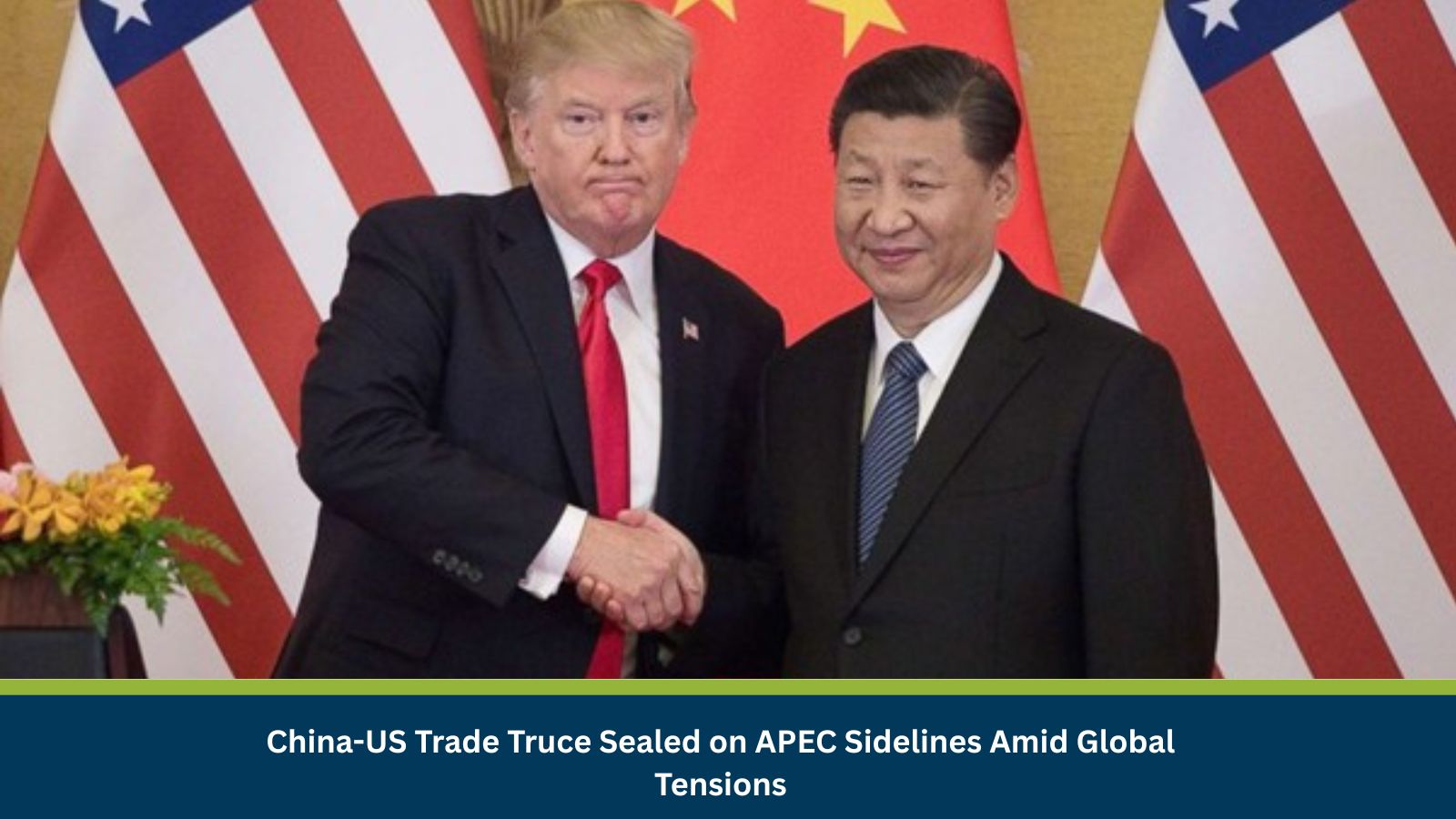
US President Donald Trump and Chinese President Xi Jinping signed a significant trade truce during bilateral meetings on the sidelines of the Asia-Pacific Economic Cooperation (APEC) summit in Busan, South Korea, on 30 October, 2025. This agreement represents a major step toward de-escalating the costly tariff war that has strained the global economy, and it includes key commitments on critical technology and the US opioid crisis.
Key Provisions of the Trade Truce
The agreement establishes a temporary cessation of economic hostilities and outlines new structures for managing future strategic friction between the world’s two largest economies:
Tariff Standstill and Reduction: The most immediate outcome was a mutual commitment to a tariff standstill, indefinitely postponing new tariffs that had been threatened by both nations. Crucially, the US agreed to cut tariffs on certain Chinese goods by a significant margin (e.g., fentanyl-related tariffs reduced from 20% to 10%), providing immediate market relief.
Fentanyl and Opioid Commitment: China committed to dramatically step up efforts to curb the export of illicit synthetic opioids, specifically fentanyl and its chemical precursors, to the United States. This non-trade deliverable was a major political win for the Trump administration.
Rare Earth Minerals Stability: China agreed to a one-year pause on recently tightened export controls on rare earth minerals. These critical materials are essential for US technology, defense manufacturing, and electric vehicles, making the stability commitment a crucial aspect of the truce.
Export Controls and Technology Review: Both sides established a new bilateral mechanism dedicated to reviewing and resolving disputes related to export controls and restrictions on advanced technology, signaling an intent to manage competition in high-tech sectors like semiconductors and AI.
Strategic Necessity vs. Long-Term Friction
The signing of the trade truce takes place amid an environment of systemic geopolitical rivalry and domestic economic pressure in both countries.
Economic Pressure on Both Sides: The truce provides a clear signal that, despite a posture of confrontation, neither Washington nor Beijing was willing to risk the devastating global economic consequences of a full-blown, spiraling trade war. The agreement serves as a necessary strategic pause to relieve domestic economic pressures, particularly in the US industrial sectors and China’s export manufacturing base.
China’s Strategic Blueprint: The deal was finalized shortly after the Fourth Plenum of the Communist Party, where China formally launched its 15th Five-Year Plan, emphasizing technological self-reliance. For China, securing a pause in tariff escalation allows the government to focus its resources on implementing this long-term strategy of “fortress without isolation.”
The Unresolved Core: Despite the de-escalation, the agreement leaves the majority of the existing US tariffs on Chinese goods in place. Analysts widely view the truce not as a resolution of the core structural issues such as technology transfer, state subsidies, and intellectual property but rather as a diplomatic tool to manage the rivalry and prevent it from descending into unmanaged economic collapse.
By prioritizing temporary trade stability and securing specific non-trade commitments (Fentanyl, Rare Earths), the US and China have effectively stabilized the relationship, demonstrating that the immediate need for a “trade ceasefire” superseded the continuous economic friction caused by the ongoing disputes.
Disclaimer: The article has reference to open sources including Bloomberg, Guardian, BBC, and Reuters