The Economic Imperative and Diplomatic Reset
China is Australia’s largest two-way trading partner. This relationship is a “comprehensive strategic partnership” built on strong economic complementarities, with China’s demand for Australian minerals (iron ore, coal, liquefied natural gas) being a major driver. This strong link helped Australia navigate the 2008 financial crisis.
However, the relationship soured between 2020 and 2022 due to diplomatic and political disputes, particularly after Australia called for an independent inquiry into the origins of COVID-19. China responded by imposing trade restrictions, including tariffs and unofficial bans on a wide range of Australian goods such as barley, wine, and beef.
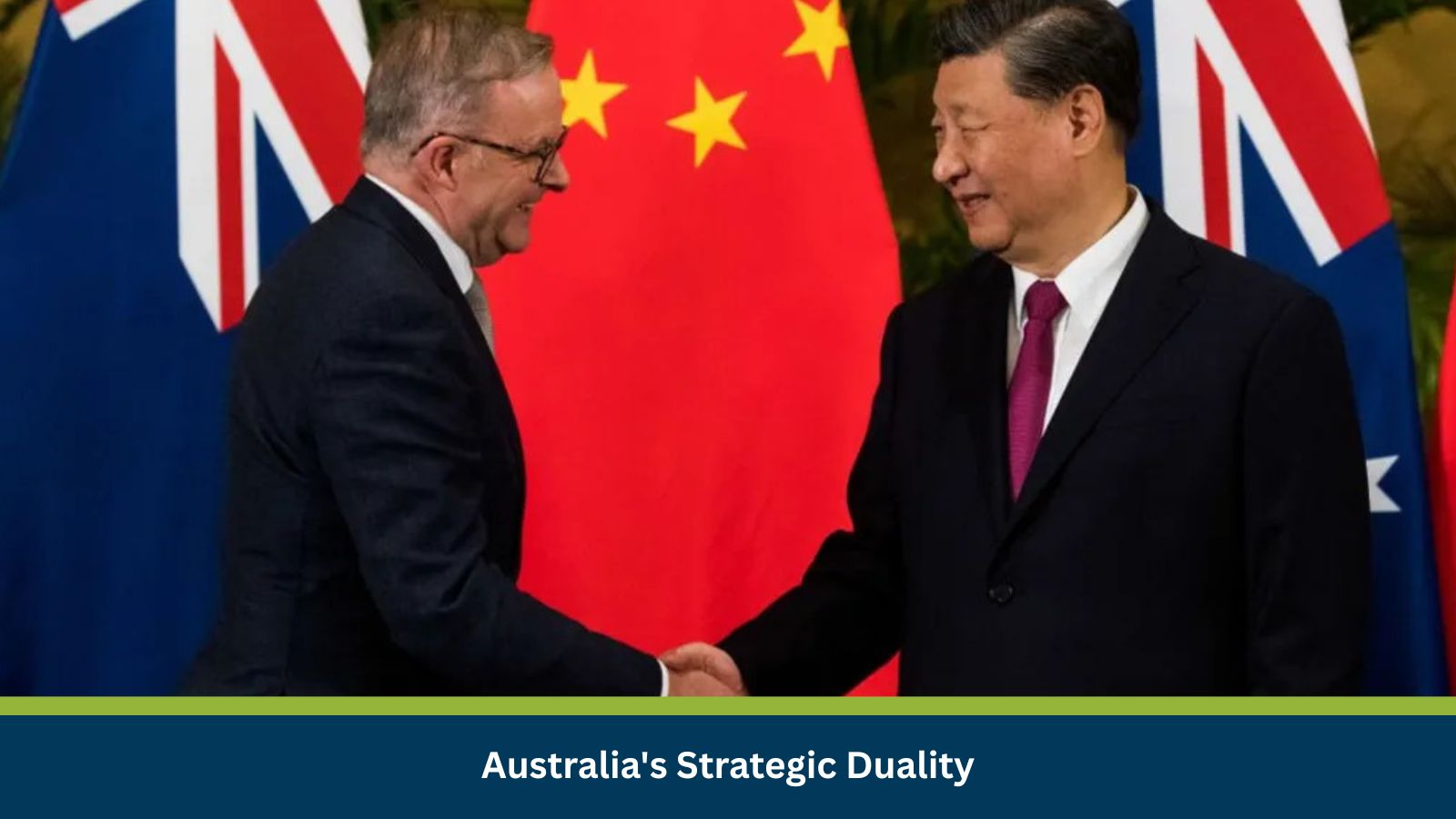
In a significant diplomatic reset, recent visits by Australian Prime Minister Anthony Albanese to Beijing have aimed to stabilize the relationship. Following high-level meetings, China has lifted most of the trade restrictions, and exports have resumed. While this signals a positive turn, a full return to pre-2020 relations is complicated. Concerns regarding U.S.’s trade policy and imposition of new tariffs have created a new dynamic, pushing traditional American allies to seek trade diversification. This presents an opportunity for China to strengthen ties with nations looking for stable trade partners. Australia is now actively focused on diversifying its trade relations and de-risking supply chains, working with other countries in the Indo-Pacific like India, Japan, and ASEAN nations, while still managing a stable and constructive economic relationship with China.
In parallel with its economic reset, Australia is doubling down on its security partnerships as a clear counterweight to China’s rising military and economic power in the Indo-Pacific.
The QUAD and AUKUS: Australia’s involvement in the Quadrilateral Security Dialogue (QUAD), along with the U.S., Japan, and India is a cornerstone of its strategy. The QUAD is a critical network for diplomatic and security cooperation. Similarly, the AUKUS trilateral security pact with the U.S. and the U.K., centered on the acquisition of nuclear-powered submarines, is a profound technological and military investment designed to enhance Australia’s defense capabilities and strengthen regional deterrence.
Australia’s strategic engagement also extends to smaller Pacific nations, which are crucial for regional stability. The Falepili Union with Tuvalu, a security and migration treaty, is a strategic move to prevent China from gaining a foothold in a nation with diplomatic ties to Taiwan. This proactive diplomacy is further evidenced by the recent Nakamal Agreement with Vanuatu, a 10-year security and business deal aimed at strengthening ties and countering China’s increasing spending and power in the region.
Further, Taiwan is a critical partner of Australia in advanced technology and critical mineral supply chains. The potential for a conflict in the Taiwan Strait highlights the inherent tension between Australia’s economic engagement with China and its strategic interests in the region.
The Strategic Dilemma for Global Business
This dual-track approach creates a new layer of complexity for global businesses. The core challenge lies in the unpredictable nature of this geopolitical environment.
- Supply Chain Disruption: A shift in diplomatic relations or a new military incident could disrupt logistics. Businesses must move beyond traditional risk assessments and model scenarios based on real-time geopolitical shifts.
- Compliance and Sanctions Risk: The potential for new U.S. or European sanctions on Chinese entities remains a constant threat. Companies must leverage up-to-the-minute supply chain intelligence to ensure they are not inadvertently dealing with sanctioned entities.
- Investment Uncertainty: The unpredictable nature of Australia – China relations introduces significant risk for foreign direct investment. Companies must continuously monitor trade data and geopolitical events to evaluate the stability of their investments and identify less volatile markets.
In this new era, business continuity requires a proactive, data-driven approach. The Australia-China balancing act is a powerful reminder that global events can shift with little warning.