ASEAN Summit 2025: Geopolitics, Trade Tensions, and Regional Integration
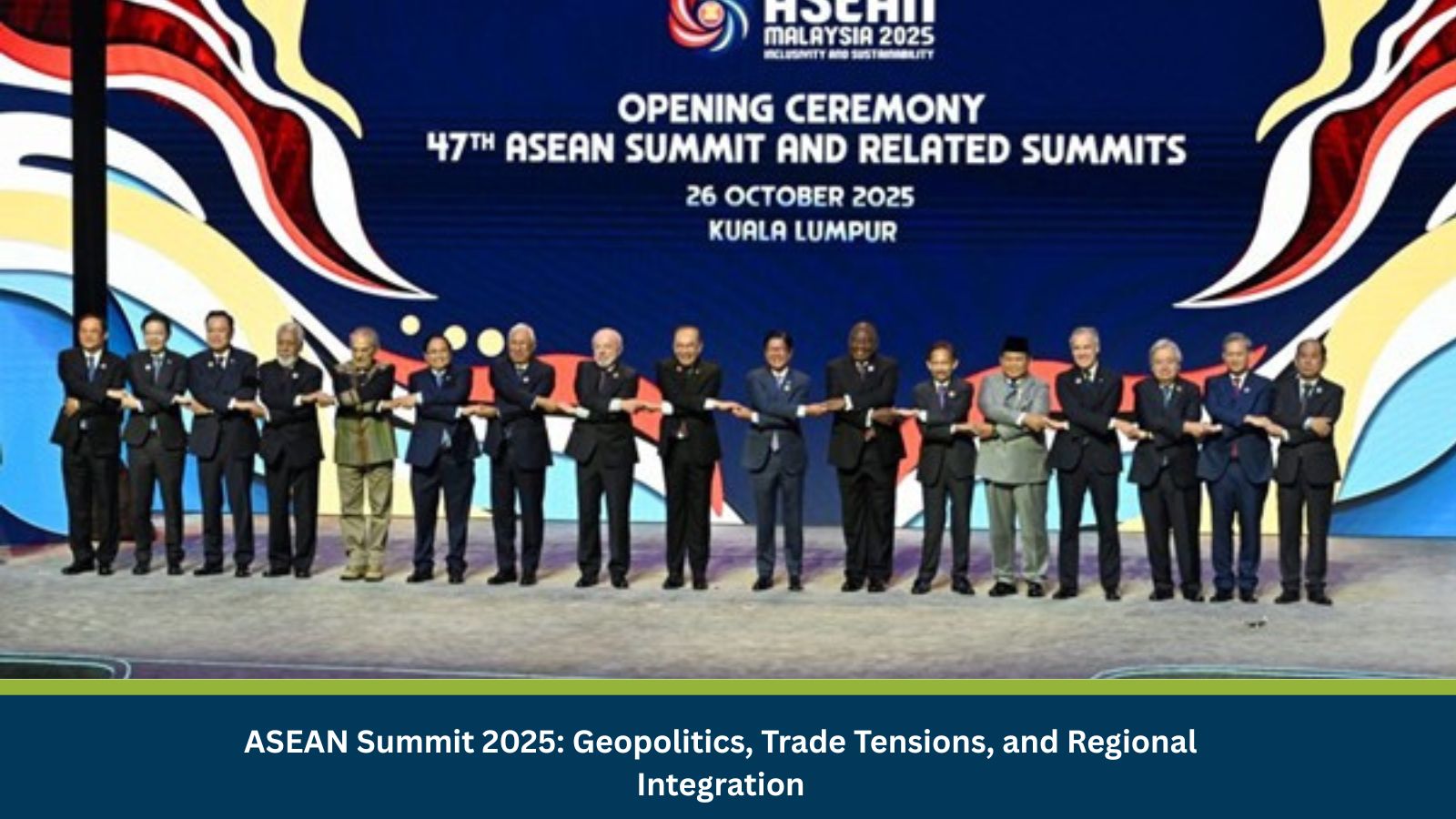
The 47th Association of Southeast Asian Nations (ASEAN) Summit and Related Summits are currently being held over three days, from 26 October to 28 October, 2025, in Kuala Lumpur, Malaysia, under the theme of “Inclusivity and Sustainability.” This critical event is serving as a major forum for addressing regional security, accelerating economic integration, and navigating the rising trade tensions between global powers. The summit has attracted high-profile global leaders, including US President Donald Trump, Canadian Prime Minister Mark Carney, Chinese Premier Li Qiang, Japanese Prime Minister Sanae Takaichi, and Australian Prime Minister Anthony Albanese while Indian Prime Minister Narendra Modi is attending virtually. The summit’s high-profile attendance and key dialogue partners, underscores the region’s importance in global geopolitics. Notably, it marks Donald Trump’s first attendance in ASEAN summit since 2017. Trump has been instrumental in official signing of peace deal between Thailand and Cambodia. The presence of Trump also allows for direct engagement on the challenging global economic landscape, particularly the ongoing US-China trade dispute and the impact of US tariffs, which were central topics at the summit. President Trump also signed a series of trade deals with four Southeast Asian partners on the sidelines of the ASEAN summit. The agreements include new reciprocal trade deals and critical minerals agreements with Malaysia and Cambodia, and a framework trade pact with Thailand and Vietnam. These agreements represent a strategic move to diversify the US supply chain, secure access to rare earths, and expand markets for US industrial and agricultural exports.
A major milestone of the summit was the bloc’s expansion, with East Timor (Timor-Leste) being officially inducted as the 11th member after signing a crucial accession treaty on 26 October. The meeting also produced a significant security achievement with the official signing of a peace deal between Thailand and Cambodia to resolve their long-standing border dispute, a ceremony presided over by President Trump and Malaysian Prime Minister Anwar Ibrahim.
Discussions at the summit are dominated by the challenging global economic landscape. The ongoing US-China trade dispute and the impact of US tariffs were central topics, with leaders discussing global supply chain vulnerabilities, particularly following the imposition of export controls on rare earth elements. ASEAN members are prioritizing the acceleration of regional economic growth, securing infrastructure finance, and leveraging the Regional Comprehensive Economic Partnership (RCEP) to affirm rule-based trade and counter rising protectionism. Furthermore, alongside economic issues, leaders are focused on complex security matters, including reviewing the implementation of the Five-Point Consensus (5PC) on the ongoing crisis in Myanmar and managing the strategic dynamics in the South China Sea.
Disclaimer: The article has reference to open sources including Reuters, Al Jazeera, Hindustan Times and Live Mint..