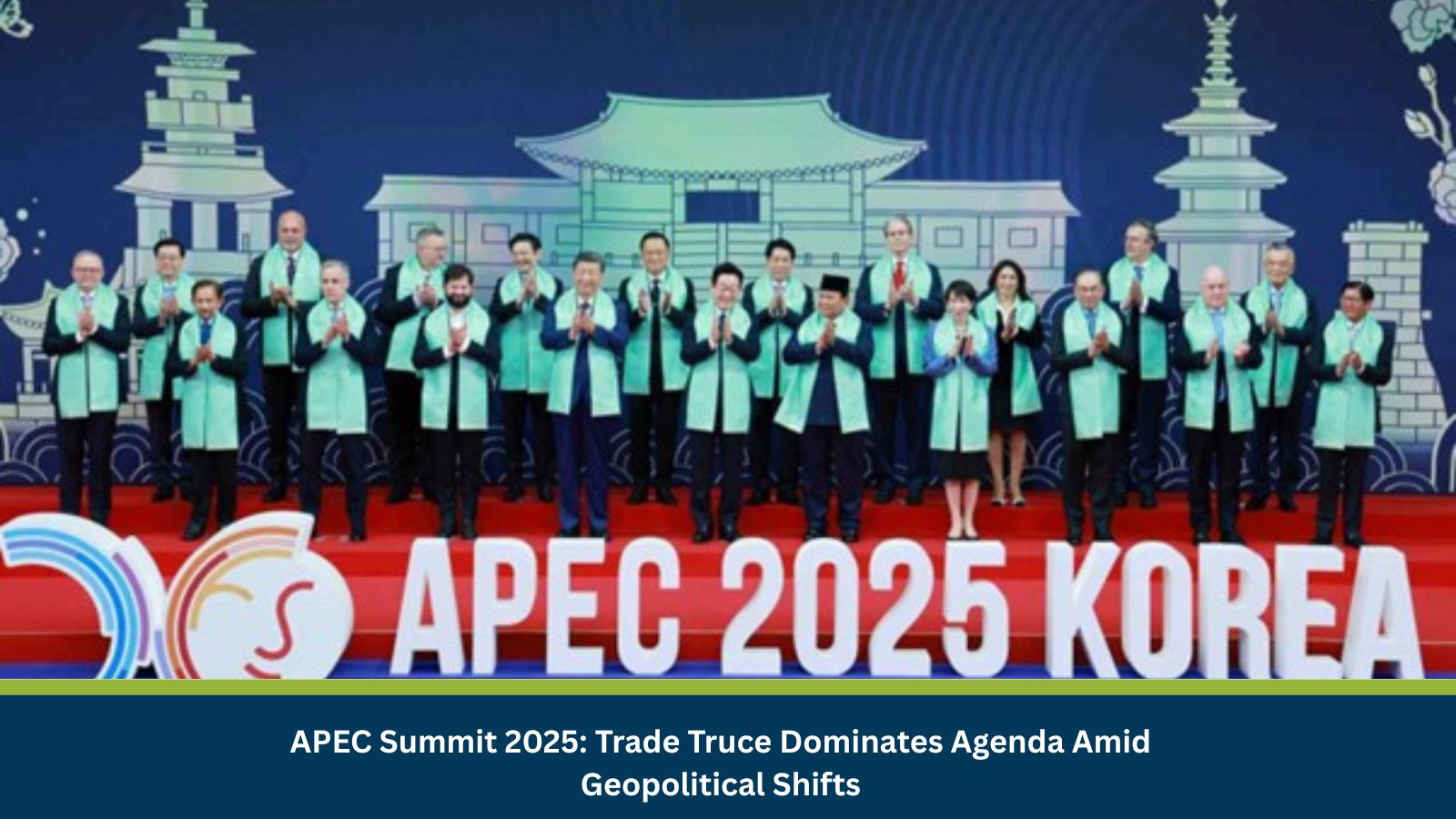
The annual Asia-Pacific Economic Cooperation (APEC) Summit, held in South Korea and concluded on 01 November, wrapped up with a major geopolitical development overshadowing its formal agenda: a significant trade truce between the United States and China. The summit served as a crucial platform for regional leaders to address global economic integration, technological shifts, and intense bilateral flashpoints.
The US-China Trade Truce
The defining moment of the summit was the de-escalation of the ongoing trade dispute between the world’s two largest economies. Presidents Donald Trump and Xi Jinping used the APEC gathering as an opportunity for high-stakes bilateral engagement, ultimately reaching a trade truce. This agreement momentarily paused the escalating tariff battle that had destabilized global supply chains and clouded economic forecasts.
While President Trump skipped the main APEC events in South Korea, his presence in the region for the bilateral talks confirmed the priority placed on managing the US-China economic relationship. The resulting truce offers temporary relief to global markets and allows both nations to step back from the brink of a full-scale trade war, shifting the immediate focus to implementing the terms of the agreement. For China, the summit was framed as “Xi Jinping’s moment,” highlighting his critical role in navigating complex global trade dynamics and conducting a “whirlwind diplomatic tour” across the continent.
However, opposition parties immediately and categorically rejected the results, denouncing the vote as a “mockery of the democratic process.” Their primary grievance stemmed from the effective suppression of major challengers. The main opposition contenders, including Tundu Lissu, were either imprisoned on treason charges (which he denies) or barred from running on legal technicalities leaving the president with little effective opposition from only sixteen fringe parties.
Regional Diplomacy and Official Declarations
Beyond the dominating US-China narrative, the summit addressed key regional challenges and advanced multilateral cooperation. South Korea, as the host nation, successfully utilized the event to strengthen its diplomatic standing, particularly with China. Following the APEC conclusion, Seoul sought to solidify bilateral ties by preparing to host President Xi Jinping for a state visit, a strategic move aimed at deepening economic and security cooperation between the two Northeast Asian powers.
In terms of official APEC business, the leaders adopted several important declarations focused on the region’s future economy:
Artificial Intelligence (AI): The summit concluded with a declaration on AI governance, aimed at setting regional standards and promoting responsible development of the technology.
Demographic Change: Leaders also adopted a consensus declaration addressing the significant economic and social implications of demographic change, a major concern across several member economies.
Conclusion
The 2025 APEC Summit will be primarily remembered not for its technical declarations, but as the moment a temporary stopgap was placed on the US-China trade war. This outcome highlights APEC’s enduring function as a critical platform for high-level diplomatic intervention, where economic cooperation is intrinsically linked to geopolitical stability. The summit ultimately provided a much-needed cooling-off period for the global economy, though the long-term success of the truce remains contingent upon sustained dialogue and fundamental resolution of underlying trade imbalances.