





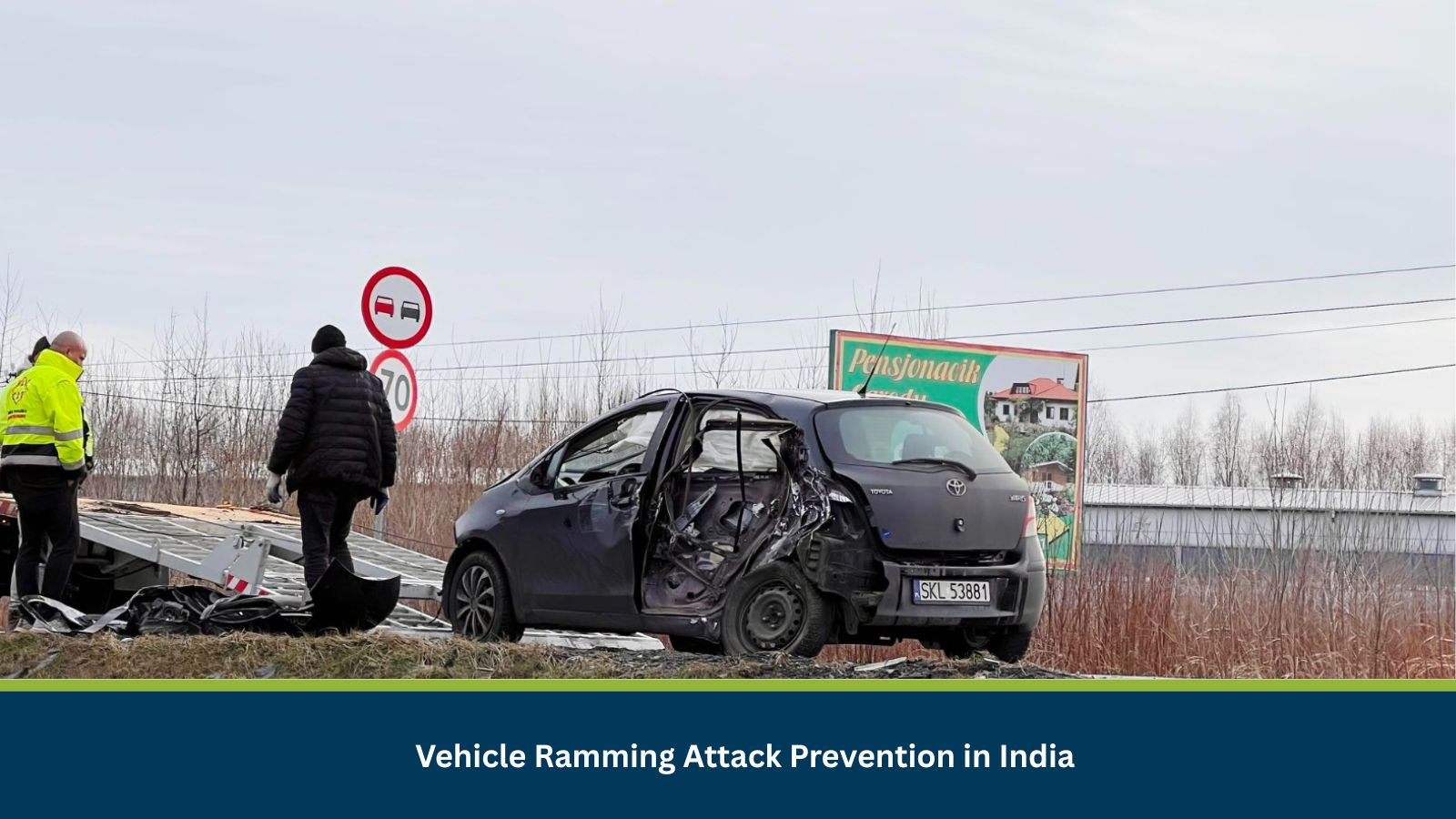
Picture a busy market street in Mumbai on a festival evening, or a crowded promenade during New Year’s Eve celebrations. Thousands of people, shoulder to shoulder, moving freely and just a few feet away, open road. It’s a scene repeated in cities across India every single day. It’s also, unfortunately, exactly the kind of scene that has made vehicles one of the world’s most unpredictable weapons in recent years.
Vehicle ramming attacks — where a car, truck, or other vehicle is deliberately driven into crowds of pedestrians — have emerged as one of the most difficult security threats to defend against. No specialized weapons. No complex planning. Just a vehicle, a crowd, and intent. That simplicity is precisely what makes prevention so important, and so achievable when done right.
In this guide, we’ll walk through why vehicle ramming has become a growing global concern, what makes Indian cities uniquely vulnerable, and — most importantly — the practical, proven strategies that urban planners, event organizers, businesses, and security teams can use to protect public spaces without turning every street into a fortress.
Why Vehicle Ramming Attacks Are So Hard to Stop
Most terrorist or mass-casualty attacks require specialized knowledge, weapons, or coordination — all of which create opportunities for detection. Vehicle ramming attacks flip that equation. Almost anyone with a driver’s license and access to a car has the means to cause harm, which means traditional intelligence-gathering and interdiction methods often come too late.
This low barrier to entry is exactly why security experts around the world have shifted their focus from predicting who might attempt an attack to designing environments that limit the damage a vehicle can do in the first place. It’s a shift from reactive policing to proactive urban design — and it’s a shift India’s rapidly growing cities are uniquely positioned to make, provided the right steps are taken early.
Why India Needs to Pay Attention Now
India presents a distinctive mix of factors that planners and security professionals need to take seriously:
Public spaces here are often intensely crowded, whether it’s religious processions, political rallies, wedding season traffic, or the daily crush around railway stations and markets. Many high-footfall areas — from Connaught Place in Delhi to Marine Drive in Mumbai to temple towns like Varanasi — were designed decades or even centuries before modern vehicle-based threats existed, meaning pedestrian and vehicle zones often overlap with little separation. Add to this the sheer scale of India’s public events calendar, from Republic Day parades to Kumbh Mela gatherings that draw tens of millions of people, and the case for proactive protection becomes clear.
The good news is that India doesn’t need to invent new solutions from scratch. Cities around the world — London, Paris, New York, Nice — have already faced this threat and developed a robust playbook of physical, technological, and procedural defences that can be adapted to Indian conditions.
The Three Pillars of Vehicle Ramming Prevention
Effective protection against vehicle ramming attacks generally rests on three interconnected pillars: physical infrastructure, technology and surveillance, and human preparedness. No single layer is enough on its own — it’s the combination that makes public spaces genuinely resilient.
Pillar One: Physical Infrastructure and Urban Design
The most reliable defence against a vehicle ramming attack isn’t a camera or a guard — it’s a well-placed obstacle. Bollards, planters, raised curbs, and reinforced barriers can stop a moving vehicle in its tracks, and when designed thoughtfully, they don’t have to look like a fortress checkpoint.
Cities like London have popularized the idea of “hostile vehicle mitigation” that hides in plain sight — decorative planters that double as crash barriers, benches with reinforced steel cores, and sculptural bollards that blend into a street’s aesthetic rather than announcing themselves as security infrastructure. This is a critical lesson for Indian urban planners: protection doesn’t have to come at the cost of a street’s character or its commercial vibrancy.
Beyond permanent infrastructure, temporary and event-specific barriers matter enormously. Festivals, rallies, marathons, and religious gatherings can deploy portable bollards, water-filled barriers, or repurposed heavy vehicles to seal off pedestrian zones for the duration of an event — a low-cost, high-impact measure that many Indian event organizers are only beginning to adopt systematically.
Pillar Two: Technology and Surveillance
Physical barriers stop vehicles, but technology helps detect trouble before it starts. AI-powered CCTV systems can now flag erratic driving patterns, unauthorized vehicles entering pedestrian corridors, or vehicles idling suspiciously near crowded areas — giving security teams precious extra seconds to respond.
Automatic number plate recognition (ANPR) systems, increasingly common at Indian toll plazas and city entry points, can be extended to flag vehicles of interest near high-risk zones. Meanwhile, real-time crowd density monitoring — already used at events like the Kumbh Mela — can help authorities identify when a location has become dense enough to warrant additional vehicle restrictions.
Command-and-control centres that integrate CCTV, ANPR, and crowd sensors into a single dashboard allow city security teams to make faster, better-informed decisions — something several Indian metros have started investing in as part of broader “smart city” initiatives.
Pillar Three: Human Preparedness and Training
Infrastructure and technology only work if the people on the ground know how to use them. Security personnel, event stewards, and even shopkeepers in high-footfall areas benefit enormously from basic training on how to recognize warning signs, how to safely direct crowds away from a moving vehicle, and how to coordinate with law enforcement during an incident.
Equally important is public awareness. Simple, non-alarmist guidance — like keeping an eye on designated pedestrian zones during large events, or knowing the nearest safe exit route — can meaningfully reduce casualties without inducing panic or fear in everyday life. Countries that have faced repeated attacks have found that calm, well-rehearsed responses save far more lives than last-minute reactions.
Practical Steps for Different Stakeholders
For City and Urban Planners
Conduct vulnerability assessments of high-footfall public spaces, prioritize hostile vehicle mitigation in new infrastructure projects, and retrofit existing high-risk zones — markets, promenades, transit hubs — with unobtrusive barrier systems.
For Event Organizers
Build vehicle security into event planning from day one, not as an afterthought. This means mapping vehicle access points, deploying temporary barriers around pedestrian zones, coordinating with local police on traffic diversions, and briefing on-ground staff on response protocols.
For Businesses and Commercial Complexes
Malls, office parks, and large retail complexes with open pedestrian plazas should evaluate their perimeter design, consider decorative but functional barriers at vehicle entry points, and train security staff on rapid-response procedures.
For Religious and Cultural Institutions
Temples, mosques, gurdwaras, and churches that regularly draw large crowds — especially during festivals — should work with local authorities to establish clear vehicle exclusion zones and temporary barrier plans well ahead of major events.
Learning from Global Best Practices
India isn’t starting this journey alone. After a string of vehicle ramming incidents in Europe throughout the mid-2010s, cities like London, Berlin, and Barcelona overhauled their approach to public space security almost overnight — closing vehicle access to iconic pedestrian areas, retrofitting bridges and squares with barriers, and building hostile vehicle mitigation into every new public infrastructure project by default.
The key takeaway from these global experiences isn’t just the specific barriers or technologies used — it’s the mindset shift. Vehicle ramming prevention works best when it’s treated as a standard part of public space design, not a special measure reserved for high-alert periods. That’s the model Indian cities, event organizers, and institutions can start building toward now, before rather than after an incident force the issue.
Frequently Asked Questions
1. What is a vehicle ramming attack?
A vehicle ramming attack occurs when a vehicle — typically a car or truck — is deliberately driven into a crowd of pedestrians with the intent to cause harm. These attacks are a growing global concern due to their simplicity and high impact.
2. Why are vehicle ramming attacks difficult to prevent?
These attacks require minimal resources — just a vehicle and intent — making them hard to detect through traditional intelligence methods. Prevention therefore relies more on physical barriers, urban design, and preparedness.
3. Which public spaces in India are most vulnerable?
Crowded markets, religious sites, transit hubs, event venues, and pedestrian-heavy zones are most at risk, especially where vehicles can easily access foot traffic areas.
4. How can events and public places be secured against such attacks?
Security can be improved by controlling vehicle access, installing barriers like bollards, coordinating with authorities, and training staff in emergency response protocols.
5. How does MitKat help prevent vehicle ramming attacks?
MitKat provides risk intelligence, vulnerability assessments, and customized security strategies to identify and mitigate threats. From securing high-footfall areas to planning safe events, MitKat helps organizations shift from reactive response to proactive prevention.
Conclusion
Vehicle ramming attacks prove one thing — threats don’t need complexity to cause damage. But prevention doesn’t need to be complex either.
With smarter design, better planning, and trained security, India can protect public spaces without losing its openness.
MitKat helps organizations stay ahead with risk intelligence, threat assessments, and proactive security strategies — turning vulnerabilities into resilience.