




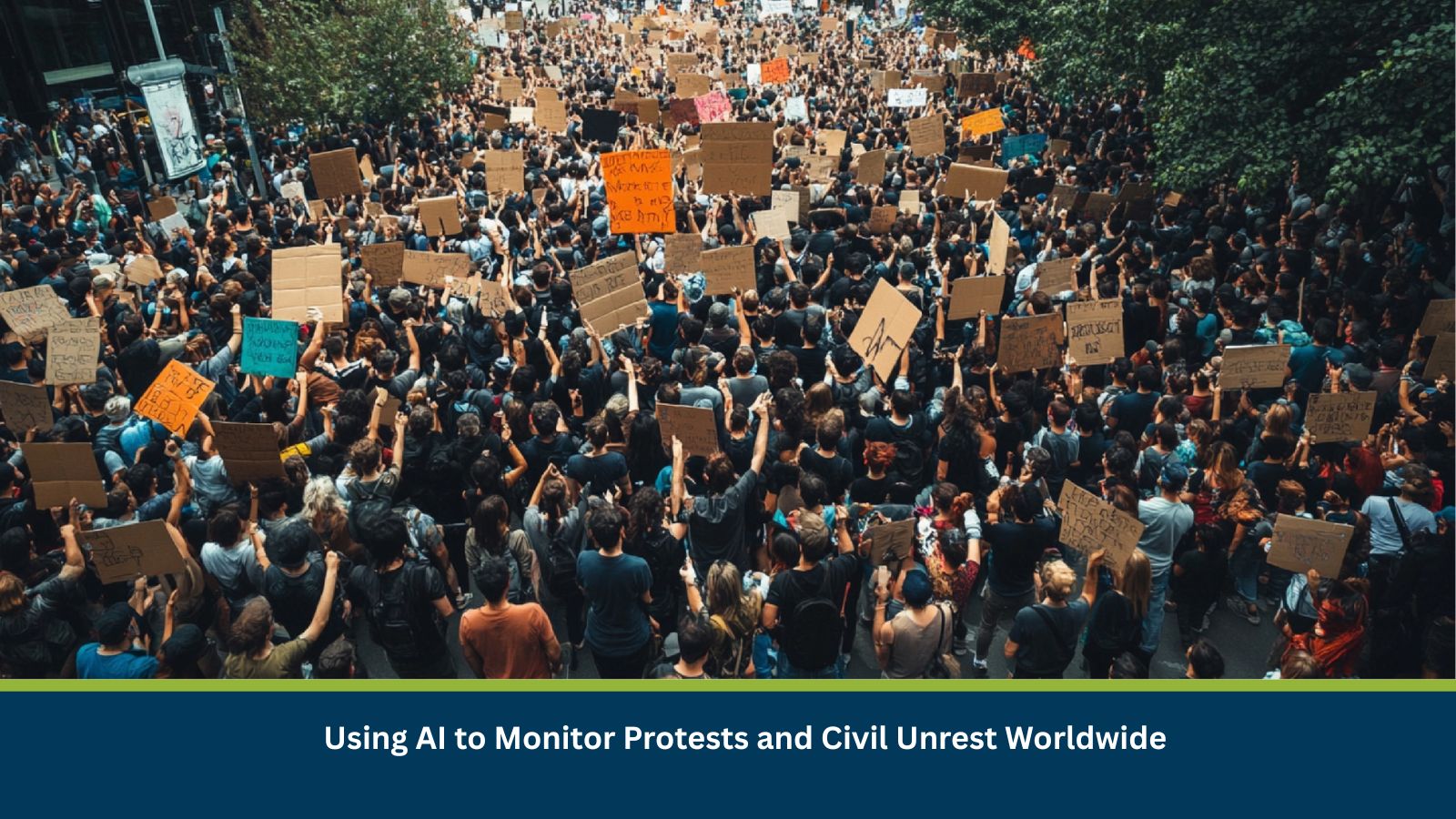
In an increasingly volatile world, protests and civil unrest have become more frequent, unpredictable, and impactful. From political demonstrations and labour strikes to sudden outbreaks of violence, these events can disrupt cities, halt operations, and pose serious risks to people and businesses.
To navigate this complexity, organizations are turning to Artificial Intelligence (AI) for real-time monitoring and analysis. AI-powered systems enable faster detection, deeper insights, and proactive decision-making—transforming how global risks are managed.
Why Monitoring Protests and Civil Unrest Matters
Civil unrest can escalate quickly, often with little warning. For businesses, governments, and travellers, the consequences can be significant.
Key risks include:
- Threats to employee safety
- Disruptions to supply chains and logistics
- Road closures and restricted movement
- Damage to property and infrastructure
- Reputational and financial losses
Without timely information, organizations may struggle to respond effectively.
What is AI-Based Monitoring?
AI-based monitoring uses machine learning, natural language processing (NLP), and data analytics to track and analyse events in real time.
It processes large volumes of data from:
- News and media sources
- Social media platforms
- Government alerts and advisories
- Public safety reports
AI then filters, verifies, and prioritizes this data to deliver actionable insights.
How AI Detects Protests and Civil Unrest
1. Real-Time Data Collection
AI continuously scans global data sources to detect early signals of unrest, such as:
- Trending keywords
- Sudden spikes in activity
- Location-specific mentions
2. Natural Language Processing (NLP)
NLP helps AI understand context, sentiment, and intent behind text data.
Example:
- Differentiating between peaceful protests and violent clashes
- Identifying calls for gatherings or strikes
3. Geo-Tagging and Location Mapping
AI assigns geographic coordinates to events, enabling:
- Precise location tracking
- Identification of high-risk zones
- Visualization on maps
4. Risk Scoring and Prioritization
Not all events carry the same risk. AI evaluates:
- Size and intensity of protests
- Proximity to critical assets
- Historical patterns of escalation
This helps prioritize alerts based on severity.
Benefits of Using AI for Monitoring Civil Unrest
1. Faster Response Times
AI detects events as they unfold, allowing organizations to act immediately.
2. Improved Situational Awareness
Decision-makers gain a clear, real-time view of evolving risks.
3. Reduced Information Overload
AI filters out irrelevant data, focusing only on high-impact events.
4. Enhanced Employee Safety
Organizations can warn employees, reroute travel, or initiate safety protocols.
5. Better Business Continuity
Proactive planning minimizes disruptions to operations and supply chains.
Use Cases Across Industries
Corporate Security Teams
Monitor risks near offices, factories, and employee locations.
Travel Risk Management
Provide alerts to employees traveling in high-risk regions.
Logistics and Supply Chain
Avoid routes affected by protests or roadblocks.
Government and Public Safety
Enhance crowd monitoring and emergency response planning.
Challenges in AI-Based Monitoring
While AI offers powerful capabilities, it also comes with challenges:
1. Data Accuracy and Verification
Not all sources are reliable; misinformation can affect insights.
2. Privacy and Ethical Concerns
Tracking and monitoring must comply with data protection laws.
3. Language and Regional Variations
AI must adapt to multiple languages and local contexts.
4. Rapidly Changing Situations
Events can evolve quickly, requiring constant updates and validation.
Best Practices for Implementing AI Monitoring
To maximize effectiveness, organizations should:
- Combine AI insights with human analysis
- Use multiple data sources for verification
- Define clear response protocols
- Train teams on interpreting AI alerts
- Regularly update systems and algorithms
Future of AI in Civil Unrest Monitoring
The role of AI will continue to grow with advancements in:
Predictive Analytics
Forecasting potential unrest before it happens.
Image and Video Analysis
Analysing live footage for crowd behaviour and risk indicators.
Hyper-Local Intelligence
Providing street-level insights for precise decision-making.
Automated Response Systems
Triggering alerts and actions without manual intervention.
FAQs
1. How does AI monitor protests and civil unrest?
AI analyses data from news, social media, and other sources to detect and track events in real time.
2. Is AI monitoring accurate?
AI is highly effective but works best when combined with human verification and multiple data sources.
3. Can AI predict protests before they happen?
AI can identify patterns and early signals, helping predict potential unrest with some level of accuracy.
Conclusion
AI is transforming how organizations monitor and respond to protests and civil unrest worldwide. By delivering real-time insights, improving situational awareness, and enabling proactive decision-making, AI empowers businesses to stay ahead of risks in an unpredictable environment.
As global uncertainties continue to rise, investing in AI-driven monitoring is no longer just an advantage—it is a necessity for ensuring safety, resilience, and operational continuity.
Datasurfr helps monitor protests and civil unrest worldwide by providing real-time, geo-tagged alerts and AI-driven insights, enabling faster, informed decisions to protect people, assets and operations.