




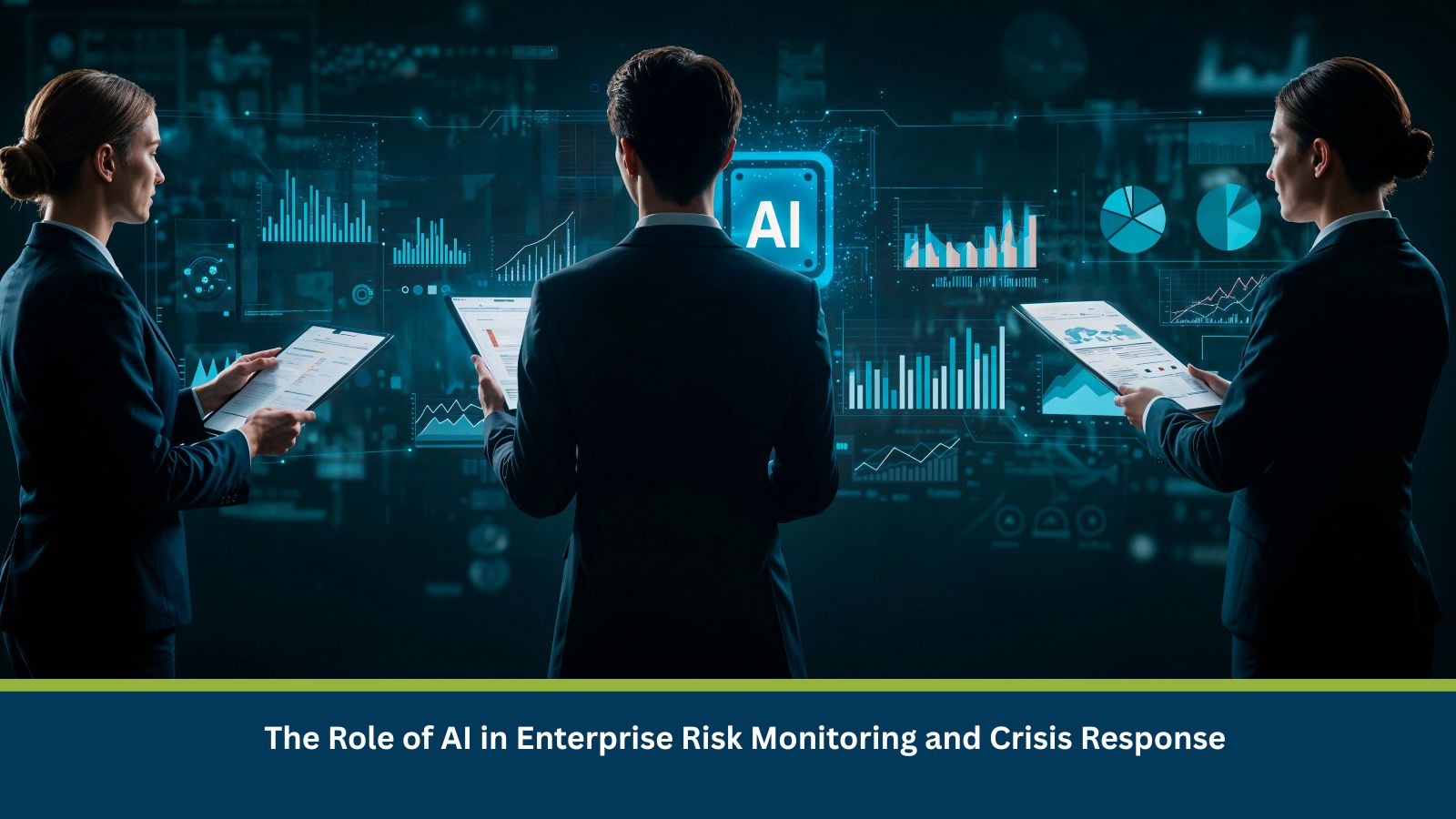
In today’s rapidly evolving threat landscape, organizations face an increasing number of risks that can disrupt operations, impact employee safety, and damage business reputation. Cyberattacks, geopolitical tensions, natural disasters, supply chain disruptions, and regulatory changes can emerge with little warning, making proactive risk management more important than ever.
Traditional risk monitoring methods often struggle to keep pace with the speed and complexity of modern threats. This is where Artificial Intelligence (AI) is transforming enterprise risk monitoring and crisis response by enabling organizations to detect risks faster, analyse large volumes of data, and respond to incidents with greater speed and accuracy.
This blog explores the critical role of AI in enterprise risk monitoring, crisis management, and organizational resilience.
Why Enterprise Risk Monitoring Is Evolving
Organizations today operate in a highly interconnected environment where risks can originate from multiple sources simultaneously.
Key challenges include:
- Growing cyber threats
- Geopolitical instability
- Supply chain disruptions
- Extreme weather events
- Regulatory complexity
- Employee safety concerns
- Reputational risks
To effectively manage these challenges, organizations need real-time visibility and predictive insights that traditional monitoring systems often cannot provide.
What Is AI-Powered Risk Monitoring?
AI-powered risk monitoring uses technologies such as:
- Machine Learning (ML)
- Natural Language Processing (NLP)
- Predictive Analytics
- Geospatial Intelligence
- Automated Data Analysis
These technologies continuously monitor and analyse vast amounts of information from multiple sources to identify emerging threats and support informed decision-making.
AI transforms raw data into actionable intelligence that organizations can use to prevent, mitigate, and respond to risks.
How AI Enhances Enterprise Risk Monitoring
1. Real-Time Threat Detection
AI continuously monitors multiple data streams including:
- Global news sources
- Government advisories
- Cyber threat feeds
- Social media signals
- Weather alerts
- Operational data
This enables organizations to detect emerging threats as they develop rather than after they have already caused disruption.
Benefits
- Faster threat identification
- Reduced response times
- Improved situational awareness
2. Predictive Risk Analytics
One of AI’s most powerful capabilities is predicting potential risks before they occur.
By analysing historical and real-time data, AI can identify patterns and trends that indicate emerging threats.
Examples
- Forecasting supply chain disruptions
- Predicting cyberattack trends
- Identifying potential civil unrest
- Anticipating weather-related disruptions
Predictive analytics allows organizations to move from reactive response to proactive risk management.
3. Automated Risk Prioritization
Organizations often receive thousands of alerts every day.
AI helps prioritize risks by evaluating:
- Threat severity
- Likelihood of occurrence
- Potential business impact
- Geographic proximity
- Asset exposure
This helps security and risk teams focus on the most critical incidents.
4. Enhanced Situational Awareness
AI-powered systems aggregate information from diverse sources and present it in a unified view.
This improves situational awareness by providing:
- Real-time incident visibility
- Geographic risk mapping
- Threat correlations
- Impact assessments
Better visibility enables faster and more effective decision-making during crises.
AI in Crisis Response and Emergency Management
When a crisis occurs, speed and accuracy are critical.
AI helps organizations respond more effectively by supporting every stage of the crisis lifecycle.
Automated Crisis Detection
AI identifies incidents as they emerge and triggers alerts to relevant stakeholders.
Examples include:
- Security incidents
- Cyberattacks
- Natural disasters
- Transportation disruptions
- Public health emergencies
Early detection can significantly reduce operational impact.
Intelligent Alerting Systems
AI ensures the right people receive the right information at the right time.
Alerts can be customized based on:
- Location
- Threat type
- Employee exposure
- Business function
- Risk level
This improves communication efficiency during emergencies.
Decision Support for Crisis Teams
AI provides actionable insights that help crisis management teams evaluate response options and allocate resources effectively.
Benefits include:
- Faster decision-making
- Reduced uncertainty
- Better resource coordination
- Improved response outcomes
The Role of GEO Intelligence in AI-Powered Risk Monitoring
Geospatial intelligence plays a critical role in modern crisis management.
AI combined with GEO intelligence helps organizations:
- Monitor risks geographically
- Track incidents in real time
- Assess impact on employees and assets
- Deliver location-based alerts
- Support evacuation planning
Location intelligence provides organizations with a deeper understanding of how threats may affect specific operations and regions.
Benefits of AI for Enterprise Risk Monitoring
Faster Response Times
AI enables near-instant detection and analysis of emerging threats.
Improved Operational Resilience
Organizations can better withstand disruptions and recover more quickly.
Enhanced Employee Safety
Real-time alerts and risk monitoring help protect employees during emergencies.
Better Decision-Making
Leaders gain access to actionable intelligence and predictive insights.
Reduced Business Impact
Early detection and proactive mitigation reduce operational and financial losses.
Best Practices for Implementing AI in Risk Monitoring
Integrate Multiple Data Sources
Combine internal and external intelligence sources for comprehensive risk visibility.
Establish Clear Response Protocols
Ensure AI-generated alerts trigger predefined response workflows.
Use Human Oversight
AI should complement, not replace, human expertise in risk management.
Continuously Train AI Models
Regular updates improve accuracy and adapt to evolving threats.
Align AI With Business Objectives
Focus on risk monitoring capabilities that directly support organizational resilience and continuity goals.
Challenges of AI-Powered Risk Monitoring
While AI offers significant advantages, organizations should address potential challenges.
Common Challenges
- Data quality and reliability
- False positives
- Privacy and compliance concerns
- Integration with existing systems
- Change management and user adoption
A balanced approach combining AI technology and human expertise delivers the best results.
The Future of AI in Crisis Management
AI will continue to reshape how organizations monitor and respond to risks.
Emerging Trends
- Predictive crisis forecasting
- Autonomous threat detection
- AI-powered crisis simulations
- Advanced geospatial analytics
- Automated emergency response workflows
- Real-time enterprise resilience platforms
Organizations investing in AI today will be better prepared for tomorrow’s challenges.
Frequently Asked Questions (FAQs)
What is AI-powered risk monitoring?
AI-powered risk monitoring uses artificial intelligence, machine learning, and analytics to identify, assess, and monitor risks in real time.
How does AI improve crisis response?
AI helps detect threats faster, automate alerts, prioritize incidents, and provide actionable insights for crisis management teams.
Conclusion
AI is revolutionizing enterprise risk monitoring and crisis response by providing organizations with real-time visibility, predictive insights, and faster decision-making capabilities. As threats become more complex and interconnected, traditional approaches are no longer sufficient to ensure resilience.
By leveraging AI-powered monitoring, predictive analytics, geospatial intelligence, and automated alerting systems, organizations can proactively identify risks, improve crisis response, and protect employees, assets, and operations.
Businesses that embrace AI-driven risk intelligence will gain a significant advantage in navigating uncertainty and building long-term operational resilience.
Datasurfr enhances enterprise risk monitoring and crisis response by providing AI-powered real-time threat intelligence, continuous risk monitoring, geospatial situational awareness, predictive analytics and automated alerts.