





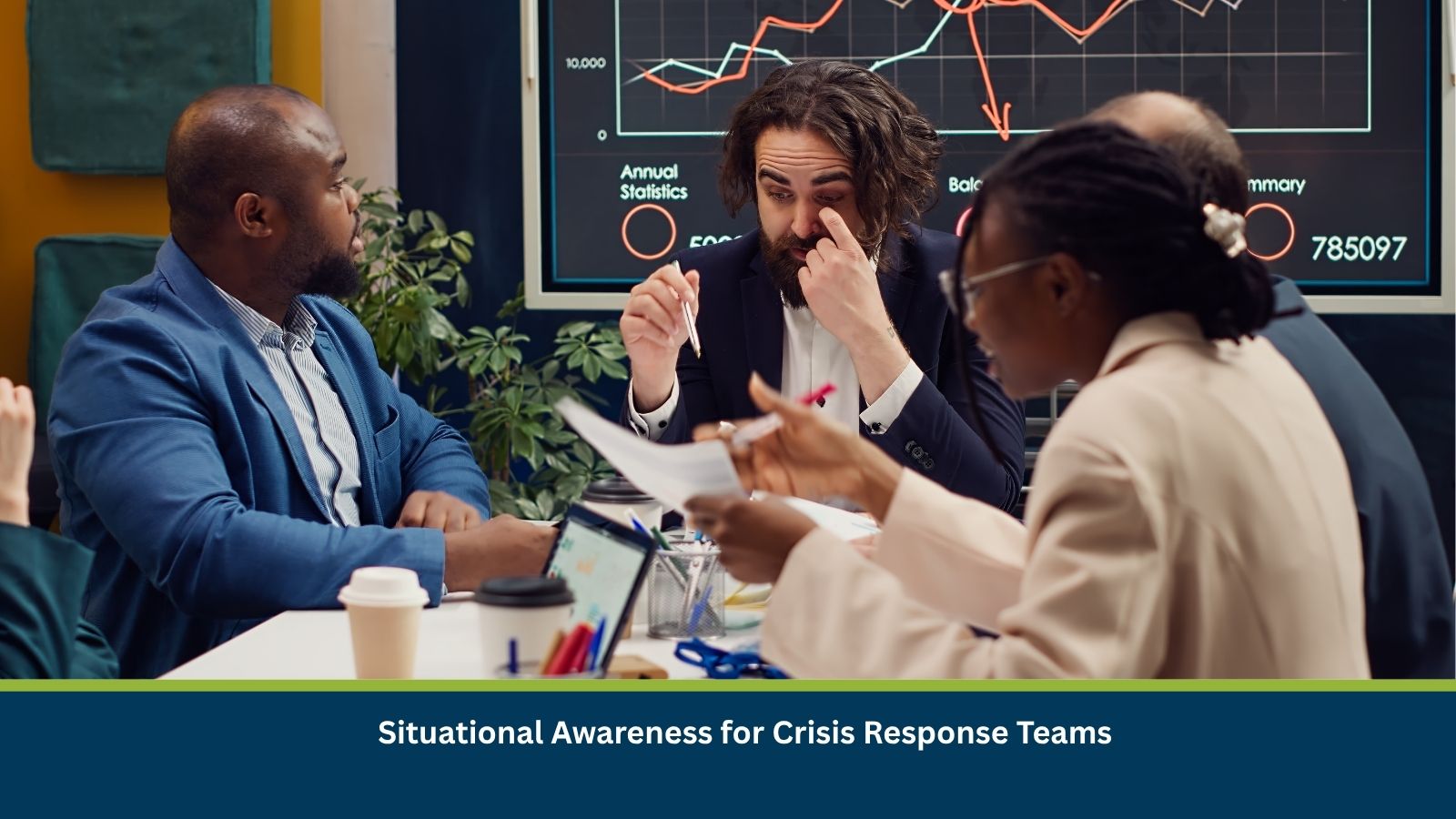
In today’s fast-moving and unpredictable world, crises can unfold within minutes—whether triggered by geopolitical tensions, natural disasters, cyberattacks, or operational failures. For Crisis Response Teams (CRTs), the difference between effective management and costly disruption often comes down to one critical capability: situational awareness.
Situational awareness is more than just having information—it’s about understanding what is happening, why it matters, and what actions need to be taken in real time. Organizations that build strong situational awareness frameworks are better equipped to respond quickly, minimize damage, and maintain business continuity.
What is Situational Awareness in Crisis Management?
Situational awareness refers to the ability to collect, analyse and interpret information in real time to support informed decision-making during a crisis.
It involves three key components:
- Perception: Identifying critical events and data points
- Comprehension: Understanding the impact of those events
- Projection: Anticipating future developments and risks
For Crisis Response Teams, this means having a clear, real-time view of evolving threats and the ability to act decisively.
Why Situational Awareness is Critical for Crisis Response Teams
In a crisis, delays and misinformation can escalate risks rapidly. Situational awareness helps teams:
- Respond faster to emerging threats
- Reduce uncertainty and confusion
- Coordinate effectively across departments
- Protect employees and assets
- Maintain operational continuity
Without it, organizations risk making reactive decisions that may worsen the situation.
Key Challenges in Maintaining Situational Awareness
Despite its importance, achieving effective situational awareness is not easy. Common challenges include:
1. Information Overload
Crisis teams often receive data from multiple sources, making it difficult to filter what truly matters.
2. Fragmented Communication
Lack of coordination between teams can lead to delays and inconsistent responses.
3. Lack of Real-Time Data
Outdated or delayed information reduces the accuracy of decision-making.
4. Limited Visibility Across Operations
Organizations with global operations may struggle to track risks across different regions.
Core Elements of Effective Situational Awareness
To build strong situational awareness, organizations should focus on the following elements:
1. Real-Time Data Collection
Access to up-to-date information from multiple sources such as:
- News and media reports
- Government advisories
- Internal systems and sensors
- Social and digital signals
2. Centralized Information Dashboard
A unified platform that consolidates all relevant data helps teams:
- Avoid duplication
- Identify patterns quickly
- Make faster decisions
3. Clear Communication Channels
Establishing structured communication ensures:
- Faster information flow
- Reduced confusion
- Better coordination between teams
4. Defined Roles and Responsibilities
Every team member should know:
- Their role during a crisis
- Decision-making authority
- Escalation protocols
5. Predictive and Analytical Capabilities
Using analytics helps teams:
- Identify trends
- Anticipate risks
- Plan proactive responses
How Crisis Response Teams Can Improve Situational Awareness
1. Implement Real-Time Monitoring Systems
Use tools that continuously track global and local risks to ensure timely alerts.
2. Conduct Regular Training and Simulations
Crisis drills help teams practice decision-making and improve response speed.
3. Develop Standard Operating Procedures (SOPs)
Clear SOPs ensure consistency and reduce confusion during high-pressure situations.
4. Use Geo-Spatial Intelligence
Mapping risks geographically helps teams understand:
- Affected locations
- Impact zones
- Safe routes and alternatives
5. Enable Cross-Functional Collaboration
Integrate teams from:
- Security
- Operations
- HR
- IT
- Communications
This ensures a coordinated response.
Role of AI in Enhancing Situational Awareness
Artificial Intelligence is transforming how organizations manage crises by:
- Filtering and prioritizing critical information
- Detecting patterns and anomalies
- Providing predictive insights
- Automating alerts and notifications
AI enables Crisis Response Teams to move from reactive to proactive decision-making.
Impact on Business Continuity
Strong situational awareness directly supports business resilience by:
- Minimizing operational disruptions
- Protecting supply chains
- Reducing financial losses
- Maintaining customer trust
Organizations that invest in situational awareness are better prepared to handle uncertainty and recover faster.
Best Practices for Organizations
To strengthen situational awareness, organizations should:
- Establish a dedicated crisis monitoring team
- Integrate technology with human expertise
- Maintain updated contact and escalation lists
- Regularly review and update crisis plans
- Ensure leadership involvement in decision-making
Future Trends in Situational Awareness
Looking ahead, several trends will shape crisis response:
1. Increased Use of AI and Automation
Faster data processing and smarter insights will improve response times.
2. Integration of IoT Devices
Real-time data from connected devices will enhance visibility.
3. Advanced Predictive Analytics
Organizations will increasingly rely on forecasting tools to anticipate crises.
4. Enhanced Cyber-Physical Security Integration
Combining digital and physical security monitoring will become standard practice.
FAQs
1. What is situational awareness in crisis response?
It is the ability to understand and analyse real-time information to make informed decisions during a crisis.
2. Why is situational awareness important?
It helps organizations respond quickly, reduce risks, and maintain operations during disruptions.
Conclusion
Situational awareness is the backbone of effective crisis response. In an environment where risks evolve rapidly, organizations must go beyond traditional approaches and adopt real-time, intelligence-driven strategies. By combining technology, structured processes, and skilled teams, Crisis Response Teams can respond faster, make better decisions, and safeguard both people and operations. Investing in situational awareness is not just about managing crises—it’s about building long-term resilience in an increasingly uncertain world.
Datasurfr enhances situational awareness for crisis response teams by delivering real-time, geo-targeted risk intelligence, filtering critical events using AI, and enabling faster, coordinated decision-making during crises.