





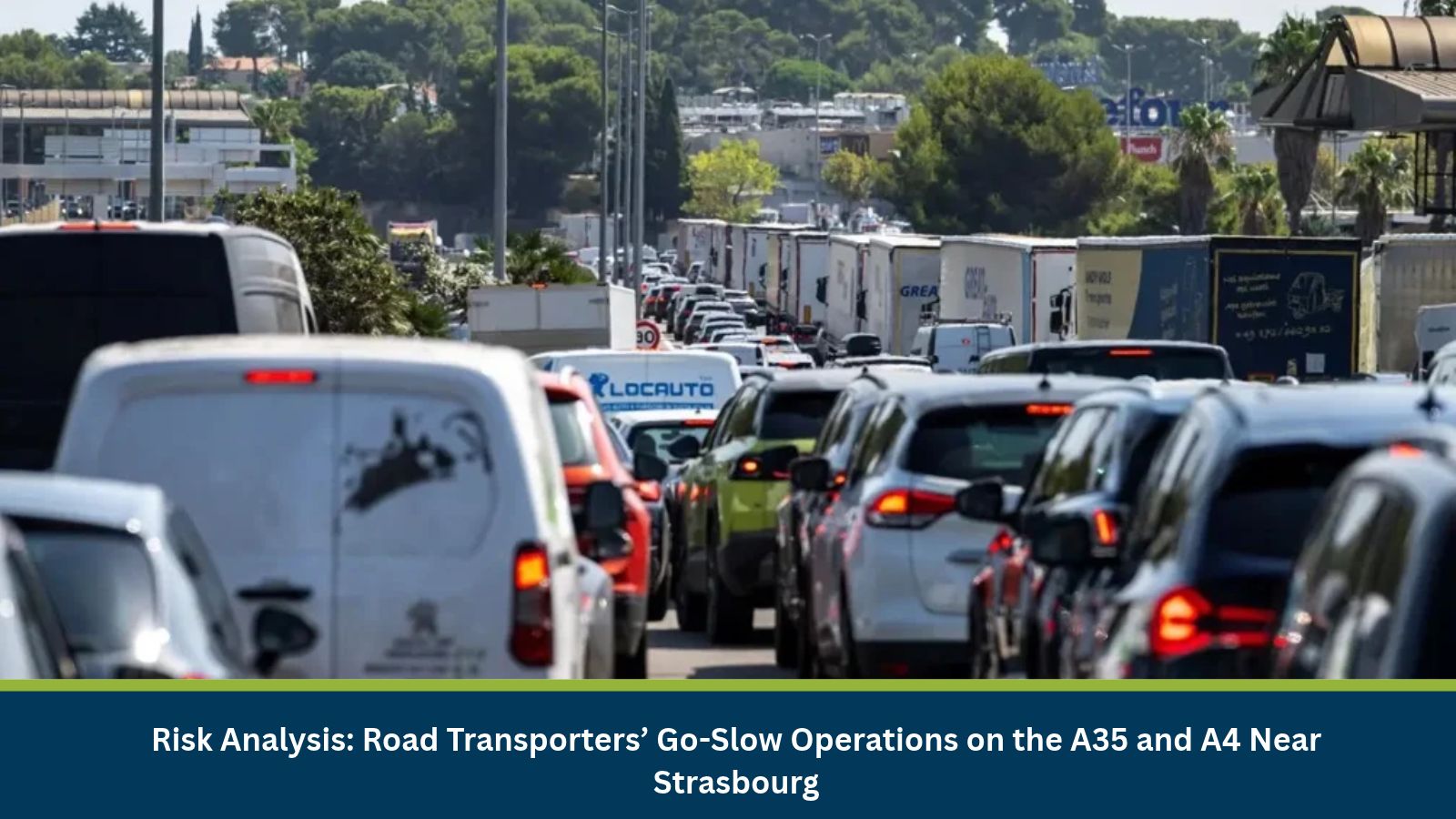
Executive Summary for Road Transporters’ Go-Slow Operations Near Strasbourg
Road transporters in France’s Grand Est region have organized go-slow operations for 15 October, to protest planned heavy-goods vehicle charges: the R-Pass in Alsace, scheduled for implementation in January 2027, and the Eco-contribution poids lourds (ECPL) in the wider Grand Est region, planned for April 2027. The mobilization is supported by transport-sector organizations, including the Fédération nationale des transports routiers (FNTR) and TLF Est. In the Strasbourg area, convoys are scheduled to depart from Duppigheim and Reichstett from around 0800 hours local time and converge near the Grand Est regional administration headquarters in the Wacken district. The planned movement is expected to disrupt traffic on the A35 and A4 and connected routes, including the M35. Congestion may affect freight deliveries, employee commutes and access to businesses throughout the morning. The available reporting describes anticipated disruption; the exact duration and extent of actual delays may vary.
- Date of Event: 15 October 2026
- Location: Strasbourg and surrounding areas, Grand Est, France; A35, A4 and connected routes including the M35
- Risk Category: Travel Risks
- Severity Score: 3/5
- Confidence Level: 75%
What is Risk Analysis in the Context of Travel Risk Events
Travel risk event analysis for transport-related demonstrations assesses how coordinated vehicle movements, slow-driving convoys and gathering points may affect road capacity, freight movement, workforce mobility and access to commercial facilities.
Known Hotspots and Sensitive Areas
High Impact
- A35 and A4 approaches to Strasbourg: These routes are specifically identified in the transporters’ protest reporting. Convoy movements towards Strasbourg may cause significant slowdowns, particularly during the morning operation.
- M35 and Strasbourg’s connecting road network: Local reporting warns of major disruption on the M35 and surrounding roads as convoys converge on the city. Delays may affect both passenger traffic and freight vehicles.
- Wacken district: The regional administration headquarters is the planned destination for the Strasbourg convoys. Traffic congestion and gathering activity may affect access to the surrounding area during the morning.
Medium Impact
- Duppigheim and the western approach to Strasbourg: A convoy of approximately 50 trucks is reported to be assembling near Duppigheim from 0800 hours before travelling towards Wacken. Traffic near the assembly area and along the route may experience delays.
- Reichstett and the northern approach: A second operation is planned to depart from Reichstett, potentially affecting traffic entering Strasbourg from the north.
- Nearby commercial and logistics facilities: Warehouses, distribution operators and businesses dependent on motorway access may experience delayed arrivals and departures.
Low Impact
- Routes outside the Strasbourg protest corridor: Roads not used by the convoys may experience less direct disruption. However, diversion traffic could create localized delays elsewhere in the metropolitan area.
- Operations scheduled away from the morning period: Journeys planned outside the main convoy movement may face lower direct exposure, but businesses should verify current traffic conditions before assuming routes have returned to normal.
Impact on Transportation and Services
- Road transportation: Slow-moving truck convoys may reduce capacity on affected motorway sections and cause queues on connected roads.
- Freight and logistics: Deliveries, collection schedules and long-distance journeys passing through Strasbourg may be delayed. Dispatch teams should consider alternative routes and delivery windows.
- Public transportation: Road-based services may be affected by congestion.
- Workforce movement: Staff travelling through the affected approaches may require additional travel time or alternative commuting arrangements.
- Business access: Congestion around Wacken may delay appointments, supplier visits and access to nearby commercial premises.
- Emergency access: Traffic queues may complicate movement through congested areas. Drivers should follow official instructions and avoid blocking emergency routes.
Recommended Actions
- Check live traffic updates: Monitor official regional traffic services and local authorities for current restrictions, convoy movements and alternative routes.
- Reroute freight where feasible: Review journeys through the A35, A4 and M35 and consider alternatives that avoid the convoy corridors.
- Adjust dispatch schedules: Where possible, move non-urgent collections and deliveries away from the expected morning disruption.
- Notify customers and suppliers: Communicate possible delays and revise delivery estimates where necessary.
- Inform employees: Advise staff commuting through Strasbourg to allow additional time and check routes before departure.
- Review Wacken access: Reschedule non-essential appointments near the regional administration headquarters if access is likely to be difficult.
- Track high-priority shipments: Maintain contact with drivers and logistics partners to identify delays and adjust downstream schedules.
- Avoid unverified shortcuts: Follow official traffic directions and avoid routes restricted by police or traffic management personnel.
Emergency Contacts
- Emergency number: 112
- Police emergency number: 17
Final Thoughts
The planned go-slow operations on 15 October present a moderate, localized travel and logistics risk around Strasbourg. The A35, A4, M35 and approaches to Wacken are the main areas of concern, with the greatest anticipated disruption associated with the morning convoy movements. Freight operators and businesses should prioritize route monitoring, flexible delivery schedules and timely communication with drivers and customers. The protest’s duration and the resulting traffic impact should be reassessed using live updates throughout the day. Leveraging MitKat’s Datasurfr enables businesses to receive real-time intelligence, monitor evolving threats and make informed decisions to protect people, assets and operations.