





What is Risk Analysis in the Context of Travel Risk Events
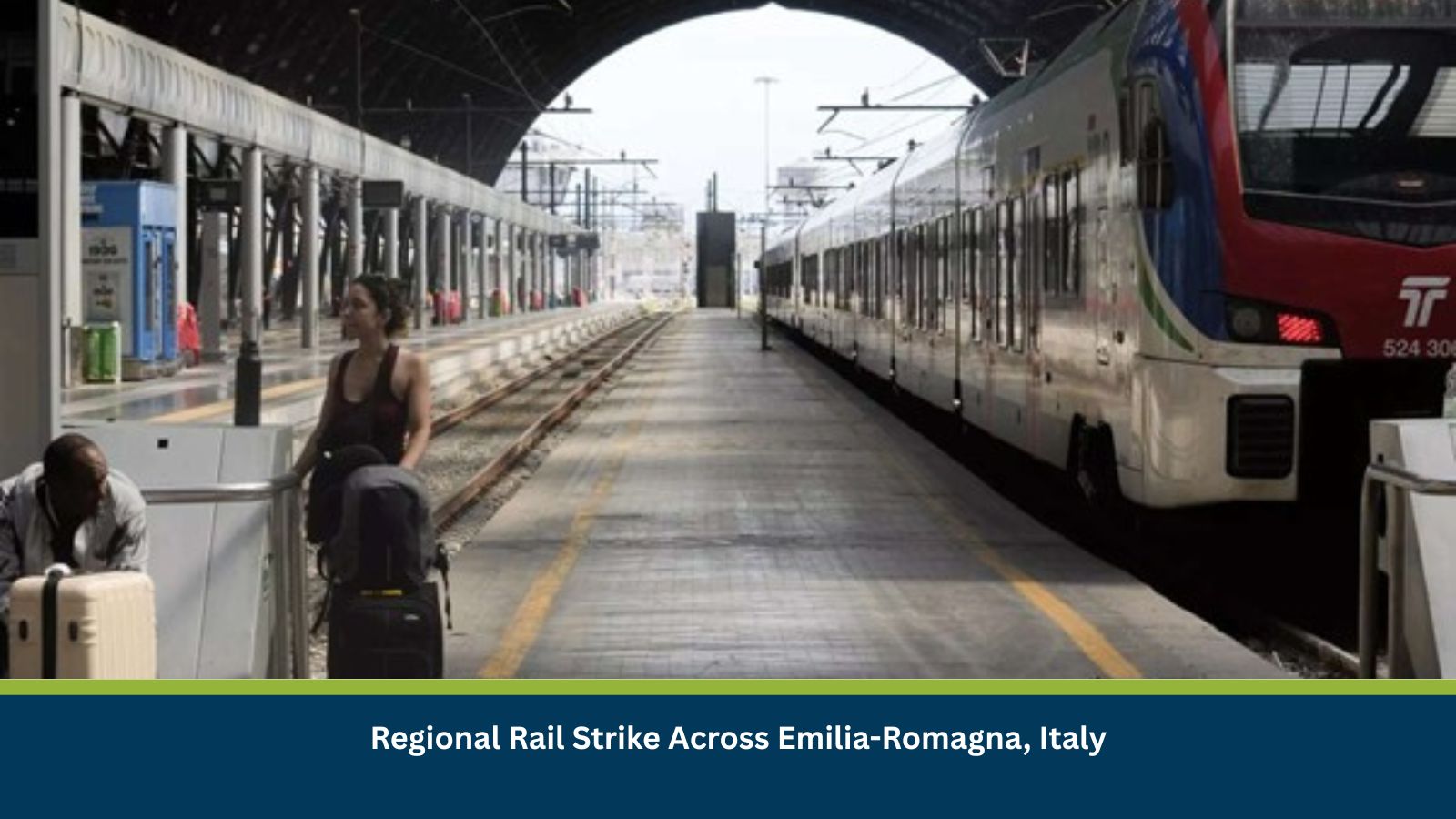
Travel risk analysis focuses on disruptions to mobility networks that affect people movement, business operations and public safety. In this case, a reactive regional rail strike represents a short-duration but high-impact travel risk. Emilia-Romagna has a history of single-day rail strikes triggered by safety incidents or union actions, typically causing concentrated commuter disruption rather than prolonged systemic outages. Monitoring such events is critical for workforce planning, logistics continuity and crowd safety management.
Executive Summary
- Date of Event: 07 January
- Location: Emilia-Romagna Region, Italy (including Bologna, Modena, Parma, Rimini and Ravenna)
- Risk Category: Travel Risks
- Severity Score: 3 / 5
- Confidence Level: 75 %
A regional rail strike is expected across Emilia-Romagna on 07 January, primarily affecting commuter and regional passenger services. The strike is assessed as a one-day action, with peak disruption during morning and evening hours. Impacts are likely to normalize within 48–72 hours, though localized congestion and staff absenteeism are expected.
Current Updates
Local reporting indicates rail staff stoppages and demonstrations linked to a recent fatal incident involving a train conductor. Rail operators are expected to publish guaranteed services and cancellations shortly before the strike. Authorities typically increase police presence at major stations, particularly Bologna Centrale, to manage crowding and demonstrations.
Known Hotspots and Sensitive Areas
High Impact: Bologna Centrale station and associated rail corridors, including Bologna–Modena, Bologna–Prato and Bologna–San Benedetto Val di Sambro, where cancellations and crowding are most likely.
Medium Impact: Regional stations in Parma, Modena, Reggio Emilia, Rimini and Ravenna, experiencing partial service reductions and commuter delays.
Low Impact: Peripheral towns and non-rail-dependent corridors, where disruption is indirect and mainly driven by secondary road congestion.
Rail strikes in Emilia-Romagna show a recurring pattern of Bologna-centric disruption with limited spillover beyond one to two days.
Impact on Transportation and Services
Rail services will face cancellations and reduced frequencies on key commuter lines. Increased passenger crowding at major stations may elevate safety concerns. Road networks, particularly the A1 and Tangenziale di Bologna, are likely to experience congestion as travellers shift to private vehicles and buses. Business operations may be affected through employee absenteeism, delayed client appointments and minor logistics rescheduling.
Recommended Actions
- Organizations should activate strike-day continuity plans, including remote work options, staggered shifts and alternative transport allowances for critical staff.
- Logistics teams should prioritize road-based routing for time-sensitive deliveries.
- Real-time monitoring of operator advisories and coordination with local police and municipal authorities is recommended.
- Longer term, employers should formalize transport disruption playbooks and employee mobility support frameworks.
Multidimensional Impact
No unrelated events are reported. However, public safety resources may be temporarily reallocated to manage demonstrations and station security, indirectly affecting routine policing elsewhere.
Emergency Contacts
- Emergency Services (Police/Fire/Ambulance): 112
- Local Police: 113
- Rail Operator: trenitalia.com/en.html
Final Thoughts
The expected rail strike represents a moderate, time-bound travel risk with predictable impacts. Key watchpoints include escalation beyond one day, crowd management at Bologna Centrale and recovery speed of services. Businesses and authorities should rely on early-warning intelligence and preparedness tools such as MitKat’s Datasurfr to reduce operational and reputational exposure. Stay ahead of operational risks with real-time alerts, scenario modeling, and expert advisories with datasurfr’s Predict. Start your 14-day free trial of Datasurfr’s Risk Intelligence Platform today.