





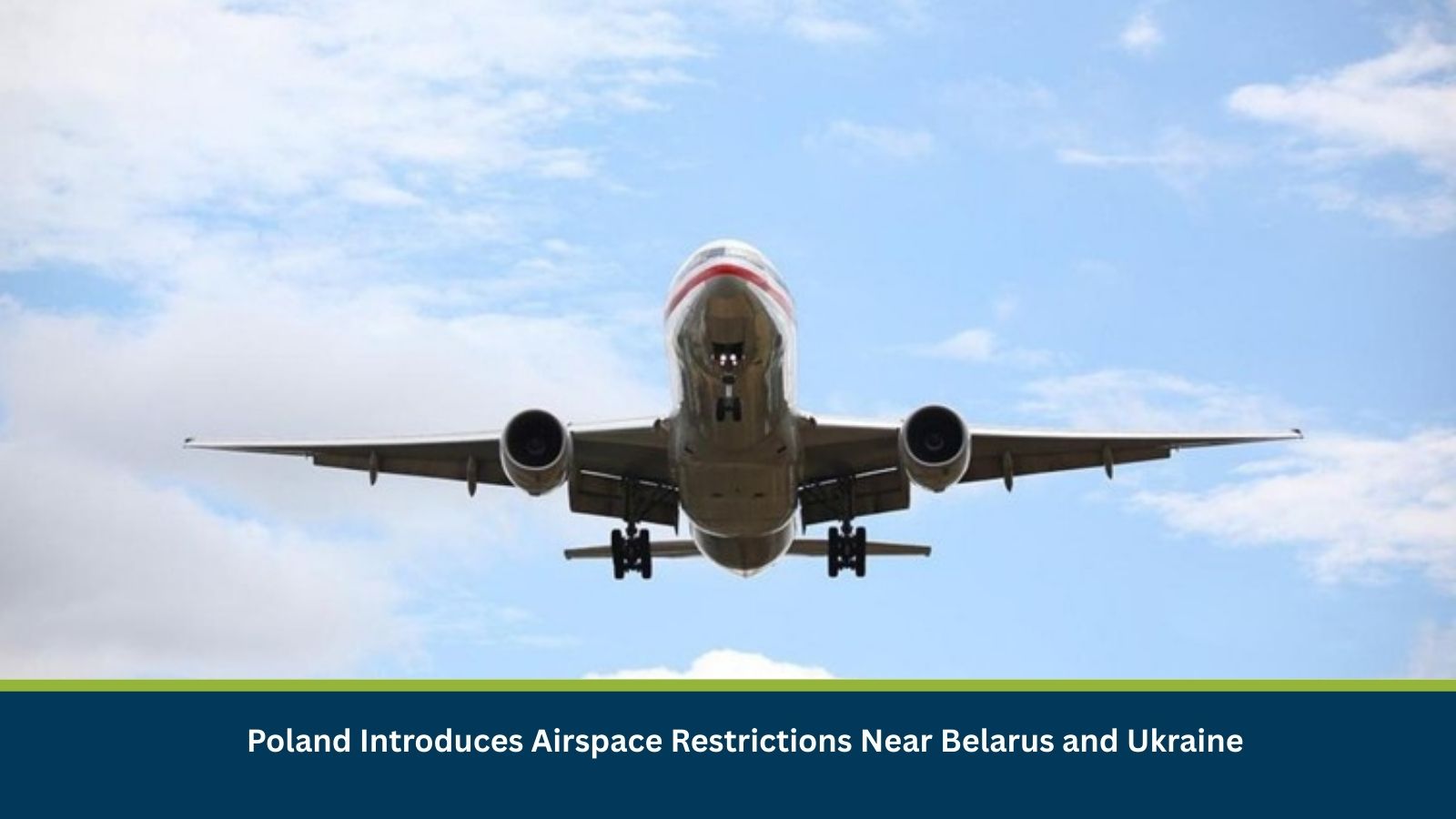
Executive Summary for the Airspace Restrictions by Poland
Polish authorities have introduced restricted airspace designated EP R130 across several eastern border regions effective 10 March. The measure is intended to strengthen aviation security in response to regional security concerns near the Belarus and Ukraine borders. The restrictions primarily affect low- and medium-altitude civilian flights and may disrupt regional aviation operations at airports such as Lublin and Rzeszów–Jasionka. While major international aviation hubs in Poland are expected to remain operational, regional flight routes, air cargo movements, and aviation logistics may experience delays or rerouting. Historical patterns suggest that similar restrictions have remained in place for multiple weeks while threat assessments remain elevated.
- Date of Event: 10 March
- Location: Eastern Poland including Lublin, Podkarpackie, and Podlaskie Voivodeships near Belarus and Ukraine borders
- Risk Category: Travel Risks
- Severity Score: 3 / 5
- Confidence Level: 86 %
What is Risk Analysis in the Context of Travel Risks Events
Travel risk analysis evaluates threats that may disrupt mobility, transportation networks, and cross-border travel. These risks can arise from geopolitical tensions, military activity, security alerts, or regulatory measures such as temporary airspace closures. In the current situation, Poland’s implementation of restricted airspace along its eastern border is a precautionary aviation security measure linked to heightened regional military activity and drone threats. Similar measures have been observed in previous years when authorities temporarily restricted flight corridors near sensitive border regions. Travel risk analysis is essential in such cases to assess impacts on aviation operations, passenger mobility, and supply chain logistics, particularly in regions where air transport plays a key role in freight and regional connectivity.
Known Hotspots and Sensitive Areas
High Impact:
- Lublin and Rzeszów aviation corridors
- Border districts including Przemyśl, Chełm, and Biała Podlaska
- Airport zones near Lublin and Rzeszów–Jasionka
Medium Impact:
- Transport corridors across Podkarpackie and Lublin Voivodeships
- Border crossing routes near Terespol, Hrubieszów, and Hajnówka
Low Impact:
- Major western Polish aviation hubs and cities outside eastern border regions
Historically, aviation restrictions and security measures are concentrated near sensitive border regions and strategic infrastructure, particularly when military activity increases in neighbouring countries.
Impact on Transportation and Services
The most immediate impact will affect regional aviation operations and airspace management. Flights operating through eastern Polish air corridors may be rerouted, delayed, or temporarily suspended depending on security advisories. Regional airports such as Lublin and Rzeszów–Jasionka may experience flight diversions or limited schedules. Airlines may redirect passengers and cargo operations to larger hubs such as Warsaw or Katowice, increasing travel time and logistics costs. Ground transportation may also experience secondary pressure as diverted passengers and cargo shipments shift to road and rail networks. Increased trucking activity along major corridors such as the A4 and S19 routes could result in localized congestion and delivery delays for time-sensitive freight.
Recommended Actions
Immediate Measures:
- Monitor aviation advisories and NOTAM updates before scheduling flights.
- Avoid non-essential travel through affected eastern aviation corridors.
- Notify logistics partners and customers regarding possible cargo delays.
- Establish alternate routing plans for air cargo shipments.
Strategic Measures:
- Strengthen business continuity planning for aviation disruptions.
- Diversify logistics routes to include road and rail alternatives where feasible.
- Maintain communication with aviation regulators and airport authorities for operational updates.
Multidimensional Impact
Although the airspace restriction does not directly mandate road closures, past incidents have seen increased security checkpoints and localized congestion near border crossings and airport access roads. Such measures may indirectly affect freight movement and regional commuter traffic.
Emergency Contacts
- Emergency Number: 112
- Polish Aviation Authority and Airspace Notices: ulc.gov.pl/en/
Final Thoughts
The introduction of restricted airspace in eastern Poland represents a moderate travel risk driven by evolving regional security conditions. While the measure is precautionary, it may result in operational disruptions to regional aviation, logistics, and cross-border travel. Businesses and travellers should remain alert to aviation advisories and prepare contingency travel plans.
Stay ahead of operational risks with real-time alerts, scenario modeling, and expert advisories with datasurfr’s Predict. Start your 14-day free trial of Datasurfr’s Risk Intelligence Platform today.