





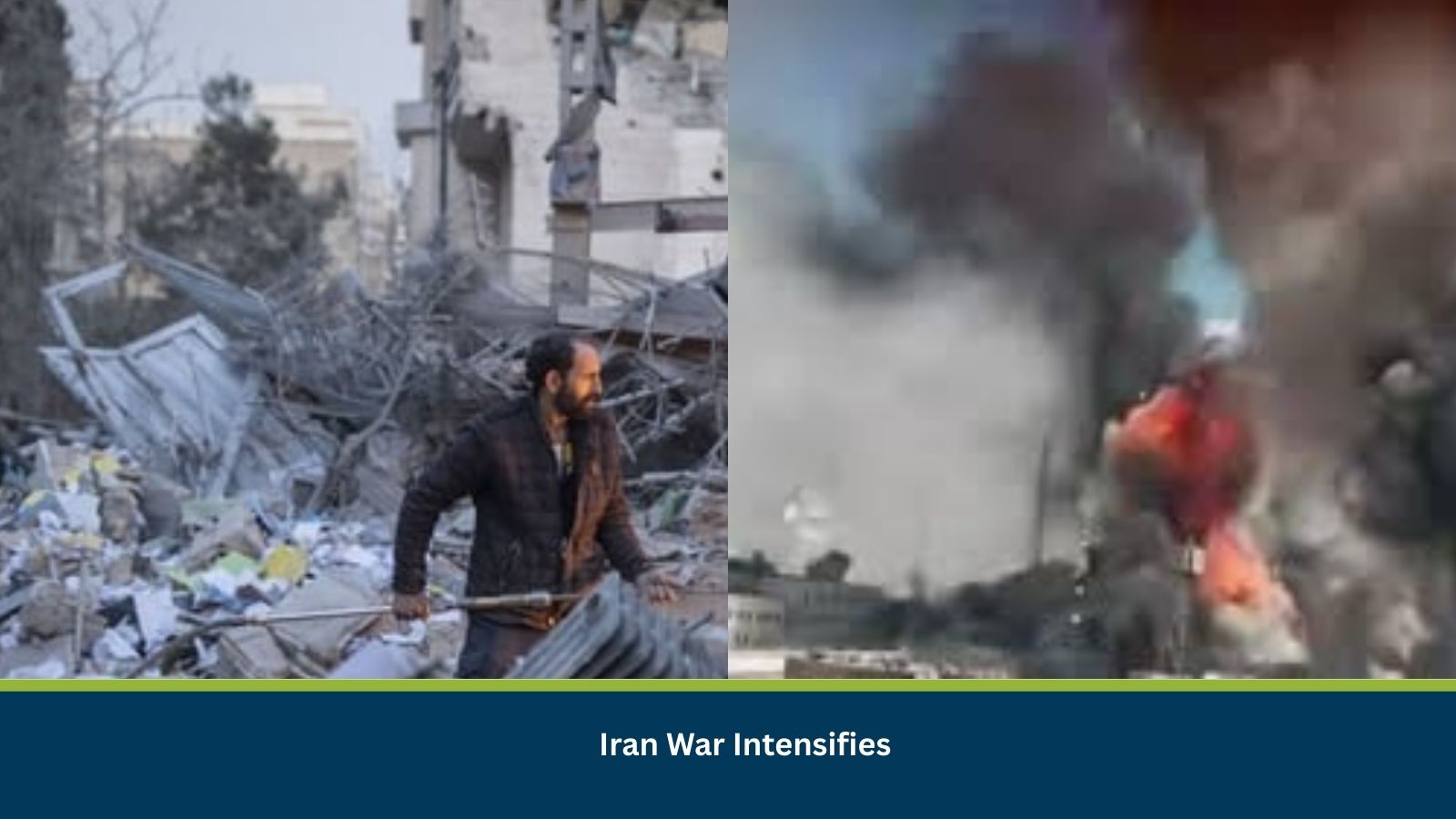
The US and Israel have hit thousands of targets inside Iran, continuing their joint campaign after they killed Supreme Commander Ayatollah Ali Khamenei. Targets include presidential office, country’s Supreme National Security Council, state broadcaster, air defence assets, command, control and communication (C3) centers, naval platforms, missiles and missile launchers and other military and IRGC capabilities.
US State Department has closed its embassies in Saudi Arabia and Kuwait after drone attacks and urged Americans to depart immediately from 14 Middle East countries, as Iran expanded its retaliatory strikes in the widening regional conflict.
Global markets tumbled, and travel has been impacted as war intensifies. Energy prices have spiked as Iranian strikes impacted oil & gas production in Saudi Arabia and Qatar and transit through Strait of Hormuz was severely restricted.
Six US service personnel, 11 Israelis, >550 Iranians and >50 Lebanese have been killed. Deaths have bene reported from UAE, Kuwait, and Bharain. Many more have been injured.
Recap and analysis of major events
US and Israel Attack Iran: On Saturday, Feb 28, 2026, the US and Israel began coordinated military strikes on Iran. US stated objectives include destroying Iranian missile, naval and military capabilities, ending Tehran’s support for regional militant groups, and preventing the country from developing a nuclear weapon. Trump said the US operation is expected to last 4-5 weeks but could go far longer. For Israel, weakening Iran’s military capabilities and proxies and ushering in regime change from within appear to be the main objectives.
Supreme Leader Killed: The first strikes killed Supreme Leader Ayatollah Ali Khamenei, and many senior leaders including Ali Shamkhani, Advisor to the Supreme Leader, General Mohammed Pakpour, Commander, Iranian Revolutionary Guard Corps (IRGC), Aziz Nasirzadeh, Minister of Defense, Abdolrahim Mosavi, Chief of Staff, Iranian Armed Forces and Gholamreza Rezaian, Police Intelligence Chief.
Retaliatory Strikes by Iran: Iran carried out missile and drone strikes against Israel, US, and its allies in the region. Its proxies in Lebanon (Hezbollah), Yemen (Houthis) and Iraq (Shia militia groups) have joined the fight.
Israel Strikes Hezbollah: Hezbollah fired missiles at Israel which responded with major strikes in Lebanon against Hezbollah targets. Commander of Quds Force has been killed. Israeli military said it had seized new areas of Lebanon in its conflict with Iran-backed Hezbollah. Over 30,000 people have reportedly been displaced in Southern Lebanon.
Global Disruption
Impact on Travel: Closure of airspaces and airports in one of the world’s business aviation corridors led to major impact on travel. Countries are scrambling to evacuate their citizens from Gulf states under attack from Iran amid widespread flight cancellations and airport closures.
Stock markets, particularly travel stocks took a hit.
Oil & Gas: Targeting of energy infrastructure, shutdown of oil & gas facilities across the region, and closure of Strait of Hormuz by IRGC have spooked energy markets. Gas supply remains tight and LNG prices have risen sharply in Europe. Oil markets remain oversupplied, but prices rose by over 10%.
Insurance companies have cancelled war risk coverage for vessels in the region as the conflict widens.
Impact on Gulf Countries
The latest Iran war has shocked Gulf states. Within 48 hours, Iran has targeted all Gulf countries – US military bases, embassies, airports, hotels, iconic landmarks, data centers and major oil and gas infrastructure. Gulf air defenses have proved effective against missiles, but some Iranian drones have managed to get through.
Qatar (hosts Al Udeid Base) has intercepted over 101 missiles (of 104 detected) and 24 (out of 39) drones. It shot down two Iranian SU-24 aircrafts. Qatar (which produces 20% of global LNG and shares world’s largest gas field with Iran) decided to halt LNG production causing major spike in gas prices in Europe.
Bahrain (hosts Vth Fleet) has intercepted 70 missiles and 76 drones. A drone strike damaged US radar at the Naval base. Subsequent waves of missile and drone attacks have also targeted the US Naval base.
Kuwait (host to US CENTCOM) – Intercepted 169 missiles out of 182 detected (rest landed in sea). It intercepted 645 drones (44 hit the territory). Targets include airport. Three US-15 fighters were shot down in a friendly fire. A drone attack caused fire at American embassy which is shut. Consular services have been suspended.
UAE: Despite not allowing the US the use of its airspace, the UAE has borne the brunt of Iran’s early attack. Damage from drone attacks and falling debris (post interceptions) to major airports and iconic tourist spots have consequences for region’s reputation as an oasis of stability and as premium global business hub. It could also force the UAE to reconsider its strategy for managing a volatile region. UAE has intercepted 172 ballistic (and many cruise) missiles and 645 drones, including Shahed drones. Targets which sustained fire/damage from debris/drone fragments include Fairmont on Palm Jumeirah, Burj Al Arab, one terminal at Dubai International Airport and Jabel Ali Port. Fire at data center impacted operations of downstream clients, including IT systems and apps of few banks. Abu Zayed International Airport took a hit with one dead and seven injured. Most injuries and damages were caused due to interception and falling debris.
Saudi Arabia – Saudi Aramco stopped production at Ras Tanura Refinery (capacity 550,000 bpd). US Embassy in Riyadh has been shut and consular services suspended after it suffered minor damage from suspected Iranian drone strike.
Oman (mediator between US and Iran) – Oman which has a policy of friends to all, initially stayed out of line of fire. Duqm commercial port was targeted by two drones; an oil tanker was attacked five nautical miles off the coast of Musandam.
Other Countries Impacted
US bases and assets in Iraq and Jordan have also faced missile and drone attacks. A series of explosions have rocked Erbil in Iraqi Kurdistan region. Incidents have been reported from some other countries.
In the neighborhood, Pakistan and Afghanistan are also involved in a war.
British Base in Cyprus. Two drones heading to RAF Akrotiri Base in Cyprus were intercepted on Monday. On Sunday night, a drone hit the British base with no casualties and minimal damage. PM Keir Starmer said the UK had agreed to a US request to use British military bases for “defensive” strikes.
US Travel Advisory
The US State Department (Security update March 2, 4 PM EST) urged citizens in the following countries to depart immediately via commercial means due to serious safety risks:
- Bahrain
- Egypt
- Iran
- Iraq
- Israel, the West Bank and Gaza
- Jordan
- Kuwait
- Lebanon
- Oman
- Qatar
- Saudi Arabia
- Syria
- UAE
- Yemen
Americans have very limited options to leave Israel, according to US Ambassador Mike Huckabee. In a post on X, he said that the US embassy was “not in a position at this time to evacuate or directly assist Americans in departing Israel.” Instead, he recommended that Americans take a bus operated by Israeli Ministry of Tourism to Taba in Egypt, where they can board a flight from there or from Cairo. He did not recommend travelling through Jordan, as flights are not consistent.
MitKat Advice to Travellers
After closure of airspaces and airports for three days, Dubai, UAE, Bahrain and Qatar have resumed some flights, cautiously returning to the skies to evacuate thousands of passengers stranded by the escalating conflict in the region.
Only move once your flight or border crossing is confirmed. Do not head to airport unless contacted directly by the airline with a confirmed departure time. Retain your hotel or accommodation until you have a confirmed departure.
MitKat will continue to monitor the evolving situation. For travel-related advice, please contact us at contact@mitkatadvisory.com or subscribe to “GoSafe.”