






The Rising Tide of Business Disruption
Floods are no longer “rare” events — they are recurring stress tests of corporate resilience. According to Munich Re’s NatCatSERVICE, global flood losses over recent years are measured in the hundreds of billions of dollars. The World Bank and Nature notes that flooding now affects more people than any other natural hazard, affecting over 1.81 billion people (23% of world population).
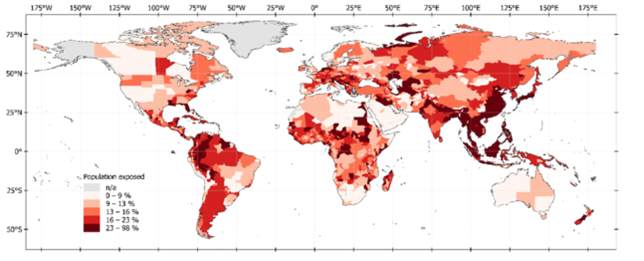
For global enterprises, the lesson is clear: flood exposure is no longer confined to riverbanks. Urban flash floods, monsoon surges, and coastal inundations are disrupting critical infrastructure, logistics networks, and supply chains from Bangkok and Chennai to Rotterdam and Houston. To remain operational in a volatile climate era, companies must integrate Flood Risk into their Business Continuity Plan (BCP) — turning reactive crisis management into proactive resilience planning.
Understanding Flood Risk in the Corporate Context
Flood Risk refers to the combined probability of a flood event and its potential impact on business assets, people, and processes.
Three main categories of flood hazards are relevant for business planning:
- Riverine (fluvial): Overflow of rivers due to excessive rainfall or dam releases.
- Coastal: Storm surges, sea-level rise, and tidal flooding, increasingly intensified by cyclones.
- Pluvial (urban): Flash floods caused by intense rainfall overwhelming urban drainage systems.
As UNDRR highlights, unmanaged flood risk can result in cascading failures such as halting manufacturing, damaging data centres, disrupting employee mobility, and contaminating water and power supplies. Yet, many BCPs still treat floods as isolated facility-level hazards rather than enterprise-level strategic risks.
The Strategic Imperative: Linking Flood Risk to Business Continuity
Traditional BCPs focus on restoring operations after disruptions. However, with climate risk rising, continuity planning must start before the flood, not after. Integrating flood risk into BCPs means embedding hazard intelligence, infrastructure mapping, and emergency response protocols into core business decisions from site selection and procurement to insurance and crisis management.
The World Economic Forum’s Global Risks Report 2025 lists “natural resource and climate-related crises” among the top global threats. For corporate leaders, this translates to a mandate: build data-driven resilience planning that quantifies, monitors, and mitigates flood risk continuously.
5 Key Steps to Integrate Flood Risk into a Business Continuity Plan
Conduct a Flood Vulnerability Assessment
Start with a site-specific Flood Risk Assessment — mapping facilities, warehouses, and logistics hubs against flood zones, drainage patterns, and elevation profiles.
Discover how a global data centre enterprise integrated advanced flood risk analytics into its expansion strategy – evaluating terrain elevation, drainage networks, rainfall intensity, and infrastructure resilience before finalising its new site.
Identify Critical Dependencies
Floods can disrupt far beyond the impacted site. Identify critical suppliers, data centres, transport corridors, and utilities linked to flood-prone zones.
Use a dependency matrix within your Business Continuity Plan to capture how upstream or downstream partners may be affected.
Develop Response and Recovery Protocols
Establish flood-specific Emergency Response Strategies and escalation procedures.
This includes clear command structures, staff safety plans, asset protection measures (e.g., sandbagging, equipment relocation), and post-flood recovery sequencing.
Align these with ISO 22301 – Business Continuity Management Systems for governance consistency.
Leverage Technology and Data
Modern Climate Risk Management uses predictive analytics, satellite data, and IoT sensors to forecast floods and measure real-time water levels. AI-enabled dashboards (like Datasurfr) can issue automated alerts when rainfall or river levels breach thresholds enabling rapid response activation across multiple geographies.
Test, Simulate, and Update
A flood plan is only as good as its last test. Conduct scenario-based drills at least annually to test the effectiveness of response teams and backup systems. Integrate findings into the BCP lifecycle, updating policies, contacts, and continuity thresholds as conditions evolve.
The Role of Technology and Intelligence Platforms
AI, remote sensing, and geospatial analytics are redefining Resilience Planning.
Platforms like Datasurfr can integrate weather forecasts, and historical pattern analysis can signal to deliver predictive flood alerts and impact visualisations tailored to corporate assets.
This enables intelligence-led decision making, helping companies prioritise site evacuations, reroute logistics, and communicate transparently with stakeholders in real time.
Conclusion: From Risk to Resilience
Integrating Flood Risk into your Business Continuity Plan is not merely compliance — it’s survival strategy. The financial and reputational cost of disruption far outweighs the investment in predictive analytics, training, and preparedness. By embedding climate intelligence into continuity frameworks, organisations can evolve from reacting to crises to pre-empting them ensuring the safety of people, protection of assets, and continuity of business operations.
Your Security Partner
MitKat’s Datasurfr platform delivers real-time, AI-powered risk intelligence, filtered and contextualised by expert analysts to support proactive decision-making. Paired with our Protective Services, we turn intelligence into action, safeguarding your leadership wherever they operate. Collaborate with MitKat to build true business resilience. From Risk Consulting and Security Design to Cyber Security and Protective Services, our integrated solutions help organisations navigate today’s complex threat landscape and build robust, future-ready risk management frameworks.
… [Trackback]
[…] Find More Info here on that Topic: mitkatadvisory.com/how-to-integrate-flood-risk-into-your-business-continuity-plan/ […]
… [Trackback]
[…] Read More on that Topic: mitkatadvisory.com/how-to-integrate-flood-risk-into-your-business-continuity-plan/ […]