





Drone Disruption in Leipzig-Halle and the Deterioration in Russo-German Relations
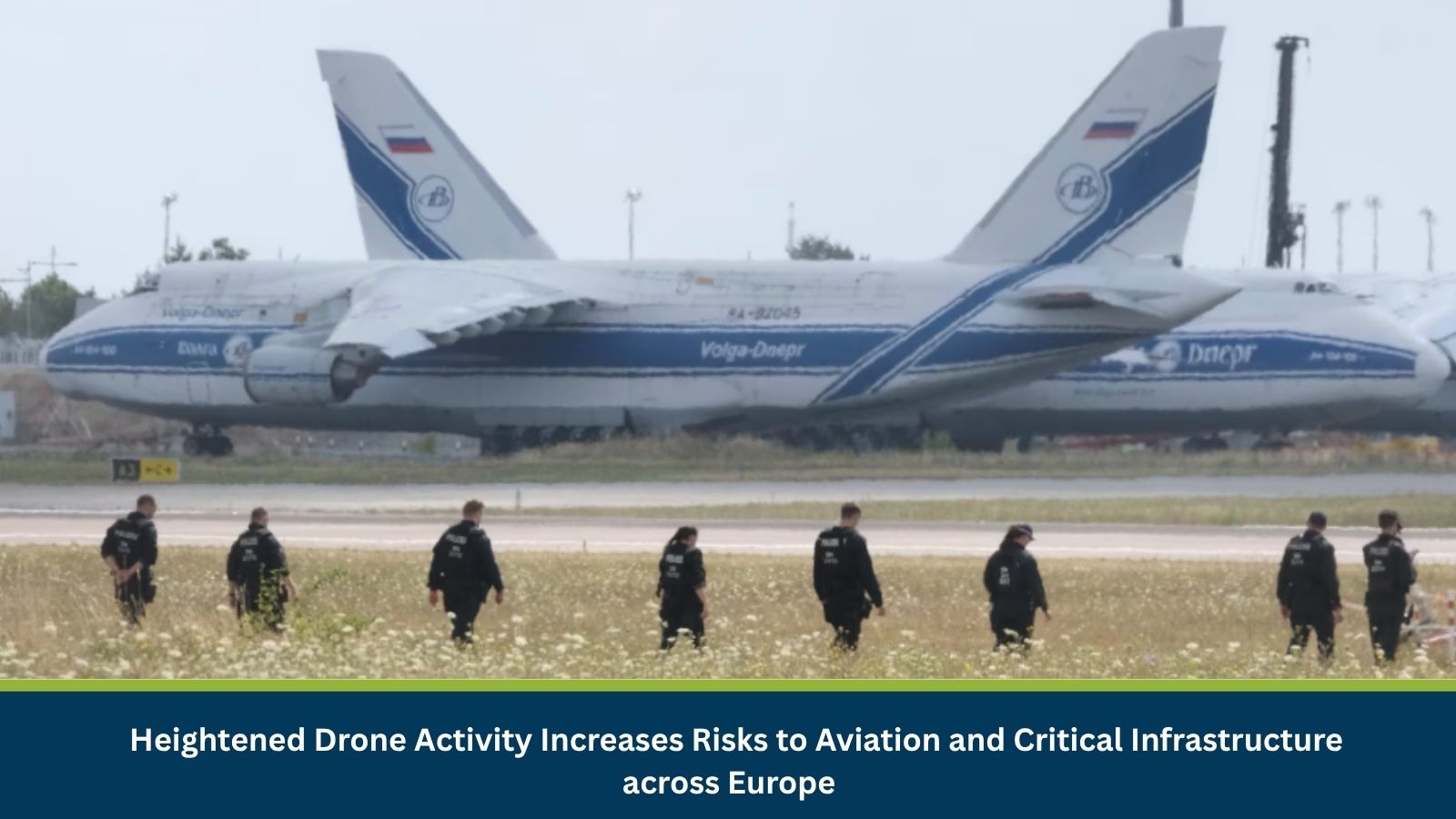
On August 4th, 2026, German authorities found a drone equipped with an improvised explosive device (IED) packed with military grade Semtex and PETN, and a detonator in the security operations area of a Ukrainian An-124 cargo plane near the south runway of Leipzig-Halle airport. The same night, a postal plane had a midair collision with what is believed to be a secondary drone. Ten days later, a third defective drone was found in a field in Kabelsketal, less than 10 kilometres from the commercial airport that services flights to and from Frankfurt-Main, Paris Charles de Gaulle, Anatalya, and 9 other airports. The incident, attributed by Chancellor Friedrich Merz to Russia, has exacerbated diplomatic tensions between the two states with Germany closing the Russian consulate in Bonn and the Russian House Cultural Centre in Berlin. In response, Russia ordered the closure of the German consulate in St Petersberg, with its workers instructed to leave Russia by September 18th. This incident is indicative of a growing trend of drone related disruptions to critical infrastructure across Europe, impacting travel security, business operations and state relations.
Understanding the Growing Trend of UAV Activity across Europe
The International Institute for Strategic Studies (IISS) found evidence of a coordinated Uninhabited Aerial Vessel (UAV) campaign between August 2024 and February 2026, documenting 144 drone sorties into NATO airspace, with increased activity from the latter half of 2025. This report outlines some key instances of this trend below:
- Moldova: On September 9th, 2026, Russian drones hit the Starokozache border crossing between Moldova and Ukraine in the southern region of Odessa, killing 2 and causing a major fire that temporarily halted passenger and vehicular traffic.
- Latvia: On May 7th, 2026, Ukrainian drones were diverted by electronic spoofing into Latvia with one causing a fire at a disused oil storage facility in eastern Latvia. A week later, this incident would force Prime Minister Evika Silina of the New Unity Party to resign. As recently as August 14th, 2026, another Ukrainian drone was shot down over Latvian airspace.
- Romania: On August 20th, 2026, a maritime drone was shot down near Neptun Deep, an offshore gas project. This comes after two separate incidents of explosive laden drones being downed near the town of Galati and port of Constanta respectively.
- Norway: After disruptions to airport service from September 22-23 due to drone sightings in the vicinity, on October 6th, 2025, a pilot reported 3-5 drones upon approach to Oslo Airport, temporarily halting flights again.
- Denmark: In September 2025, drones forced the closure of Copenhagen airport, suspending operations for 4 hours and causing at least 109 flight cancellations.
- Poland: On September 11, 2025, Poland become the first NATO country to shoot down drones heading toward Rzeszow airport, the main NATO base for supplies heading to Ukraine as well as a commercial airport servicing flights to and from destinations such as Antalya, London, Manchester, New York, and Tel Aviv.
- Belgium: Between January 2024 and November 2025, Belgium was the most affected by drone disruptions with 10 separate incidents impacting airport operations.
- Sweden: The Civil Aviation Administration (LFV) reported 5 cases between 2024 and 2025 where air traffic was halted or delayed due to drones.
Brussels’ counter UAV infrastructure continued to suffer from uneven detection, disproportionate responses such as needing to scramble fighter jets to shoot down drones, legal authority fragmentation and slow or no attribution.
UAV activities serve a three-fold purpose. First, reconnaissance and surveillance of critical infrastructure ranging from military instalments to energy facilities. Second, the disruption of civilian airports results in economic and psychological costs by decreasing public confidence in air space security and impacting travel. Third, although unintended, the electronic jamming or GPS spoofing measures that Russia and Ukraine employ to deter one-another has external costs on civilian lives and infrastructure in neighbouring countries where the UAV may land or be re-directed.
Business Impacts
- Direct Operational Costs: First-order costs including cancelled, delayed and diverted flights, and additional shifts for security and operational personnel will be absorbed by airport operators.
- Downstream and Cascading Costs: Freight and logistics operators carry a tighter exposure than airports themselves, particularly where cargo moves through hubs running fixed overnight sorting windows that cannot easily be rescheduled once disrupted, as in the case of time-sensitive cargo such as pharmaceuticals and perishables, and for contracts that carry penalty clauses tied to delivery timing. Businesses operating just-in-time supply chains face indirect exposure as delayed shipment can affect production schedules or stock availability at a later point in the supply chain.
- Business travel and Executive Exposure: For organisations routing staff through affected airports, the relevant cost driver will likely be the value of time lost that was scheduled around a critical negotiation, site visit, or time-sensitive deployment.
- Reputational and Customer Trust Cost: Repeated incidents at the same site may gradually impose reputational costs, influencing how freight clients and corporate travel buyers weigh route reliability in their planning, with effects typically visible in routing and contracting decisions over successive quarters rather than immediately after a singular disruption.
- Insurance and Risk Transfer Cost: For the purpose of preventing friction in claim-making later, organisations should explore the coverage of their business interruption and aviation war risk policies which may not have been drafted with this risk profile in mind and may lack specificity on the treatment of a short, unattributed drone incident where intent cannot be established or government-led investigations end without a definite conclusion.
Travel and Employee Safety Risks
Despite increased intensity of these incidents, the likelihood of escalation to physical damage in Western Europe is low, with the main risk to travellers transiting through airports remaining operational delay. Suspended or delayed flights associated with the pause of airport operations and airspace closure due to UAVs are not included in disruptions entitled to compensation under EU air passenger rights since they are classified as extraordinary circumstances arising from security risks and air traffic management decisions.
Beside direct disruption in the form of flight diversions, cancellations or overnight stranding, travellers may also face knock-on congestion at diversion airports, and reduced availability coupled with increased price of alternative flight tickets, especially during peak travel season. However, in NATO countries sharing a border with Russia and Ukraine, escalation to physical risk due to spillover is probable, and not limited to critical infrastructure sites.
The unpredictable and short-notice nature of this risk poses a new and evolving challenge to corporate travel programs and their duty-of-care frameworks. This is where Datasurfr’s new Travel Safety interface fills in the gaps. By tracking drone related incidents in real time, categorising them under External Threats, Extremism, Travel Risk or Critical Infrastructure dimensions depending on the initial target and eventual impact of drone activity, Datasurfr allows near-real time intelligence and an interface to connect your Travel Security team with their travellers in foreign airports or on diverted flights facing such disruptions.
What Businesses Should Monitor
- Proximity to sensitive co-located sites: Across several instances (including in Germany, the Netherlands, and Poland), the likelihood of multiple drone sightings and airport disruption increases when the facility either operates both civilian and military flights, or regularly services shipments to Ukraine. Likewise, critical infrastructure, such as power plants or border crossings, near the Russian or Ukrainian border also has a higher likelihood of experiencing ISR activities.
- Cross-border sequencing: Datasurfr’s geo-fence alert system allowed mapping of disruptions affecting nearby airports concurrently, as seen with parallel UAV activities in Denmark and Norway.
Conclusion
The Leipzig-Halle incident, involving devices found on airport grounds rather than detected in the sky, provides a new characteristic to how drone activity is manifesting in Europe. It is part of a broader trend, from German national air navigation service provider recording a ~40% increase in drone-related disruption to similar activity being reported across Belgium, Denmark, Finland, Norway, Poland, Sweden and Spain.
For travellers, the impact is typically a short notice delay that can extend to secondary hubs. For infrastructure and aviation providers, the risk profile has broadened. These developments suggest that real-time situational intelligence is becoming increasingly more important and useful than static risk assessments for this category of threat.
Stay ahead of Europe’s evolving drone threat. Book a demo to explore how Datatsurfr delivers real-time intelligence alerts, travel risk management and infrastructure resilience insights.