





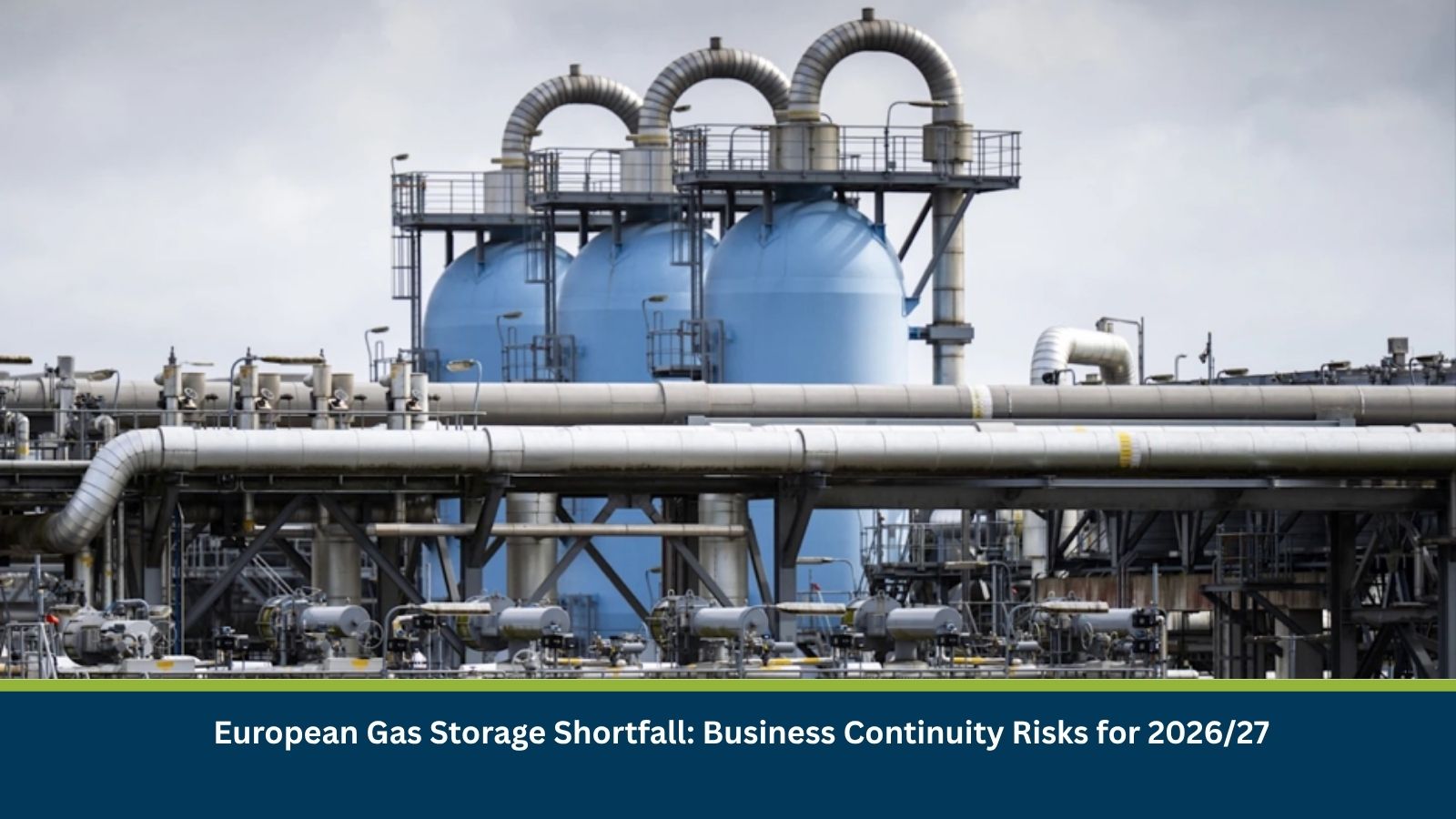
European Gas Storage Shortfall: Business Continuity Risks for 2026/27
After a historically long and cold winter, the European Union entered the storage injection period at 28% capacity, reaching an average of 48% in June, according to Gas Infrastructure Europe (GIE). With September levels at 65%, European gas storage facilities are at their lowest level toward the end of the summer in at least 15 years. According to Bloomberg models, catching up to the non-binding customary target of 90% in recent years would require adding more than 100 terawatts of gas equivalent to more than 7 billion euros with current rates. While European gas buyers had once bet on an end to the Iran war allowing prices to drop and a resumption of imports from Qatar, the world’s second largest exporter of LNG, the protraction of the conflict and continued stalemate for shipping in the Strait of Hormuz is a realistic possibility.
The European Energy Crisis of 2022 and Continued Geopolitical Risk Exposure
Prior to the Russian invasion of Ukraine in February 2022, Russia supplied ~40% of EU gas imports. After progressive flow cuts (including the Nord Stream 1 shutdown and, in September 2022, the Nord Stream 1 and 2 pipeline sabotage), the EU moved to phase out Russian energy imports through the REPowerEU Plan, storage targets, price caps, windfall taxes, fiscal support and diversification through LNG contracting to the US, Qatar and Norway. Although gas spiked to 324 euros/MWh, Europe did not have to resort to physical rationing due to a combination of a mild winter, demand reduction measures and successful storage refilling. The closure of the Strait of Hormuz and increased differences between European leaders, Brussels and the US administration have exposed how diversification measures have not sufficiently de-risked the procurement sources and supply chains essential to European energy security.
Potential Winter Scenarios and Strategic Implications
European energy consumption will be largely influenced by demand generated by potential weather with implications for governments, businesses, and consumers.
After a record-breaking hot summer, there is a realistic possibility that the continued El Nino effect ushers a mild winter. Under near normal or warmer temperatures and reduced EU gas demand driven by renewables growth and industrial efficiency gains, a storage fill near the projected 75 percent by November would likely prove sufficient to meet demand without triggering formal curtailment. In this scenario, businesses face cost pressure, not operational disruption. Manufacturers should budget TTF prices above historical norms with Procurement and Treasury teams prioritizing hedging over outage planning.
In a realistic alternative scenario, a sustained cold spell arriving before storage completes its seasonal decline curve would test Europe’s thinner buffer directly. States with smaller storage-to-demand ratios, including Belgium, Poland and Spain, could approach emergency thresholds faster than usual. Under EU emergency gas plans, industrial curtailment would activate before household supply is affected, placing large industrial consumers, including chemicals, steel and cement producers, first in line for demand-reduction orders. This scenario would shift the risk from pricing to operations. Exposed companies should model production stoppage directly, confirm whether existing insurance covers government-mandated curtailment, and map upstream supplier exposure, since a supplier’s curtailment can disrupt production even where a company’s own facility is untouched. A parallel diesel shortage would compound the risk further.
The EU is unlikely to face outright shortages, possessing the capacity to outbid other buyers on the global LNG market but doing so at a premium carries political costs, including pressure on household energy bills and disagreement among member states over burden-sharing. If this winter draws stocks down further than usual, the EU could enter next year’s restocking cycle, one already categorized by key elections across France, Germany, Poland and 8 other states, with an even bigger gap to close.
Implications for Businesses and Operations
The consequences of a tighter winter span several distinct risk domains. On critical infrastructure, companies in curtailment-exposed sectors and countries face genuine operational risk, from production stoppages to disrupted supplier networks. Facilities in tight-storage states should confirm backup power and generator fuel arrangements are current; given diesel supply is under separate strain alongside gas this season. Cold-weather infrastructure, particularly aging facilities in regions unaccustomed to prolonged severe cold, also carries elevated risk of equipment failure if heating is curtailed.
Environmental conditions remain the swing factor throughout, since the difference between the mild and cold scenarios outlined above rests entirely on weather that cannot yet be forecast with confidence.
On the political and regulatory side, EU and member-state responses, including how the burden of a premium-priced LNG market is shared, will shape compliance obligations and market conditions for the rest of the season. Should household energy bills rise sharply alongside industrial curtailment, businesses may face civil disturbance risk, echoing the windfall-tax debates of 2022, alongside reputational exposure for companies perceived as passing costs disproportionately onto consumers. Energy scarcity has also historically correlated with increased targeting of energy infrastructure by state and non-state actors, warranting a refreshed technology/cyber posture for any facility with SCADA or OT systems tied to gas or power supply. There is also medium physical and reputational security risk posed by the realistic possibility of political sabotage by climate activists against companies heavily linked to fossil fuels. Finally, continued war risk in the Strait of Hormuz underpinning the Qatar LNG shortfall, means the risk picture remains sensitive to developments outside European jurisdictions.
Recommendations
- Monitor storage trajectory and TTF pricing by country, not EU-wide averages alone, given the disparity across member states
- Map upstream supplier exposure to curtailment risk, particularly for suppliers in Belgium, Poland and Spain
- Refresh cyber/OT threat assessments for infrastructure tied to gas or power supply
- Prepare stakeholder communications in advance of potential price-driven public scrutiny
- Plot owned facilities and key supplier sites against real-time risk data for location-specific alerts as conditions change
Stay Ahead of Threats with Datasurfr Predict
MitKat’s Datasurfr Predict delivers accurate, real-time, and contextualised data to help organisations respond swiftly to physical, environmental, and cyber threats.
With Sam AI, our AI Agent not only provides context for unfolding events but also analyses vetted historical data to forecast how events are likely to evolve and their potential impact using industry and location-specific probabilistic scores.
Book a free demo today and see how Datasurfr Predict can transform your risk preparedness.