





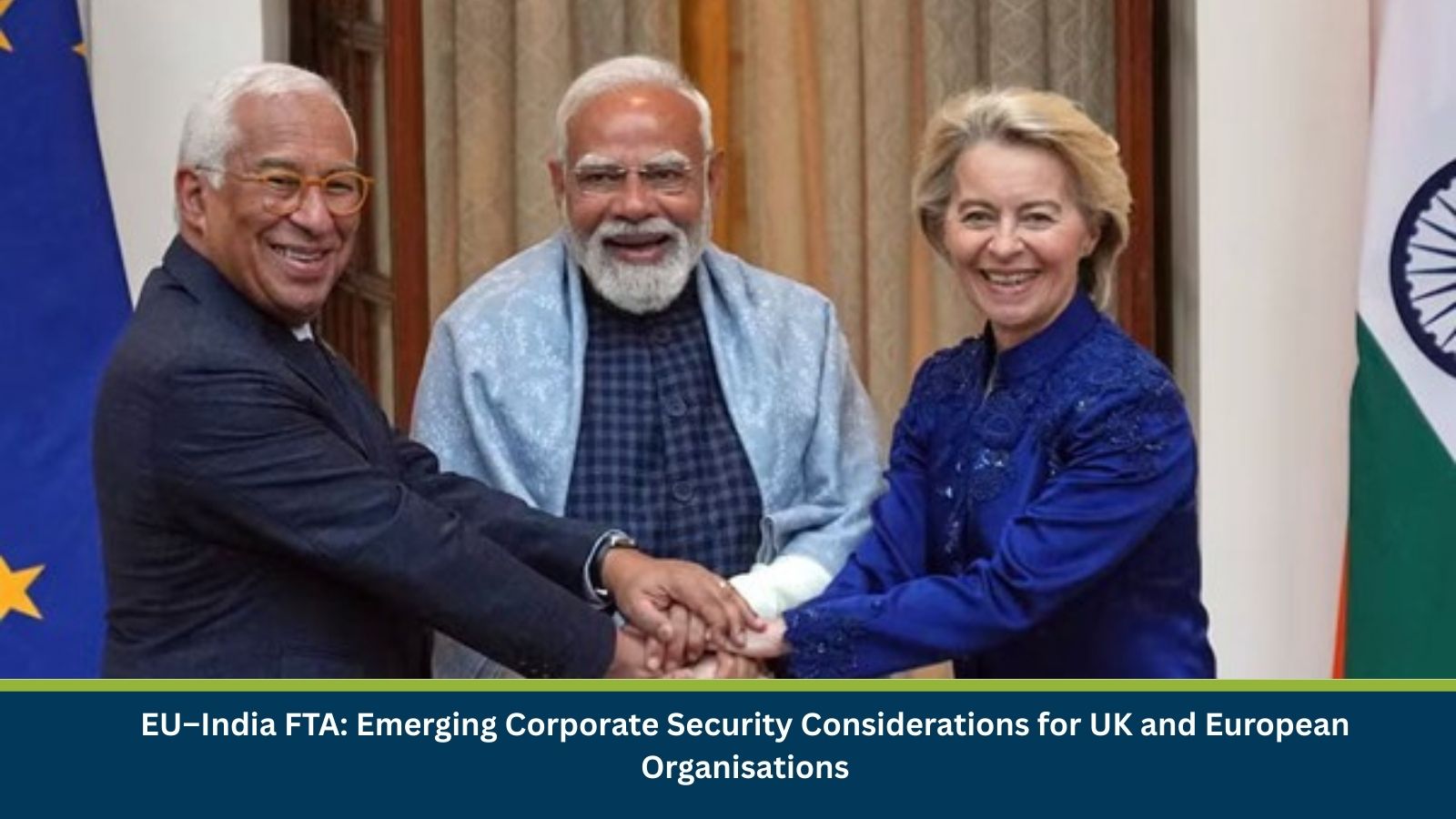
Viewing EU–India Economic Alignment Through a Security Lens
The Free Trade Agreement between the European Union and India has been described by policymakers as the “mother of all deals”, a reflection of both its economic scale and strategic ambition. Much of the public discussion focuses on tariffs, market access, and strategic cooperation.
Less attention is given to how the EU–India FTA may influence corporate operating environments – particularly for organisations headquartered in the EU or operating across Europe. From a corporate security perspective, the agreement signals deeper interdependence, bringing new expectations around governance, resilience, and risk ownership.
Why the EU–India FTA Matters Beyond Trade
As negotiations progress, the EU–India FTA is expected to accelerate cross-border business activity, professional mobility, and supply-chain integration. For many organisations, this changes how security risks materialise and how they must be managed.
Greater economic connectivity means security risks increasingly span jurisdictions. Duty of care, regulatory compliance, data governance, and third-party exposure become interconnected rather than regionally contained. This is particularly relevant for UK and European organisations expanding operations or partnerships linked to India.
The European Commission has outlined the scope and ambition of the agreement within its trade policy publications, while the UK Government continues to position India as a priority economic partner in its post-Brexit trade strategy. Guidance from the World Trade Organization also highlights how trade agreements interact with national regulatory authority.
Key Security Implications Emerging from the Agreement
Workforce Mobility and Cross-Border Duty of Care
One of the most immediate effects of the EU–India FTA is increased professional and talent mobility. While this supports growth, it also introduces new security considerations, including:
- Insider risk across multiple jurisdictions
- Identity assurance and access control consistency
- Employee safety and duty of care obligations outside Europe
For UK and European employers, mobility must be supported by security frameworks that scale across borders rather than rely on localised controls.
Regulatory Complexity in a Partially Aligned Environment
Although the EU–India FTA aims to reduce friction, regulatory regimes will remain distinct. Organisations must continue to navigate differences in:
- Data protection and monitoring requirements
- Incident response expectations
- Compliance accountability and reporting
As a result, security teams are increasingly required to work closely with legal, privacy, and enterprise risk functions to ensure decisions remain defensible across jurisdictions.
Geopolitical Context Shaping Corporate Threat Landscapes
Trade agreements do not exist in isolation. The EU–India FTA sits within a broader geopolitical environment that can influence corporate exposure. Organisations may experience:
- Increased cyber interest linked to strategic sectors
- Heightened reputational and activism-related risks
- Greater scrutiny of supply-chain and third-party relationships
For UK and European organisations, geopolitical awareness must be embedded into enterprise security planning rather than treated as an external concern.
Governance and Accountability for UK and European Boards
The implications of the EU–India FTA increasingly surface at board level. Questions around ownership, oversight, and accountability become harder to delegate when risks span multiple jurisdictions.
For organisations operating across the United Kingdom and the EU, this often requires clearer governance models that define who owns cross-border security risk and how decisions remain defensible under differing regulatory expectations.
Final Thoughts?
The EU–India FTA will rightly be viewed as a significant economic and strategic development. For corporate security leaders, however, it also represents an operational shift.
As integration deepens, organisations that proactively reassess governance, mobility frameworks, and geopolitical exposure will be better positioned to support growth without accumulating unmanaged risk. Translating trade alignment into practical security strategy will be a critical capability for UK and European enterprises in the years ahead.
At MitKat, we support organisations across the UK and Europe in understanding how developments such as the EU–India FTA affect corporate security, governance, and risk accountability.
If your organisation is navigating cross-border expansion, regulatory complexity, or geopolitical exposure, MitKat can help you develop clear, defensible security strategies aligned to today’s operating environment.
Get in touch to explore how we can support your risk leadership agenda.