





Executive Summary for Chuseok Holiday Traffic Across South Korea
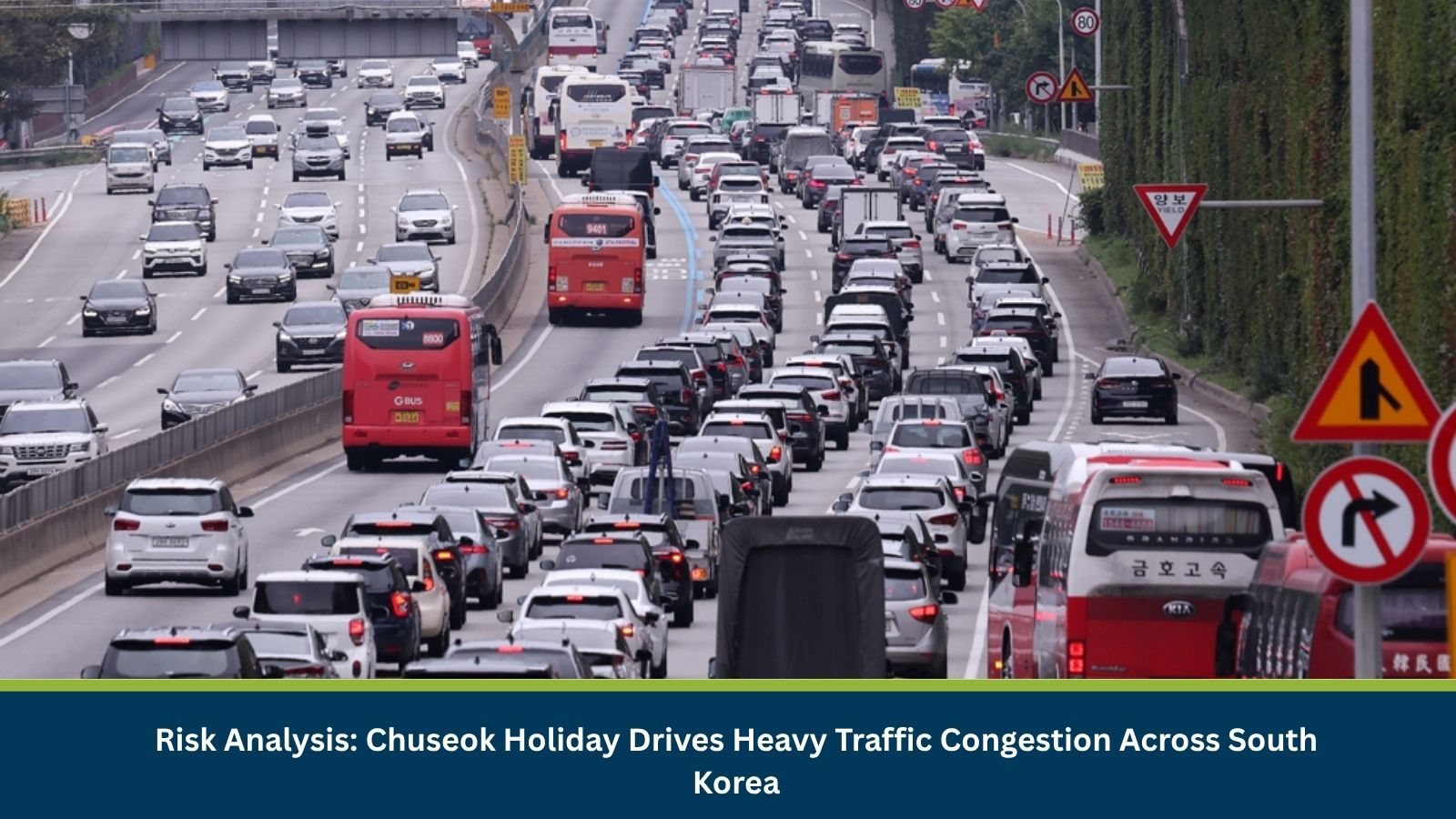
South Korea is experiencing significant traffic congestion on Thursday, 24 September, the first day of the four-day Chuseok holiday. Large numbers of people are travelling from the Seoul metropolitan area towards their hometowns, resulting in heavy congestion on major expressways. As of 0700 hours local time on 24 September, estimated road travel times were approximately 10 hours 30 minutes from Seoul to Busan, nine hours 30 minutes to Gwangju, 10 hours 20 minutes to Mokpo and six hours 10 minutes to Gangneung. Traffic heading away from the capital is expected to peak between 1100 and 1300 hours local time, while congestion is forecast to ease from around 2000 hours.
- Date of Event: 24 September 2026
- Location: South Korea, particularly major expressways departing the Seoul metropolitan area
- Risk Category: Travel Risks
- Severity Score: 3/5
- Confidence Level: 80%
What is Risk Analysis in the Context of Travel Risk Events
Travel risk analysis assesses the impact of large-scale holiday travel and their impact on traffic conditions. The holiday travel can place substantial pressure on road infrastructure, resulting in longer journey times, congestion at highway junctions and delays to scheduled road-based movements. During Chuseok, the effect extends across major intercity routes connecting Seoul with regional cities.
Known Hotspots and Sensitive Areas
High Impact
- Gyeongbu Expressway, particularly southbound routes towards Busan.
- Seohaean Expressway, including the Seopyeongtaek Junction and routes towards Mokpo.
- Seoul–Yangyang Expressway, with increasing traffic towards Yangyang.
- Routes connecting the Seoul metropolitan area with Busan, Gwangju and Mokpo.
Medium Impact
- Major highways connecting Seoul with other regional destinations.
- Routes approaching major junctions and interchanges during the peak travel period.
Low Impact
- Local roads outside the main intercity travel corridors are expected to experience comparatively lower direct disruption.
Impact on Transportation and Services
The Korea Expressway Corporation expects approximately 6.16 million vehicles to use South Korean roads on 24 September, including around 510,000 vehicles travelling from the Seoul metropolitan area to other regions. Regional-to-capital traffic is also expected to reach approximately 380,000 vehicles. The congestion may affect employee commuting, commercial road movements and time-sensitive deliveries. Rail stations and airports are also expected to experience increased passenger volumes during the extended holiday period.
Recommended Actions
- Allow significant additional journey time for intercity road travel.
- Businesses should factor potential delays into scheduled deliveries and employee movements.
- Monitor live highway conditions before undertaking time-sensitive journeys.
- Consider rail or other public transport alternatives where operationally feasible.
Emergency Contacts
- Emergency Services: 112
- Fire and Ambulance: 119
Final Thoughts
Chuseok travel is generating substantial congestion across South Korea on 24 September, particularly on major routes connecting Seoul with southern and eastern regions. Businesses and travelers using these corridors should anticipate extended journey times throughout the holiday period. Leveraging MitKat’s Datasurfr enables businesses to receive real-time intelligence, monitor evolving threats and make informed decisions to protect people, assets and operations.