





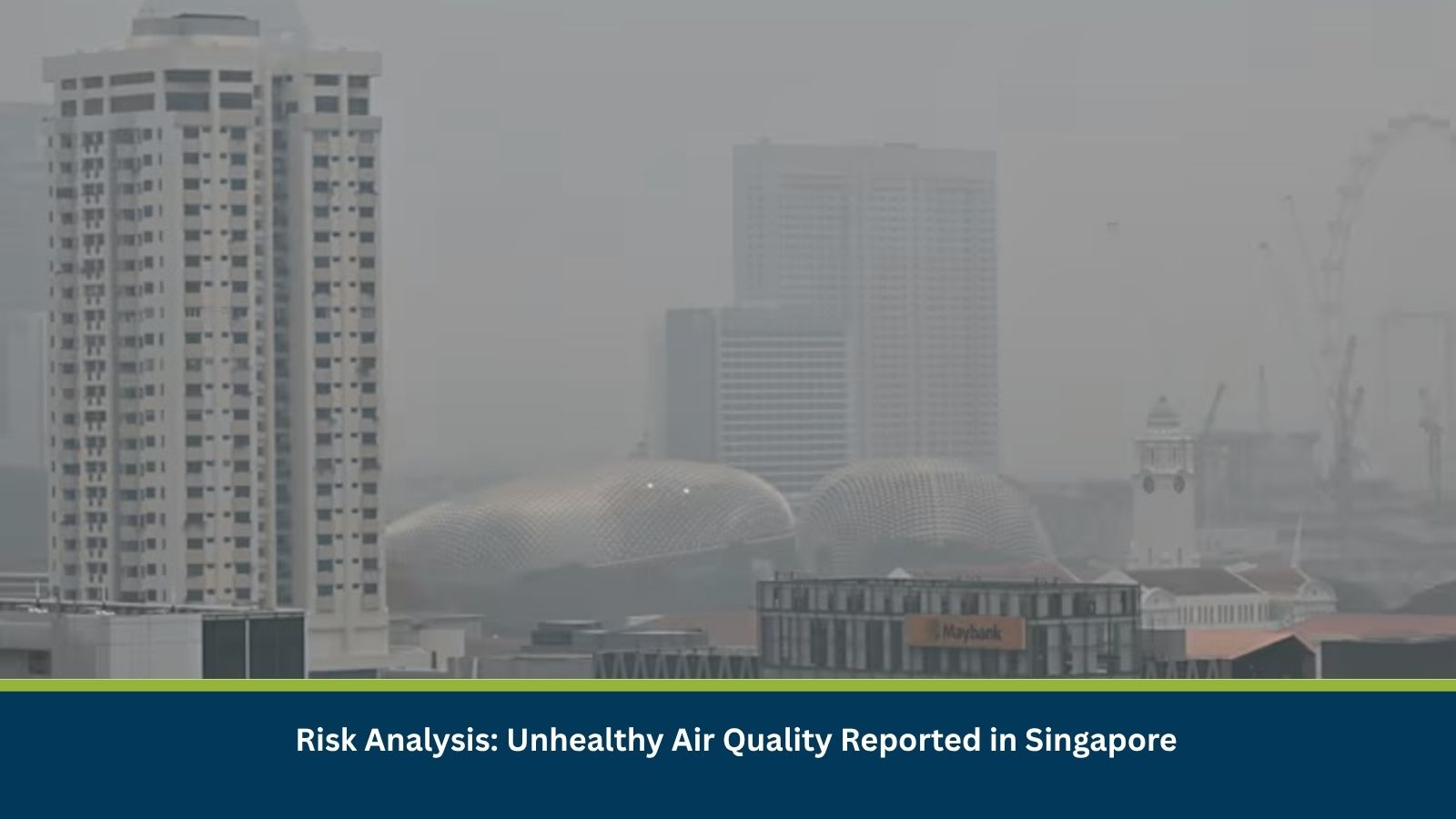
Executive Summary for Unhealthy Air Quality in Singapore
Unhealthy air quality was reported across central, eastern and western Singapore on 07 October, with the 24-hour Pollutant Standards Index (PSI) reaching 130 in central Singapore, 118 in the east and 117 in the west at 0700 hrs. One-hour PM2.5 readings were also elevated at 68, 61 and 85 respectively. Northern and southern Singapore remained in the moderate range, with PSI readings of 99 and 97. The National Environment Agency (NEA) attributed the haze conditions to smoke plumes from southern Sumatra and West Kalimantan, with dry conditions and prevailing southeasterly winds supporting the continued movement of smoke towards Singapore. NEA’s latest regional update indicates that the haze situation is likely to remain elevated over the coming days.
- Date of Event: 07 October 2026
- Location: Singapore, particularly central, eastern and western regions
- Risk Category: Environment
- Severity Score: 3/5
- Confidence Level: 75%
What is Risk Analysis in the Context of Environment Events
Environmental risk analysis assesses how weather incidents like elevated concentrations of pollutants such as fine particulate matter can affect public health, outdoor operations, transport visibility and business activity. The 24-hour PSI is used to assess air quality for planning, while one-hour PM2.5 readings provide a more immediate indication of exposure conditions. Singapore classifies PSI readings of 101–200 as unhealthy.
Known Hotspots and Sensitive Areas
High Impact
- Central Singapore: PSI 130 at 07:00, placing the region in the unhealthy range.
- Western Singapore: PSI 117, with the highest reported one-hour PM2.5 reading among the three affected regions at 85.
- Eastern Singapore: PSI 118, with elevated PM2.5 at 61.
Medium Impact
- The haze is affecting Singapore more broadly, although the north and south remained within the moderate PSI range at the time of the morning assessment.
- Outdoor workers, commuters and businesses dependent on prolonged outdoor activity may experience increased exposure during periods of elevated PM2.5.
Low Impact
- No major disruption to Singapore’s transport network or essential infrastructure has been reported as a direct result of the current haze conditions.
- Indoor commercial and office operations are expected to face comparatively limited direct disruption, although businesses may need to modify outdoor activities if air quality deteriorates.
Impact on Transportation and Services
The immediate impact is primarily related to public health and outdoor activity rather than infrastructure disruption. Prolonged exposure to unhealthy air can affect outdoor workers and individuals undertaking strenuous activities. Reduced visibility from haze may also create secondary concerns for road users and outdoor operations if conditions worsen.
Recommended Actions
- Businesses should monitor the latest PSI and one-hour PM2.5 readings before scheduling prolonged outdoor activities.
- Outdoor workers should reduce strenuous activity when pollution levels rise.
- Employers should consider adjusting outdoor work schedules if unhealthy conditions persist.
- Individuals in vulnerable groups should minimize prolonged or strenuous outdoor activity during unhealthy PSI conditions.
- Companies with outdoor events or large gatherings should monitor NEA advisories and prepare contingency measures if haze levels deteriorate.
- Maintain awareness of regional fire and haze conditions in Sumatra and Kalimantan, as continued smoke movement could prolong the situation.
Emergency Contacts
- Singapore Police Force: 999
- Singapore Civil Defense Force / Emergency Ambulance: 995
Final Thoughts
Singapore is currently experiencing localized unhealthy air quality concentrated across the central, eastern and western regions. While there is no indication of major infrastructure or transport disruption at present, continued smoke movement from Sumatra and Kalimantan means conditions could persist or worsen, particularly if dry weather continues. Leveraging MitKat’s Datasurfr enables businesses to receive real-time intelligence, monitor evolving threats and make informed decisions to protect people, assets and operations.