





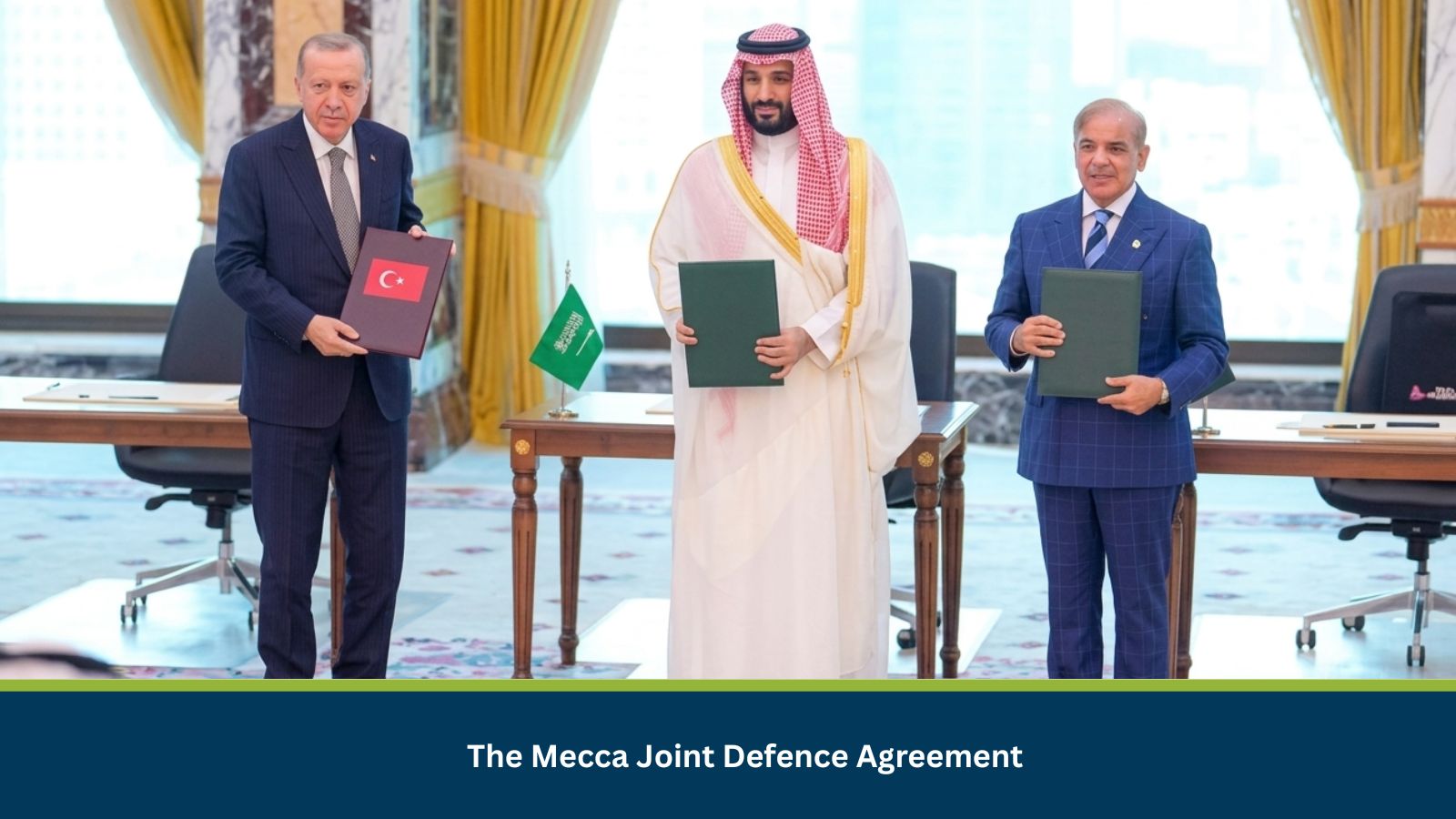
On 7th August 2026, Saudi Arabia, Turkey and Pakistan signed a landmark defence agreement in Mecca, Saudi Arabia, creating a collective defence framework under which an attack on any one signatory is treated as an attack on all three. Turkish Foreign Minister Hakan Fidan has described the framework as technically comparable to NATO’s Article 5, though all three governments insist the arrangement is purely defensive and does not target any specific country.
The pact builds on the Saudi-Pakistan Strategic Mutual Defence Agreement signed in September 2025. Saudi Arabia anchors the Gulf side, Pakistan contributes a South Asian military link and nuclear deterrent, and Turkey brings advanced drone, electronic warfare and cyber capabilities. Together, this new military coordination framework covers joint exercises across land, maritime, aerial and cyber domains, alongside cooperation in unmanned systems, artificial intelligence and defence industry technology transfer.
The timing of this defence agreement is closely tied and driven by the ongoing US-Iran conflict, which has put pressure on Saudi energy infrastructure and Gulf shipping routes. By building a trilateral defence agreement, Saudi Arabia is diversifying its defence partnerships rather than relying on a single external power, while also building defence capabilities against nuclear, aerial and maritime threats.
For India, this defence agreement holds particular significance. Pakistan now has a formal security relationship with two influential regional powers, potentially giving Islamabad added diplomatic leverage during future tensions with New Delhi. However, Saudi Arabia’s bilateral trade ties with India which amounts to nearly $43 billion makes direct Saudi Arabia’s involvement in India-Pakistan conflict unlikely. Saudi Arabia is expected to stay neutral rather than actively backing Pakistan under this defence agreement.
Compared with NATO, this defence agreement is still institutionally shallow. It has three members whereas NATO has 32. Analysts see this trilateral defence agreement as an early-stage security cooperation agreement whose real significance depends on whether it succeeds in creating permanent military cooperation, intelligence sharing arrangements and regular trilateral exercises.
For MNCs, the agreement is about the slow reshaping of regional risk and its impacts. Companies with Gulf and Red Sea linked supply chains should watch for rising insurance premium, airspace restrictions and shipping delays, while defence, aerospace, cyber and infrastructure related businesses may find new opportunities as Saudi Arabia pursues localization through this defence industrial cooperation.
In conclusion, the Mecca framework signals a broader shift toward a multipolar security order in the Middle East and South Asia. The potential of the agreement will depend on how Saudi Arabia, Turkey and Pakistan implement its provisions in the months ahead. It is a development every regional stakeholder and global business should be tracking closely for minimal loss and maximum benefit.