





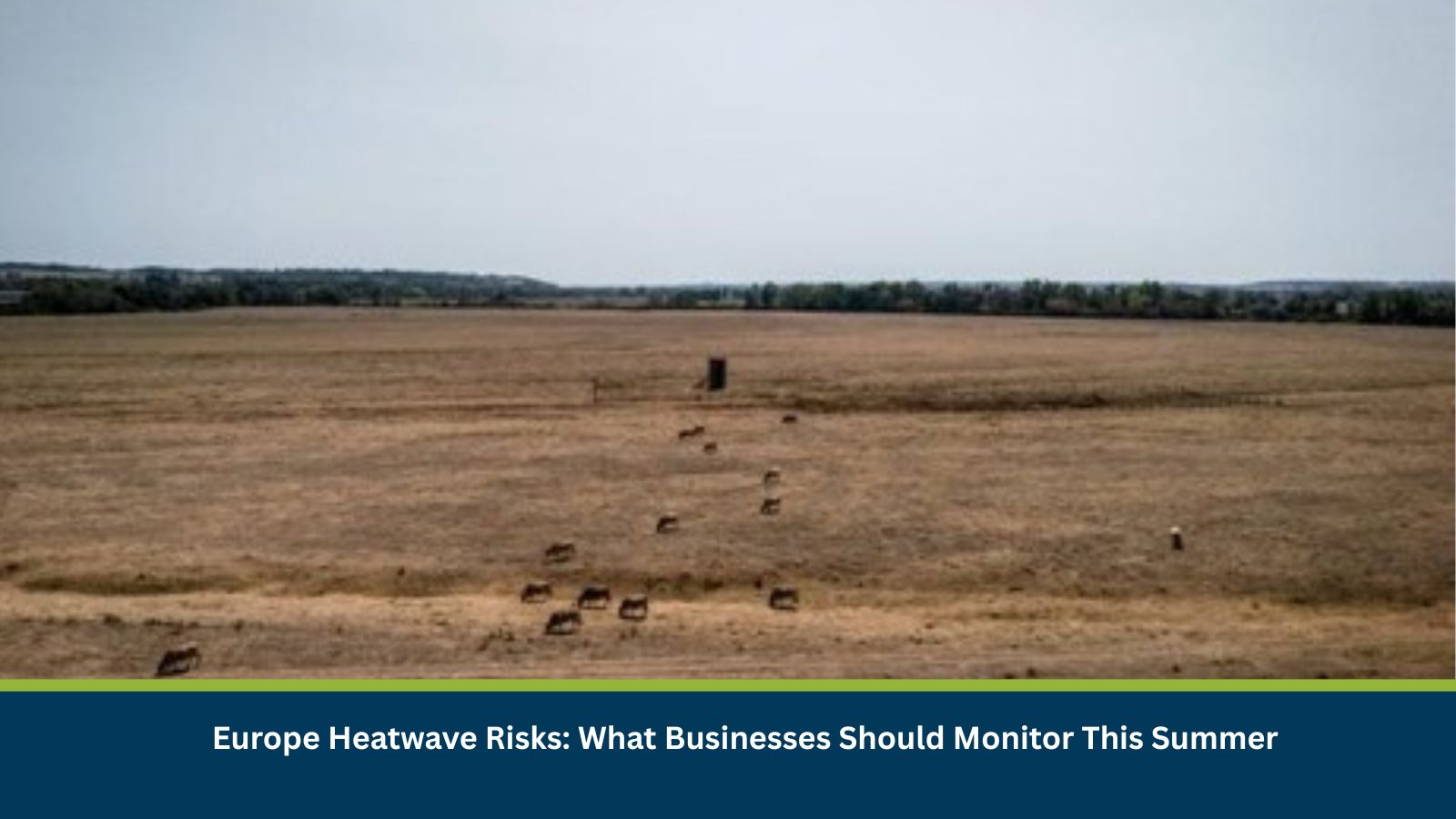
Europe Heatwave Risks: What Businesses Should Monitor This Summer
May 2026 gave Europe its hottest start to summer in recent years. The UK reached a 35.1°C may record, and Portugal hit 40.3°C. France, Spain and Germany also broke records. July and August are expected to bring worse heat, and the World Meteorological Organization sees near-record global temperatures lasting through 2030. For business, this is a continued operational risk. Heat at this level hits the workforce, travel, supply chains and energy costs simultaneously.
Why Heatwaves Now Disrupt European Business The overall economic cost is severe. A July 2025 study by Allianz Research estimated that recent heatwaves cut European GDP by around 0.5 percentage points. Each day above 32°C, it found, did about as much damage as half a day of labour strikes. That makes extreme heat a serious business continuity concern, which requires planning and action.
Primary Heatwave Risks for European Companies
Workforce Health and Productivity
Heat takes a toll on the workfroce. Long hot spells bring fatigue, dehydration and heat illness, which increases absences and safety incidents, and labour output drops as well. The same Allianz study found that the ability to do physical work falls by about 40% at 32°C, and by two-thirds at 38°C. Construction, manufacturing and logistics are most impacted, as well as any work done outdoors or without AC. For companies there are two risks to manage here: a legal duty to keep staff safe, and the lost labour productivity.
Travel and Employee Safety Risks
Heat also breaks the transport networks that move staff and goods. Rail operators in France and Britain have cancelled trains and cut speed limits as tracks warp and overhead lines sag. In one single year heat-buckled rails cost UK passengers more than 350,000 minutes in delays. Road traffic is impacted as well, because of the heat waves surfaces can break up and collision risk rises by an estimated more than 1% per degree. Airlines sometimes have to lighten loads or cancel. The result for a business is late staff, disrupted trips and deliveries, which makes travel risk management a priority during heat waves.
Supply Chain and Energy Disruption Finally, supply chains face multi-directional pressure. On rivers like the Rhine, low water severely drops barges capacity, which raises freight costs and pushes cargo onto already busy roads. Especially perishables are the weak point: for fresh produce and medicines a 1°C change can cut shelf life in half. Energy gets more expensive at the same time. In the 2025 heatwave, daily power prices doubled or tripled, and French nuclear plants had to cut output because the river water meant to cool them was too warm.
How European Businesses Should Respond to Heatwave Risks
Most of these risks can be planned for. It starts with knowing what’s coming: heat-health warnings, transport advisories, grid alerts and the state of cold storage. From there, three things make the biggest difference:
• Protect the workforce: reschedule shifts away from peak heat, require hydration breaks, and provide shade and cooling equipment.
• Upgrade infrastructure: install efficient cooling and HVAC, service equipment to prevent overheating, and add cold-storage capacity to limit spoilage.
• Build supply chain buffers: spread suppliers across regions and hold extra stock of critical inputs to absorb heat-driven delays.
Frequently Asked Questions (FAQs)
How do heatwaves affect business continiuity in Europe?
Heat affects several areas at once: lower workforce productivity, higher health and absence risk, disrupted rail, road and air travel, strained supply chains, and higher energy costs.
Which industries are most exposed to heatwave risk?
Construction, manufacturing and logistics are most exposed, as much of the work is outdoors or non-air-conditioned. Food, pharmaceuticals and other cold-chain sectors are also vulnerable, along with retail and hospitality, which lose customers in extreme heat.
How can companies prepare for extreme heat?
Start with real-time monitoring of heat warnings, transport advisories and grid alerts. Then protect staff with rescheduled shifts and cooling, upgrade cooling and cold-storage infrastructure, and build supply chain buffers for heat-driven delays.
Conclusion
Extreme heat is now a fixed part of the European summer. It reaches staff, transport, supply chains and energy costs all at once, and 2026 has already broken records with more still to come. The companies that handle it best will be the ones watching the risk and preparing early, rather than scrambling once the temperature spikes.
Want to stay ahead of extreme-weather and climate risk across Europe? See how Datasurfr supports enterprises with real-time threat intelligence, OSINT risk intelligence, travel risk management and business continuity insight. Book a demo today.