





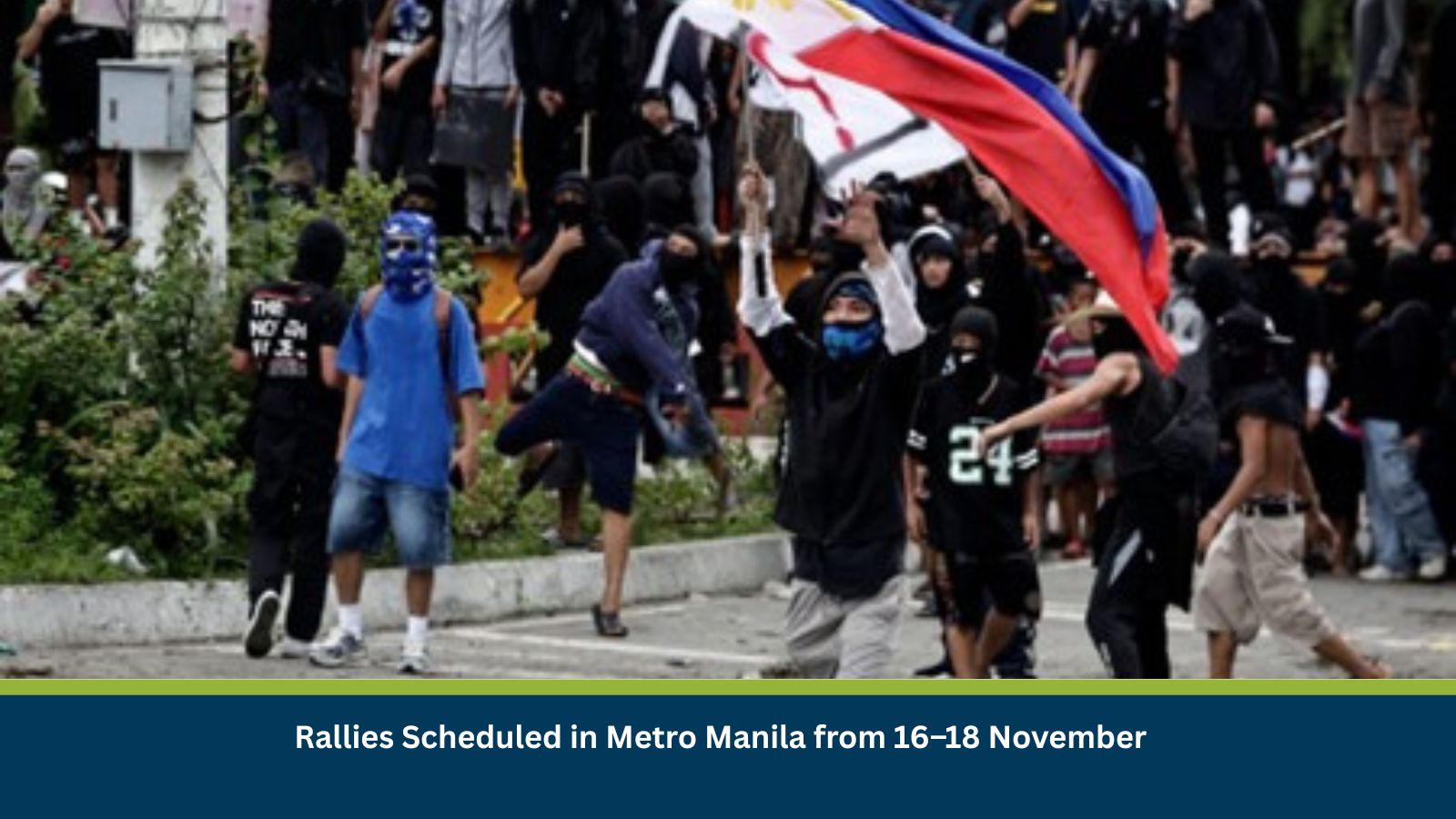
What is Risk Analysis in the Context of Civil Disturbance Events
Civil-disturbance risk analysis assesses threats arising from public assemblies that may escalate into unrest, violence, or property damage. In the Philippines, large rallies often involve significant police deployment due to prior incidents of clashes, stampedes, and targeted attacks. This analytical approach is crucial for anticipating disruptions, safeguarding personnel, and maintaining continuity in dense urban areas such as Metro Manila, where protest activity frequently intersects with critical commercial and transport hubs.
Executive Summary
- Date of Event: 16 November 2025
- Location: Metro Manila, Philippines
- Risk Category: Civil Disturbance
- Severity Score: 4 / 5
- Confidence Level: 85 %
Scheduled rallies from 16–18 November carry high-severity risks due to credible intelligence reports of infiltrators and potential grenade attacks. Historical precedent, including violent protest clashes and large-scale religious mobilisations, underscores the likelihood of severe travel disruption, safety threats, and business interruption. Impacts are expected throughout the three-day period, with residual effects on mobility and operations extending into 19 November.
Known Hotspots and Sensitive Areas
High Impact:
Luneta (Rizal Park), Mendiola, Roxas Boulevard, Taft Avenue, Quirino Avenue.
These areas have recurrent large-scale gatherings, police clashes, and heightened security activity.
Medium Impact:
Ermita, Malacañang surroundings, P. Ocampo Street, M. Adriatico Street.
Risk includes crowd spillovers, dense foot traffic, and extended checkpoints.
Low Impact:
Peripheral business districts and non-rally zones across Quezon City and Pasig, where impacts are largely limited to traffic congestion.
Past events show that political anniversaries, religious assemblies, and policy-related protests often attract large, diverse groups, raising the likelihood of escalation.
Impact on Transportation and Services
Major road closures across Manila will likely cause severe traffic congestion, particularly near Roxas Boulevard, Taft Avenue, and Quirino Avenue. Public utility vehicles may be rerouted or suspended, delaying commutes and hindering staff movement. Businesses may face reduced customer access, late deliveries, or temporary closures. Network congestion is possible around rally zones due to high device usage, though no direct threat to core IT systems is anticipated.
Recommended Actions
Immediate Measures:
- Implement work-from-home arrangements for non-essential staff from 16–18 November.
- Activate secure transport protocols for essential personnel and enforce avoidance of rally hotspots.
- Strengthen access control, conduct facility sweeps, and elevate security vigilance in light of grenade-threat intelligence.
Strategic Measures:
- Update business continuity plans, focusing on supply chain redundancy and alternative routing.
- Maintain proactive communication with clients and partners regarding delays.
- Coordinate with security agencies for timely intelligence and operational readiness.
Multidimensional Impact
Rallies may compound congestion already addressed under Metro Manila’s holiday-season traffic measures. Outcomes of the 16–18 November events could influence public sentiment and security posture ahead of future demonstrations later in the month.
Emergency Contacts
- National Emergency Hotline Number: 911
- Bureau of Fire Protection: (02) 8426-0246
- MMDA Traffic Hotline: 136
Final Thoughts
The rallies present elevated and credible civil-disturbance risks requiring a proactive, coordinated response. Early-warning systems, structured communication channels, and platforms such as MitKat’s Datasurfr can significantly enhance situational awareness and operational resilience during this three-day period. Stay ahead of operational risks with real-time alerts, scenario modeling, and expert advisories with datasurfr’s Predict. Start your 14-day free trial of Datasurfr’s Risk Intelligence Platform today.