





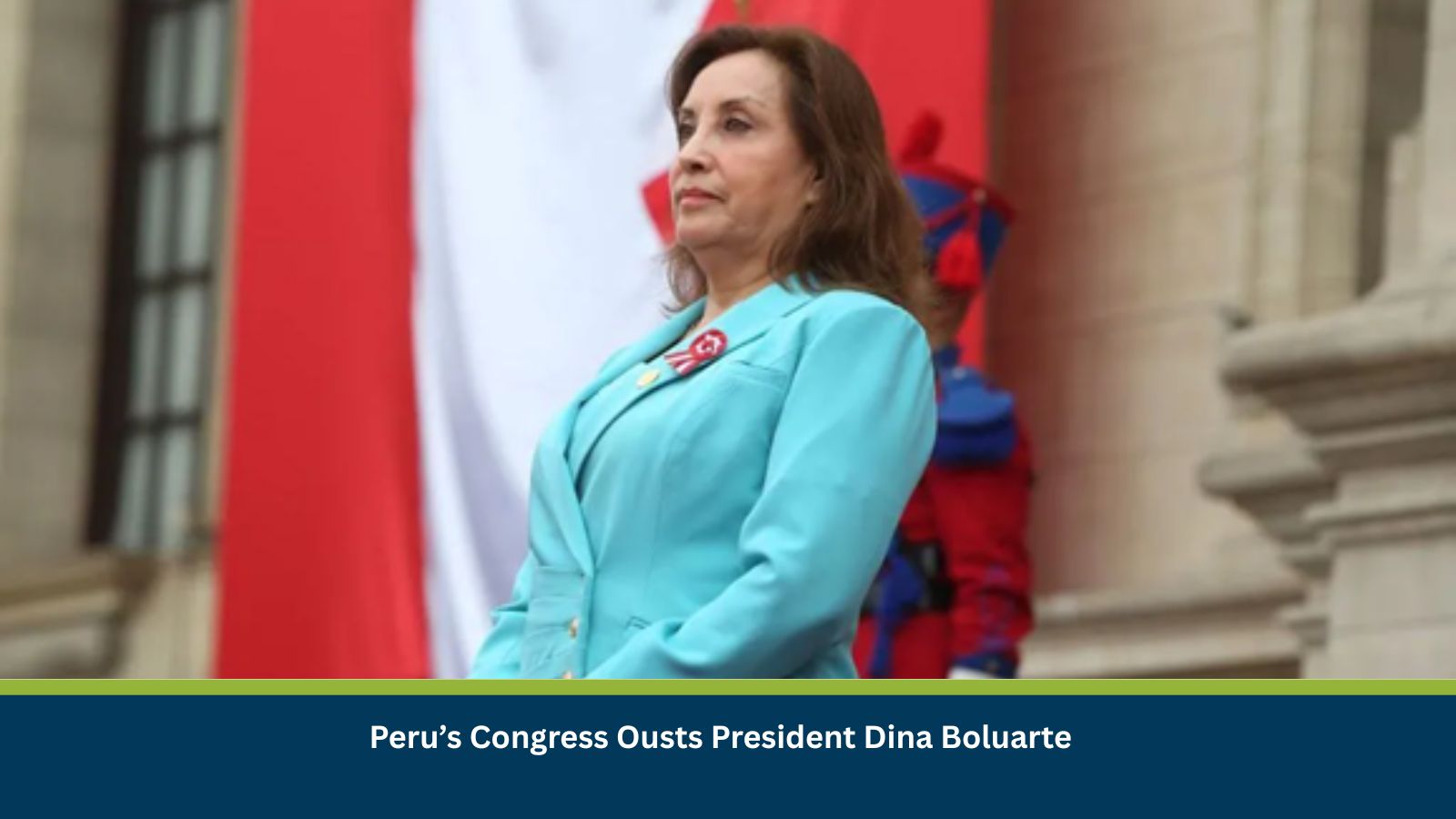
Peru’s Congress voted in the early hours of 10 October 2025, to remove President Dina Boluarte from office. Boluarte, the nation’s first female president, was ousted after months of growing discontent over her government’s handling of rising crime and public safety concerns, reflecting the persistent political volatility that has plagued Peru in recent years.
Circumstances of Removal
The impeachment proceedings were triggered by a shooting at a concert in Lima, following a series of violent acts linked to extortion gangs. In response to mounting outrage and protests demanding government action, Congress convened a late-night session. Lawmakers cited “moral incapacity” under the Peruvian Constitution, pointing to Boluarte’s failure to curb organized crime and address rising extortion. With 124 of 130 members voting in favor of her removal, the motion drew support from across the political spectrum, in contrast to the eight previous failed attempts to remove her.
Boluarte took office in late 2022 after her predecessor, Pedro Castillo, was impeached and arrested. Since then, she has been under steady criticism as approval ratings lingered at historic lows of 2 to 4 percent, amid recurring protests and allegations of corruption. Her tenure has been marked by investigations into “Rolexgate,” accusations of illicit enrichment, and her handling of protest crackdowns that left dozens dead.
Immediate Aftermath and Succession
Following Boluarte’s impeachment, Congress leader José Jerí was sworn in as interim president, as constitutionally required due to the absence of a vice president. Jerí, a 38-year-old conservative, has been tasked with guiding the country through a security crisis and maintaining political “neutrality” ahead of the scheduled April 2026 presidential elections. His mandate faces significant challenges, compounded by his association with the traditional political elite and existing allegations of sexual abuse and corruption.
Political and Economic Outlook
With Jerí now at the helm, Peru faces critical challenges. Chronic instability, with seven presidents in less than a decade, continues to erode faith in institutions and hinder economic development. Rising crime, recurring corruption scandals, and unresolved social grievances threaten not only public order but also investor confidence and business operations. Despite the removal, upcoming elections and potential reforms offer an opportunity for political renewal. However, analysts caution that unless the root causes of rampant corruption, institutional weakness, and rising violence are addressed, changes in leadership alone will not resolve Peru’s ongoing crisis.
Peru’s political landscape has been marked by persistent volatility since 2016, with frequent leadership changes, corruption scandals, and social unrest weakening institutions. This instability is compounded by domestic challenges, including mining disputes and environmental protests, alongside global economic pressures. Congressional fragmentation and low public approval have fueled policy inconsistency, leaving the country vulnerable to ongoing crises. Although Peru has had positive experiences with interim governments, the stakes are high. While the economy performed well in the first half of the year, growing 3.4 percent supported by high commodity prices, growth is expected to decelerate toward the latter part of 2025. Americas Quarterly projects national GDP growth averaging 2.7 percent this year and 2.6 percent in 2026. Looking ahead, the 2026 elections could provide an opening for reforms and institutional strengthening, but analysts warn that without effective anti-corruption measures and coordinated governance, political instability, rising crime, and social tensions are likely to persist well into the next decade.