Core Provisions and Political Standoff
The shutdown occurred because the two major parties could not agree on a bill to fund government services into October and beyond. Although the Republicans currently control both chambers of Congress, they were short of the 60 votes needed to pass the spending bill in the Senate, which gives the opposition Democrats negotiating power. Democrats oppose spending cuts to government health agencies. A stopgap bill designed to avoid the shutdown was passed in the House, or lower chamber, but failed to clear the Senate.
The current political risk is heightened by the administration’s response. White House officials have threatened to use the shutdown to identify more “non-essential” workers who could be permanently let go. The duration of the shutdown is uncertain and depends on when or if either party agrees to a compromise. The Republican administration is reportedly unwilling to offer substantive concessions, believing the Democrats will bear the brunt of public blame for operational disruptions, while Democrats believe their efforts to secure cheaper healthcare are popular.
Immediate Effects on Operations and Economy
The shutdown is immediately expected to suspend many federal services and trigger widespread furloughs, creating a complex environment for business operations and economic stability.
Workforce and Service Disruption: Approximately 750,000 federal workers (about 40% of the federal workforce) are expected to be put on unpaid leave (furlough). Federal contractors working for these agencies will also miss out on work. Government employees deemed essential services (such as air traffic control and law enforcement) continue to work but do not get paid until the shutdown is resolved. Under a 2019 law, furloughed workers receive retroactive pay when the shutdown ends.
Operational Bottlenecks: The disruption leads to delays in processing applications for passports, small business loans, or government benefits. The Airlines for America trade body warned that flight systems might “need to slow down, reducing efficiency,” and passport agencies have warned of longer processing times for travel documents.
Safety and Inspection Gaps: Services like Social Security and Medicare continue to flow. However, there will be fewer food-safety inspections and reductions in other federal programs. Institutions like the Smithsonian museums will likely be reduced or closed. Furthermore, while national parks and forests remained open during the last shutdown in 2018, they operated with few or no staff, which led to a rise in vandalism, littering, and looting of historical sites.
Economic and Market Impact
The shutdown’s impact is directly related to its duration.
- Short-term Hassle: A shutdown lasting only a few days is largely viewed as a hassle that undermines public confidence but is unlikely to have a significant impact on the economy.
- Prolonged Damage: A prolonged shutdown can cause bigger, albeit mostly temporary, problems. Analysts estimate that the disruption could trim 0.1–0.2 percentage points from weekly growth, though much of this may be recouped later. Combined with tariff effects and the delay of key government economic data, the shutdown adds to U.S. economic uncertainty.
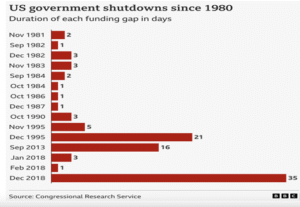
Past shutdowns have resulted in significant operational crises: in late 2018, the longest shutdown (35 days) ended only after unpaid air traffic controllers disrupted flights. The current standoff underscores a high level of political risk that businesses must manage, given their reliance on federal regulatory and financial services.