



In today’s unpredictable global environment, businesses with international offices face constant exposure to risks—from geopolitical tensions and protests to natural disasters and infrastructure disruptions. A single incident near a key office can impact employee safety, operations, and reputation.
To stay resilient, organizations are adopting advanced risk monitoring strategies powered by AI, geospatial intelligence, and real-time data. These approaches help companies detect threats early and respond quickly.
Here are five effective ways companies monitor risks near their global offices.
1. Real-Time Global Incident Monitoring
Companies track global events as they happen using real-time intelligence systems that collect data from:
- News and media sources
- Social media platforms
- Government alerts and advisories
- Security and intelligence feeds
Why it matters:
Real-time monitoring allows organizations to identify incidents near their offices instantly and take immediate action.
2. Geo-Tagging and Location-Based Alerts
Modern risk monitoring tools use geospatial intelligence to map incidents to specific locations.
How it works:
- Incidents are tagged with exact coordinates
- Systems match these with office locations
- Alerts are triggered when risks occur nearby
Benefit:
Companies gain hyper-local visibility, ensuring alerts are relevant and actionable.
3. Artificial Intelligence for Risk Detection
AI plays a crucial role in processing vast amounts of global data.
AI capabilities include:
- Filtering noise and irrelevant information
- Detecting patterns and anomalies
- Prioritizing high-risk incidents
- Predicting potential threats
Result:
Security teams receive accurate, timely, and prioritized alerts instead of overwhelming data.
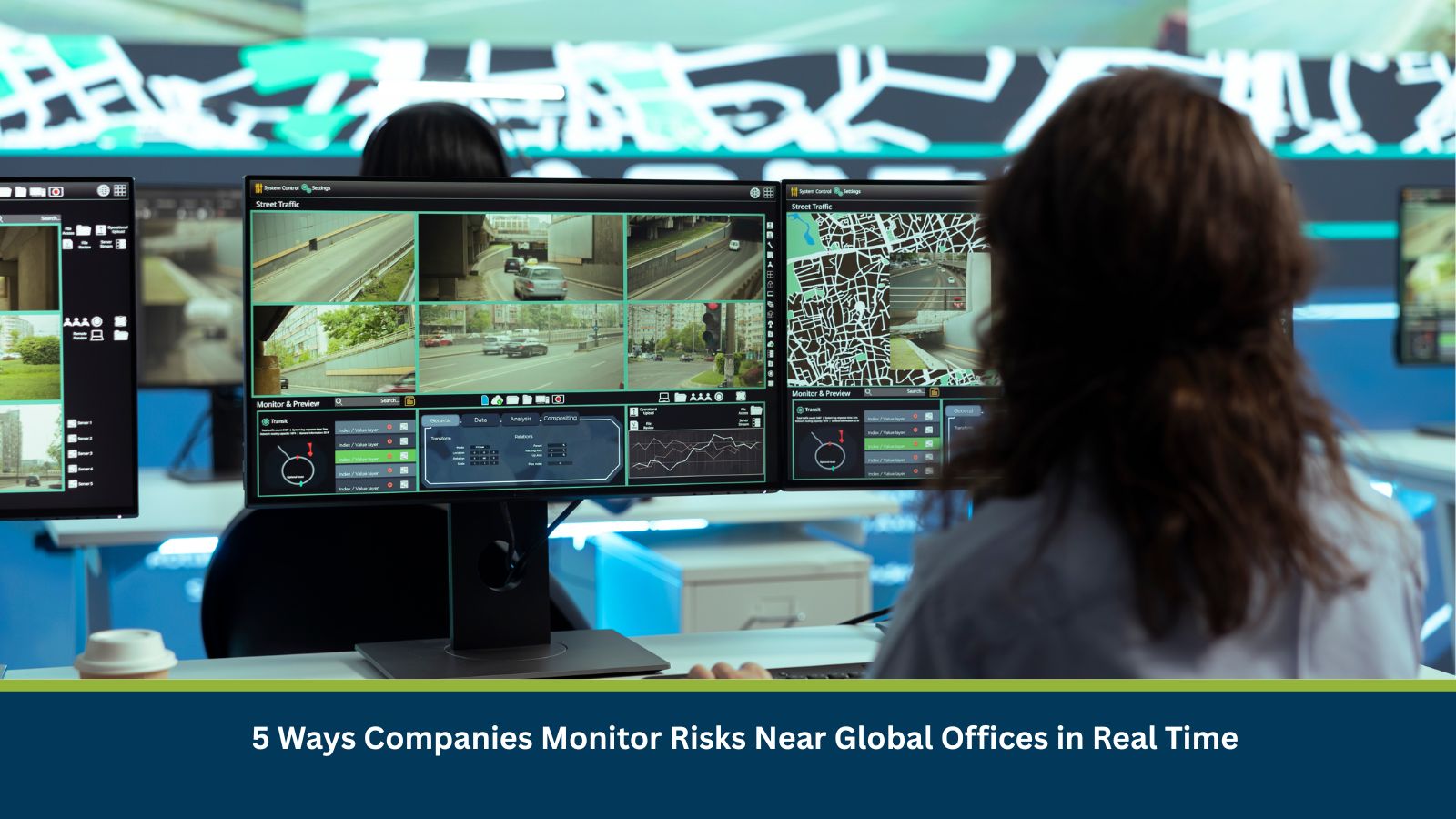
4. Integrated Security Dashboards
Organizations use centralized dashboards to monitor risks across all locations.
Key features:
- Live incident maps
- Risk severity indicators
- Employee and asset tracking
- Real-time updates
Why it’s important:
Dashboards provide a single source of truth, enabling faster and more informed decision-making.
5. Proactive Communication and ResponseSystems
Monitoring risks is only effective when combined with strong communication.
What companies do:
- Send alerts to employees near affected areas
- Share safety instructions and updates
- Activate crisis response teams
- Coordinate with local authorities
Outcome:
Faster response reduces risk exposure and ensures employee safety.
Why Monitoring Risks Near Offices Is Critical
1. Employee Safety
Protecting people is the top priority for any organization.
2. Business Continuity
Early detection helps avoid operational disruptions.
3. Risk Mitigation
Proactive monitoring reduces financial and reputational impact.
4. Compliance
Helps organizations meet duty of care and regulatory requirements.
Common Risks Companies Monitor
- Political unrest and protests
- Terror threats and security incidents
- Natural disasters (earthquakes, floods, storms)
- Infrastructure failures (power outages, transport disruptions)
- Health emergencies and outbreaks
Best Practices for Effective Risk Monitoring
To maximize effectiveness, companies should:
- Combine AI insights with human analysis
- Use multiple verified data sources
- Regularly update risk thresholds
- Train teams on crisis response
- Integrate monitoring with business continuity plans
Future Trends in Risk Monitoring
Predictive Intelligence
AI will forecast risks before they occur.
Hyper-Local Insights
More precise, street-level intelligence will improve accuracy.
Automation
Automated alerts and response systems will reduce reaction time.
IoT Integration
Sensors and devices will provide real-time environmental data.
FAQs
1. How do companies monitor risks near global offices?
They use real-time data, AI, and geospatial tools to track incidents and assess risks.
2. Why is location-based monitoring important?
It ensures alerts are relevant to specific office locations, improving response accuracy.
3. What role does AI play in risk monitoring?
AI processes large datasets, detects threats, and prioritizes alerts.
Conclusion
Monitoring risks near global offices is no longer a reactive task—it is a proactive strategy powered by technology and intelligence. By leveraging real-time data, AI, and geospatial insights, companies can detect threats early, respond quickly, and protect both their people and operations.
In a world where risks can emerge without warning, staying informed in real time is the key to resilience and success.
Datasurfr helps companies monitor risks near global offices by providing real-time, geo-tagged alerts and AI-powered insights, enabling faster threat detection, informed decisions and proactive response to protect employees and operations.